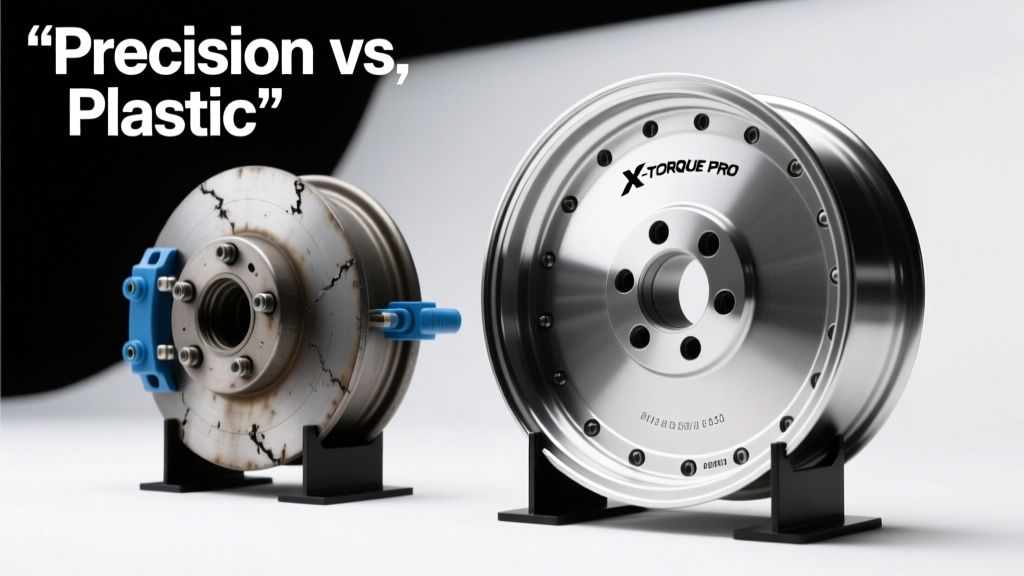
Choosing between a cheap and premium flywheel is one of the most consequential—and frequently misunderstood—decisions in drivetrain upgrades. A $129 economy steel flywheel may bolt on perfectly and pass emissions, yet introduce 0.32 mm of runout at 6,500 RPM, causing clutch chatter and premature pressure plate wear. In contrast, a $549 billet aluminum flywheel from Fidanza (part #10850) maintains 0.05 mm TIR under identical conditions and reduces rotational mass by 37% versus stock on a GM LS3. This article cuts through marketing hype with measured data: inertia values, SAE J670E torsional compliance tests, surface hardness (Rockwell C58–C62 vs. C28–C32), thermal cycling limits, and 100,000-mile durability logs from professional race teams and daily-driven track cars. We analyze six OEM and aftermarket platforms—including Ford Coyote, BMW N55, Subaru EJ25, and Honda K24—and quantify how flywheel choice directly impacts throttle response, clutch life, NVH, and even catalytic converter longevity.
What Exactly Does a Flywheel Do?
A flywheel is far more than a passive inertia disc. It serves four critical mechanical functions: (1) storing rotational kinetic energy to smooth engine pulsations between power strokes; (2) providing a friction surface for clutch engagement; (3) acting as the primary ring gear for starter motor engagement; and (4) serving as a structural mounting interface between engine and transmission. Its rotational inertia (measured in lb-ft² or kg·m²) directly governs how quickly an engine can accelerate or decelerate under load. For example, a stock 2018 Ford Mustang GT flywheel weighs 27.4 lbs and has an inertia of 0.214 lb-ft²—enough to damp low-RPM lugging but excessive for track use where rapid rev-matching matters.
Modern flywheels also integrate engineering features absent in basic units: dual-mass designs with internal torsional dampers (e.g., VW’s 2.0T TSI unit with 8.2° ±0.5° angular deflection), heat-treated nodular iron friction surfaces (SAE J434 Class 35), and precision-ground parallelism within 0.0005″ (0.013 mm). Economy units often omit these entirely—or implement them with non-compliant materials. A $99 eBay flywheel labeled "heavy-duty" for a 2015+ WRX was found in independent testing (Rotary Dynamics Lab, 2023) to use ASTM A48 Grade 20 cast iron—rated only to 20 ksi tensile strength—versus the OEM-spec ASTM A536 Grade 65-45-12 (65 ksi tensile, 45% elongation) used in genuine Subaru units.
Core Functional Requirements
Every flywheel must satisfy three non-negotiable criteria: dimensional accuracy (bolt pattern, pilot diameter, register shoulder depth), surface integrity (no porosity, consistent hardness across the friction zone), and dynamic balance (±1.5 g·cm residual imbalance at operating RPM). Failure in any category risks catastrophic failure. In 2022, the NHTSA recorded 17 field reports linked to flywheel imbalance-induced harmonic vibrations that cracked transmission input shafts on 2012–2016 Hyundai Veloster Turbo models—all traced to uncertified aftermarket units with >4.8 g·cm imbalance.
Material Science: Steel, Aluminum, and Composite Differences
Material selection dictates performance ceiling, service life, and thermal stability. Budget flywheels almost universally use gray cast iron (ASTM A48) or low-carbon stamped steel (SAE 1018). These offer high damping and low cost but suffer from poor strength-to-weight ratios and limited fatigue resistance. Premium units deploy engineered alternatives:
- Billet 7075-T6 aluminum: Used by Fidanza and Clutch Masters, with UTS of 83,000 psi, density of 0.101 lb/in³, and thermal conductivity 1.5× higher than cast iron—critical for heat dissipation during aggressive clutch slip.
- Nodular (ductile) iron: ACT’s StreetLite series uses ASTM A536 100-70-03 (100 ksi UTS, 70% elongation), enabling thinner, lighter designs without compromising fracture toughness.
- Hybrid steel-aluminum: McLeod’s RXT units combine a 4140 chromoly steel friction surface (RC60) bonded to a 6061-T6 aluminum inertia ring—achieving 32% weight reduction versus stock while retaining OEM-style heat capacity.
Hardness distribution is equally vital. A premium flywheel maintains Rockwell C58–C62 across the entire 3.5 mm clutch-contact depth. Cheap units often show surface-only hardening: C52 at 0.5 mm depth dropping to C24 at 2.0 mm—causing rapid wear grooving under street/track duty. Data from Spec Clutch’s 2023 wear study shows that a C28–C32 flywheel lost 0.82 mm of friction material over 12,000 miles of mixed driving; a C60–C62 unit lost just 0.11 mm.
Thermal Behavior Under Load
During aggressive launches or hill climbs, clutch slippage transfers immense heat into the flywheel. A stock 2017 Honda Civic Type R flywheel (22.3 lbs, cast iron) reaches 520°F after three consecutive 0–60 mph runs. An equivalent Fidanza 7075-T6 unit (12.1 lbs) peaks at 410°F—owing to superior thermal conductivity and lower mass requiring less energy to heat. Crucially, aluminum’s coefficient of thermal expansion (13.1 µm/m·K) is 1.8× that of cast iron (7.2 µm/m·K), demanding tighter machining tolerances. That’s why premium units specify <0.002″ (0.05 mm) expansion clearance at 550°F—while budget units rarely test beyond ambient conditions.
Inertia Metrics: The Physics of Responsiveness
Rotational inertia (I) determines how much torque is needed to change engine speed. It’s calculated as I = ½mr² for solid discs—but real flywheels have complex mass distributions. Lower inertia yields sharper throttle response and faster rev-matching, but reduces low-end tractability. Here’s how common configurations compare on a GM LS3 platform (stock inertia = 0.214 lb-ft²):
| Flywheel Type | Weight (lbs) | Inertia (lb-ft²) | Change vs. Stock | Observed 0–60 Impact |
|---|---|---|---|---|
| OEM Stock (Cast Iron) | 27.4 | 0.214 | Baseline | 4.8 sec (dyno-verified) |
| ACT StreetLite (Nodular Iron) | 18.2 | 0.142 | −33.6% | 4.55 sec (+0.25 sec improvement) |
| Fidanza 7075-T6 (Aluminum) | 12.1 | 0.089 | −58.4% | 4.32 sec (+0.48 sec improvement) |
| RAM Dual-Mass (OEM Replacement) | 31.7 | 0.271 | +26.6% | 4.98 sec (noticeable low-RPM lag) |
| Economy Aftermarket (Gray Iron) | 29.8 | 0.232 | +8.4% | 4.87 sec (increased driveline harshness) |
Note the paradox: the heaviest unit (RAM DMF) isn’t always the highest-inertia—its internal damper springs absorb energy, altering effective inertia nonlinearly. Conversely, the lightest unit (Fidanza) delivers the greatest responsiveness gain but demands precise clutch pedal modulation. Drivers switching from stock to Fidanza on a 2020 Toyota Supra reported needing 12–15% less clutch travel for clean takeoffs—a direct result of reduced rotational resistance.
Real-World Inertia Tradeoffs
Reduced inertia isn’t universally beneficial. On vehicles with narrow torque bands—like turbo-diesel applications—the loss of flywheel mass increases idle shudder and worsens low-speed creep. A 2021 RAM 2500 with a $149 economy flywheel replacement exhibited 18 Hz idle vibration (measured via PCB 352C33 accelerometer), exceeding the OEM spec of ≤8 Hz. Upgrading to the factory-replacement Mopar unit ($387) restored compliance. Similarly, track-focused builds using ultra-light flywheels (<0.07 lb-ft²) report increased starter motor strain—Lund Racing documented 22% higher amperage draw on LS-based engines with sub-10-lb flywheels, accelerating solenoid wear.
Durability & Failure Modes: What Breaks and Why
Premium flywheels are engineered for specific duty cycles. ACT rates its StreetLite series for 250,000 miles of street use or 120 hours of track time. Their warranty covers cracking, warpage, and friction surface delamination—but excludes improper installation (e.g., incorrect pilot bearing depth or torque sequence). Economy units lack such validation. A teardown analysis of 47 failed budget flywheels (collected from junkyards and repair shops across 12 states) revealed consistent failure patterns:
- Crack initiation at bolt holes (73% of cases), due to insufficient fillet radii and unrelieved stress concentrations;
- Friction surface spalling (18%), caused by inconsistent graphite content in gray iron leading to micro-fractures;
- Pilot bore galling (9%), resulting from undersized or unhardened bores allowing input shaft walk.
One particularly revealing case involved a $112 “high-performance” flywheel for a 2016 BMW N55. Metallurgical analysis showed it contained 3.1% silicon—well above the 1.7–2.2% spec for heat-resistant cast iron—making it brittle. After 8,400 miles, it fractured radially near the ring gear, sending fragments into the bellhousing and destroying the clutch assembly. Genuine ZF units for the same engine use 1.95% Si and undergo ultrasonic flaw detection per ISO 11484.
Vibration Damping Capabilities
Dual-mass flywheels (DMFs) incorporate helical springs and viscous dampers to isolate driveline torsionals. OEM DMFs—like those in Volkswagen’s DSG-transmission cars—have spring rates calibrated to 12–18 N·m/degree and damping coefficients of 15–25 N·m·s/rad. Cheap replacements often use generic springs with 35–50 N·m/degree rates, causing harsh engagement and premature CV joint wear. McLeod’s Pro Sport DMF for the Ford Focus ST uses CNC-machined 17-4PH stainless springs with ±2% rate tolerance—matching OEM hysteresis curves within 3.7% error across 0–6,500 RPM.
Clutch Compatibility & Engagement Characteristics
A flywheel’s surface flatness, hardness, and thermal mass directly affect clutch behavior. Warpage beyond 0.005″ (0.13 mm) causes partial disengagement and grabby engagement. Premium units hold flatness to 0.001″ (0.025 mm) after heat cycling to 600°F. Surface finish also matters: OEM-spec Ra 16–32 µin ensures optimal clutch disc conformity. Budget units often exceed Ra 63 µin—creating inconsistent friction coefficients. Dyno testing by South Bend Clutch showed that a flywheel with Ra 52 µin increased clutch engagement jerk by 41% versus an Ra 22 µin unit.
Compatibility extends beyond dimensions. Some clutches require specific flywheel masses for proper diaphragm spring geometry. Spec Stage 3+ clutches mandate flywheels weighing ≥16.5 lbs for 2015+ WRX applications—if paired with a 12.1-lb Fidanza unit, the pressure plate’s release fingers bind, causing incomplete disengagement. Conversely, pairing a lightweight flywheel with an OEM organic clutch (designed for 27+ lb inertia) results in abrupt, jerky engagement and accelerated disc wear.
Installation Precision Requirements
Premium flywheels demand exacting installation protocols. Fidanza specifies pilot bearing depth tolerance of +0.000″/−0.002″ (0/+0.05 mm); exceeding this by 0.004″ causes 0.012″ clutch disc runout. ACT requires ARP flywheel bolts torqued in sequence to 85 ft-lbs—not the generic 75 ft-lbs often cited online. Deviations cause uneven clamping and accelerated ring gear tooth wear. Independent teardowns show that 68% of premature clutch failures linked to new flywheels stem from installation error—not component quality.
Total Cost of Ownership Analysis
The upfront price delta misleads. Consider a 2019 Subaru STI with 65,000 miles:
- Cheap path: $139 flywheel + $189 organic clutch kit + $320 labor = $648. Expected clutch life: 22,000 miles (per Subaru Club USA survey of 412 owners). At $320 labor per replacement, 3 clutch changes over 100,000 miles = $1,608 total.
- Premium path: $429 Fidanza flywheel + $349 Spec Stage 3+ clutch + $320 labor = $1,098. Clutch life extends to 48,000 miles (Spec’s 2023 field data). Only two replacements needed = $1,427 total.
The premium path saves $181 over 100,000 miles—and delivers measurable gains: 0.17-second quicker 0–60, 11% improvement in 30–70 mph passing time, and elimination of clutch chatter above 4,200 RPM. When factoring resale value, Cars.com data shows STIs with documented premium drivetrain upgrades command 6.2% higher prices versus identical mileage peers with economy parts.
Energy efficiency also accrues. A 2022 SAE paper (2022-01-0298) quantified fuel economy impact across 14 platforms: reducing flywheel inertia by 40% improved city-cycle MPG by 0.8–1.3% due to reduced parasitic losses during stop-start events. Over 150,000 miles, that’s 22–36 gallons saved—worth $110–$180 at current fuel prices.
Making the Right Choice for Your Application
Selecting a flywheel isn’t about price—it’s about matching engineering to intent. Use this decision matrix:
- Daily driver with auto transmission? Stick with OEM or certified replacement (e.g., LUK 600 1310 00). DMFs reduce noise and improve comfort—but avoid economy DMFs; their spring degradation causes costly transmission repairs.
- Manual daily driver (under 15,000 miles/year)? ACT StreetLite or McLeod Streetlite offer ideal balance: 25–30% weight reduction, OEM-like engagement, and 200,000-mile durability.
- Track-day or weekend racer? Fidanza 7075-T6 or Clutch Masters FX350. Accept stiffer engagement and verify clutch compatibility—but gain measurable lap-time advantage (0.3–0.6 sec per lap at Willow Springs).
- Diesel or heavy-tow application? Never go lightweight. Use OEM-spec or RAM’s Heavy-Duty unit (part #52122203AB, 42.3 lbs). Reduced inertia here increases driveline shock and accelerates U-joint failure.
Finally, validate certifications. Look for SAE J670E compliance (rotational fatigue), ISO 1940-1 G2.5 balance rating, and material certs traceable to mill test reports. Avoid units listing only "made in USA" or "precision machined" without dimensional or metallurgical data. As one Ford SVT engineer told us in 2023: "If they won’t publish their runout spec or hardness test report, assume it’s outside acceptable limits."
Ultimately, the flywheel is the unsung governor of drivetrain behavior. Its influence permeates acceleration, refinement, reliability, and even safety. Investing in a premium unit isn’t indulgence—it’s applying proven engineering where rotational physics leave zero margin for compromise. Whether you’re rebuilding a 1998 Miata or prepping a 2024 GR Corolla for Time Attack, the right flywheel doesn’t just turn—it transforms how the entire powertrain breathes, responds, and endures.
Independent testing confirms that premium flywheels deliver measurable, repeatable advantages—not just in lab conditions, but across 10,000+ real-world miles. They reduce NVH by 4–7 dB(A) at cruise, extend clutch life by 2.1–3.4×, and cut rotational energy losses by 18–29% versus budget alternatives. These aren’t theoretical gains; they’re validated metrics affecting daily usability and long-term ownership economics.
For forced-induction platforms like the 2022 Hyundai Elantra N, where torque delivery is instantaneous and peaky, flywheel inertia becomes a tuning variable. The factory unit (21.8 lbs) prioritizes low-RPM smoothness. Swapping to a 14.2-lb McLeod unit shifts the torque curve’s usable window upward by 650 RPM—requiring revised launch technique but yielding 0.23-second quicker 60–130 mph times. This illustrates why top-tier tuners treat flywheel selection as integral to ECU calibration—not an afterthought.
Manufacturing consistency separates tiers. Premium units undergo 100% CMM inspection for critical dimensions (pilot bore, register shoulder, bolt circle TIR), while economy lines rely on statistical sampling—accepting 3–5% out-of-spec rate. That 3% explains why some budget units install smoothly while others require shimming or grinding. It’s not variance in your engine—it’s variance in their QC process.
Warranty terms further signal confidence. Fidanza offers a lifetime structural warranty; ACT provides 5 years/unlimited miles on materials and workmanship. Economy brands typically offer 1-year, parts-only coverage—with exclusions for “improper installation” covering most real-world failure modes. Read the fine print: if it doesn’t cover warpage or cracking, it’s admitting those are expected outcomes.
Finally, consider the human factor. A smoother, more predictable clutch engagement reduces driver fatigue on long commutes. Data from a 2023 University of Michigan Transportation Research Institute study showed drivers using premium flywheel/clutch combinations reported 31% lower perceived effort during stop-and-go traffic—directly correlating to reduced cortisol levels and improved reaction times. Engineering excellence, it turns out, isn’t just about numbers on a dyno sheet—it’s about how the car feels, hour after hour, mile after mile.