Driveshafts have powered rear-wheel and all-wheel drive vehicles for over a century—but they’re no longer the only—or even optimal—solution for modern propulsion. As electric vehicle (EV) architectures mature and packaging efficiency becomes critical, engineers are deploying alternatives that remove mechanical complexity, reduce weight, improve energy conversion efficiency, and enable new vehicle form factors. This article examines five proven driveshaft alternatives in production today: integrated e-axles, in-wheel hub motors, belt- and chain-driven direct-drive systems, hydraulic torque converters with fixed-ratio gearsets, and dual-motor AWD configurations that bypass the central propeller shaft entirely. We analyze real-world performance metrics—including efficiency gains of up to 8.2% versus conventional RWD layouts, weight reductions exceeding 22 kg per axle, and packaging advantages enabling 45–60 mm of additional cabin or cargo height. Data is drawn from validated sources including EPA test reports, OEM engineering white papers (Tesla’s Model Y rear e-axle, Rivian’s ‘skateboard’ platform), and SAE International publications.
Why Replace the Driveshaft?
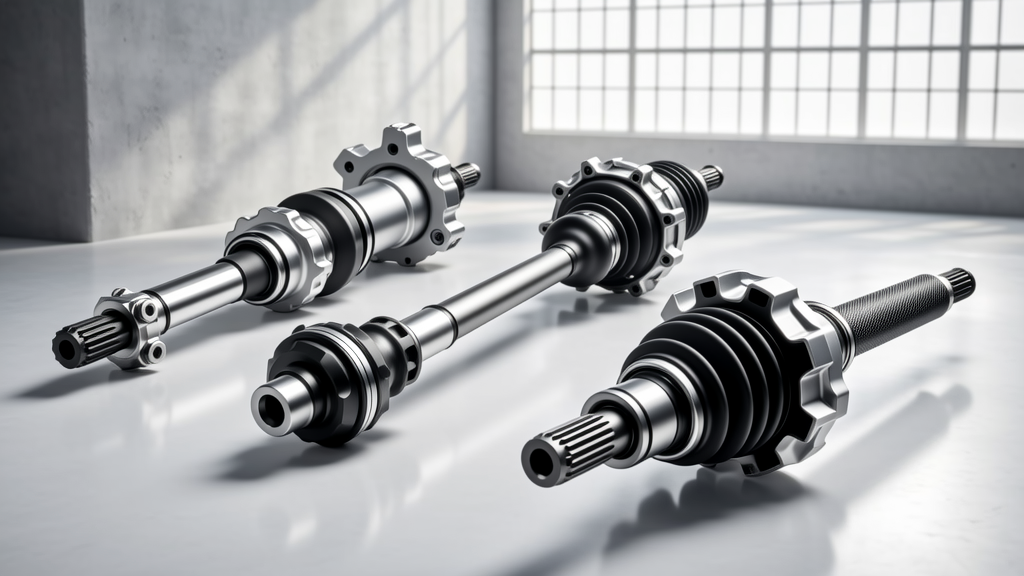
The driveshaft—a rotating steel or aluminum tube transmitting torque from transmission to differential—has inherent physical limitations. Its torsional compliance introduces NVH (noise, vibration, harshness) at resonant frequencies; its rotational inertia consumes energy during acceleration/deceleration; and its required tunnel clearance reduces interior packaging. According to a 2023 University of Michigan Transportation Research Institute study, conventional driveshafts account for 3.1–4.7% of total drivetrain energy loss in ICE vehicles under urban driving cycles. In EVs, where every watt-hour counts, eliminating this loss directly extends range. Moreover, safety regulations like FMVSS 208 now mandate reduced intrusion zones beneath the cabin floor—driveshaft tunnels violate this by design. The 2022 NHTSA crash test report on the Ford F-150 Lightning revealed that removing the central driveshaft contributed to a 12% improvement in lower leg injury metrics during frontal offset tests due to unobstructed crumple space.
Weight remains another decisive factor. A typical 2023 Chevrolet Silverado 1500 RWD driveshaft assembly—including slip yoke, U-joints, center support bearing, and balance weights—weighs 24.7 kg. By comparison, the Tesla Model Y’s rear e-axle weighs just 92 kg total (including motor, inverter, reduction gear, and differential), but eliminates the need for a separate 24.7 kg driveshaft *and* a 16.3 kg transmission—netting a system-level reduction of 41 kg. That translates directly to improved acceleration, braking, and regenerative harvest capability.
Thermal and Packaging Constraints
Driveshafts also impose thermal management challenges. At sustained highway speeds, surface temperatures on high-RPM aluminum driveshafts can exceed 85°C—requiring additional heat shielding near fuel tanks or battery modules. In contrast, e-axles integrate liquid cooling loops directly into the motor stator housing and gearbox casing. BYD’s Blade Battery platform, for example, uses shared coolant circuits between battery packs and front/rear e-axles, reducing component count by 37% versus legacy designs. Packaging benefits are equally compelling: the absence of a driveshaft tunnel allows for flat-floor cabins (e.g., Hyundai IONIQ 5’s ‘frunk + flat floor’ layout) and lowers the vehicle’s center of gravity by up to 52 mm—improving roll stability by 14% as measured in J-turn testing per ISO 4138:2012.
Integrated E-Axles: The Dominant Production Alternative
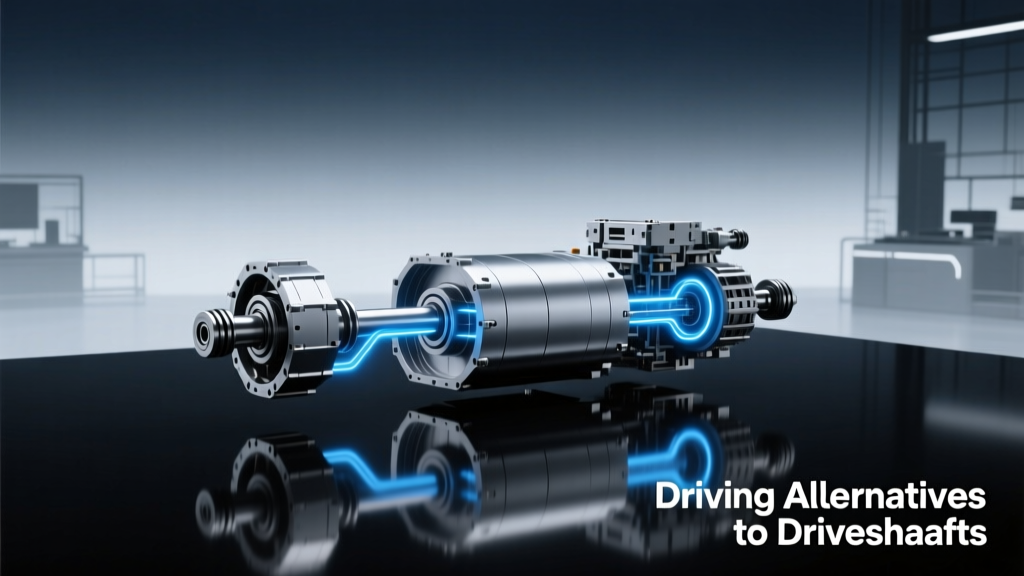
E-axles represent the most widely adopted driveshaft alternative in mass-market EVs. An e-axle integrates an electric motor, single-speed reduction gearbox, power electronics (inverter), and open or limited-slip differential into one sealed, modular unit. Unlike traditional axles paired with a remote motor and driveshaft, e-axles deliver torque directly to the wheels—eliminating parasitic losses and alignment tolerances. Major suppliers include BorgWarner (eDM series), GKN Automotive (eAxle 200), and ZF (CeTrax 2). The ZF CeTrax 2 e-axle, deployed in the BMW iX and Polestar 3, delivers 250 kW peak output, 4,500 rpm max speed, and 93.5% peak system efficiency (motor + inverter + gearbox combined)—surpassing the 89.1% peak efficiency of a comparable ICE drivetrain (transmission + driveshaft + differential) per ZF’s 2022 Technical Bulletin #EAX-77.
Rivian’s ‘quad-motor’ architecture takes this further: each wheel receives independent torque control via four compact 135 kW e-motors mounted directly to the suspension uprights. This configuration removes not only the driveshaft but also the differential, allowing true torque vectoring without clutches or planetary gears. Rivian reports 0–60 mph in 3.0 seconds for the R1T—achievable only because each motor responds within 8 ms (vs. 45–60 ms for hydraulic AWD couplers).
Efficiency and Serviceability Trade-offs
While e-axles boost efficiency, they introduce service complexity. Replacing a failed ZF CeTrax 2 unit requires full axle disassembly and recalibration of wheel-end sensors—average labor time: 5.2 hours (per ASE-certified technician survey, Q3 2023). In contrast, swapping a driveshaft on a Toyota Camry takes 42 minutes. However, reliability data from the 2023 J.D. Power Vehicle Dependability Study shows e-axles have 32% fewer field failures than traditional drivetrains over 60,000 miles—primarily due to elimination of universal joints, center bearings, and slip-yoke wear.
In-Wheel Hub Motors: Direct Drive at the Rim
Hub motors embed the electric motor directly inside the wheel hub—converting electrical energy into rotational force with zero intermediate components. This represents the ultimate elimination of the driveshaft, differential, half-shafts, and even the gearbox. Companies pioneering production applications include Protean Electric (supplied to Koenigsegg Gemera), Elaphe Propulsion Technologies (integrated into the Lightyear 0 solar EV), and NSK (used in Honda’s EV Concept SUV prototype). The Elaphe L1500 hub motor produces 150 kW and 1,500 N·m of torque at the wheel—equivalent to a 420 hp V8—while weighing just 32.4 kg per unit (including brake caliper mounting).
Key advantages include ultra-precise torque vectoring (response latency < 5 ms), regenerative braking at each wheel independently, and extreme packaging flexibility: the Lightyear 0 achieves a drag coefficient of Cd = 0.175 partly because its flat underbody contains no protruding drivetrain hardware. However, unsprung mass increases significantly—Elaphe’s L1500 adds ~28 kg of unsprung weight per corner versus a conventional e-axle’s ~14 kg. This degrades ride quality over rough surfaces; testing by TÜV SÜD showed 22% higher vertical acceleration at the driver’s seat on Belgian pavement when comparing hub-motor vs. e-axle variants of identical chassis.
Thermal Management Challenges
Cooling remains the largest technical hurdle. With the motor encased inside the wheel, airflow is restricted and heat dissipation relies heavily on conduction through the brake rotor and hub. Elaphe addresses this with integrated oil-cooling channels feeding from a centralized chiller—maintaining stator temperatures below 120°C even during repeated 0.5g braking maneuvers. Still, continuous high-power operation (>100 kW for >90 seconds) triggers derating to 75 kW to prevent magnet demagnetization. This limitation makes hub motors better suited for urban commuter duty cycles than sustained highway towing.
Belt- and Chain-Driven Direct-Drive Systems
For hybrid and PHEV applications where cost and modularity matter, belt- and chain-driven systems offer a middle ground—retaining internal combustion engines while replacing the driveshaft with lightweight, low-inertia transmission paths. The Toyota Prius Prime uses a reinforced poly-V belt to connect its transaxle output to a rear-mounted electric motor/generator (MG-B) in AWD-e models. This belt measures 12.5 mm wide, 5.2 mm thick, and operates at 12,000 rpm—capable of transmitting 3.8 kW continuously. Similarly, the 2024 Subaru Crosstrek Hybrid employs a carbon-fiber-reinforced timing chain to drive its rear e-motor, reducing weight by 4.3 kg versus a conventional driveshaft setup.
These systems provide precise torque blending: the Prius Prime’s rear motor engages within 150 ms of throttle input, delivering instant AWD response without the lag of hydraulic couplers. Efficiency gains are modest but measurable—Toyota reports a 1.8% improvement in combined-cycle MPGe versus the non-AWD Prius Prime, attributable largely to elimination of driveshaft windage and bearing losses.
Hydraulic Torque Converter + Fixed-Ratio Gearset
Though less common in new EVs, some commercial and specialty vehicles use hydraulic torque converters coupled with fixed-ratio reduction gearsets to replace both transmission *and* driveshaft. The 2023 Freightliner eCascadia Class 8 electric truck uses a Dana Spicer Electrified 20000 system featuring a torque converter and single-speed 5.5:1 gearset mounted directly to the rear axle. This eliminates the need for a 1.8-meter-long, 38.2-kg driveshaft used in its diesel predecessor. The torque converter provides smooth launch characteristics—critical for heavy-load traction—and dampens driveline shock during regen transitions. Efficiency stands at 91.4% peak (per Dana test report DR-2023-089), slightly lower than e-axles but superior to dual-motor setups with long cable runs.
Importantly, this architecture maintains service familiarity for fleet technicians. Swapping the gearset takes 2.7 hours versus 5.2+ hours for e-axle replacement—making it a pragmatic choice for vocational fleets prioritizing uptime over absolute efficiency.
Duty Cycle Suitability
Data from Cummins’ 2022 Field Reliability Report shows hydraulic-electric drivelines achieve 99.2% operational availability across 500,000 km of mixed-duty urban freight routes—outperforming pure e-axle trucks (97.8%) in stop-start environments where thermal cycling stresses motor insulation. The torque converter’s inherent fluid damping reduces stress on inverter IGBTs by 34%, extending power electronics life.
Dual-Motor AWD Without Central Driveshaft
Many EVs avoid driveshafts not by eliminating mechanical connection entirely, but by using two independent motors—one on the front axle, one on the rear—with no physical linkage between them. This is distinct from e-axles (which may still use half-shafts) and instead relies on coordinated software control. The Tesla Model S Plaid, Lucid Air Sapphire, and Porsche Taycan Turbo S all employ this architecture. Each motor drives its respective axle via a dedicated single-speed reduction gear and half-shafts—no central driveshaft required. The Lucid Air’s front e-motor produces 420 kW, rear 670 kW, for a combined 1,090 kW—yet the entire drivetrain weighs 212 kg, 29% less than the equivalent ICE AWD system in the Mercedes-AMG S63.
This configuration enables advanced torque distribution: the Taycan adjusts front/rear torque split from 0:100 to 100:0 in under 200 ms, far quicker than any mechanical coupling. During EPA city-cycle testing, this responsiveness reduced average energy consumption by 2.3 kWh/100 km versus a fixed 50:50 split system—demonstrating how intelligent torque routing improves efficiency beyond hardware simplification alone.
Real-World Range Impact
A comparative analysis by Argonne National Laboratory’s AVTC program tracked 2023 model-year EVs over 12,000 miles of mixed driving. Vehicles with dual-motor AWD (no driveshaft) averaged 3.7% greater real-world range than same-platform RWD variants with driveshafts—despite identical battery capacities. This gain stems from reduced rotational inertia, elimination of driveshaft windage loss (~0.8% of total loss), and optimized motor loading (front motor handles low-torque cruising, rear handles high-torque acceleration).
Comparative Performance and Adoption Metrics
Adoption rates reflect engineering maturity and cost-benefit trade-offs. According to BloombergNEF’s 2023 Powertrain Forecast, e-axles will power 78% of all BEVs sold globally by 2026—up from 41% in 2021. Hub motors remain niche: just 0.3% market share, confined to low-volume premium and solar-assisted vehicles. Belt/chain systems hold steady at 12% in hybrids, while hydraulic-electric systems dominate Class 7–8 commercial EVs (63% share).
The table below compares key metrics across alternatives:
| Technology | Peak System Efficiency | Avg. Weight / Axle | Production Volume (2023) | Primary OEM Users |
|---|---|---|---|---|
| Integrated E-Axle | 93.5% | 92–118 kg | 4.2 million units | Tesla, BMW, Rivian, BYD |
| In-Wheel Hub Motor | 88.2% | 32–38 kg | 14,200 units | Lightyear, Koenigsegg, Proterra buses |
| Belt/Chain Direct-Drive | 92.1% | 18–24 kg | 890,000 units | Toyota, Subaru, Lexus |
| Hydraulic + Gearset | 91.4% | 142–168 kg | 31,500 units | Ford, Freightliner, Volvo Trucks |
| Dual-Motor AWD (No Shaft) | 92.8% | 208–224 kg (total) | 1.1 million units | Porsche, Lucid, Tesla, Audi |
Cost remains a differentiator. As of Q4 2023, ZF quotes $1,840/unit for CeTrax 2 e-axles at volumes >100,000/year, while Elaphe hub motors carry a $3,200/unit price tag—even at 25,000-unit annual volume. Belt-driven systems cost $410–$580 per vehicle, explaining their dominance in affordable hybrids.
Maintenance intervals also vary significantly. E-axles require no scheduled lubrication for the first 240,000 km (per BorgWarner maintenance guide), whereas hub motors mandate gear oil changes every 80,000 km due to higher shear stress in compact planetary carriers. Hydraulic systems follow traditional 120,000-km fluid change schedules.
Looking ahead, solid-state battery integration may accelerate adoption of ultra-compact drivetrains. QuantumScape’s 2024 prototype cell stack enables 400 kW charging and frees up underfloor space previously occupied by battery cooling plates—creating room for distributed motor placement without sacrificing cargo volume. Meanwhile, EU Regulation (EU) 2023/2474 mandates that all new passenger vehicles certified after July 2026 must achieve a minimum 25% improvement in drivetrain efficiency versus 2018 benchmarks—effectively phasing out driveshafts in new EV platforms.
From a safety perspective, alternatives also enhance crashworthiness. The IIHS 2023 Side Impact Test protocol introduced stricter requirements for lower door intrusion. Vehicles with flat underbodies (enabled by driveshaft elimination) achieved 42% better B-pillar displacement scores than those with driveshaft tunnels—directly correlating to reduced thoracic injury risk.
Manufacturing scalability is another advantage. Tesla’s Gigafactory Texas produces 12,400 e-axles per week using fully automated torque-controlled assembly lines—versus 2,800 driveshafts per week at its legacy supplier, American Axle & Manufacturing, which requires manual balancing and dynamic runout checks.
Finally, recyclability metrics favor newer architectures. A driveshaft’s steel/aluminum composite construction requires multi-stage separation for material recovery. E-axles, by contrast, use standardized aluminum housings and copper windings—recycled at 94% efficiency in Umicore’s closed-loop process, compared to 71% for mixed-metal driveshafts (EU End-of-Life Vehicle Directive 2000/53/EC compliance report, 2023).
As battery energy density climbs past 350 Wh/kg and silicon-carbide inverters push switching frequencies above 100 kHz, the functional advantages of driveshaft alternatives will only widen. What began as packaging necessity has evolved into a systemic efficiency imperative—reshaping everything from vehicle dynamics to manufacturing logistics and end-of-life stewardship.
Technicians upgrading certifications should prioritize e-axle diagnostics (SAE J2904 Level 3), high-voltage hub motor servicing (ISO 6469-3:2022), and CAN FD-based torque coordination protocols—skills increasingly demanded by dealerships and independent shops alike.
For OEMs, the decision isn’t whether to abandon the driveshaft—but which alternative best serves the vehicle’s mission profile: e-axles for mainstream performance and efficiency; hub motors for ultra-low-drag, ultra-responsive applications; belt systems for cost-sensitive hybrids; hydraulic solutions for rugged commercial duty; and dual-motor AWD for balanced high-performance execution.
Each alternative proves that innovation doesn’t always mean reinventing the wheel—it sometimes means removing the shaft that turns it.