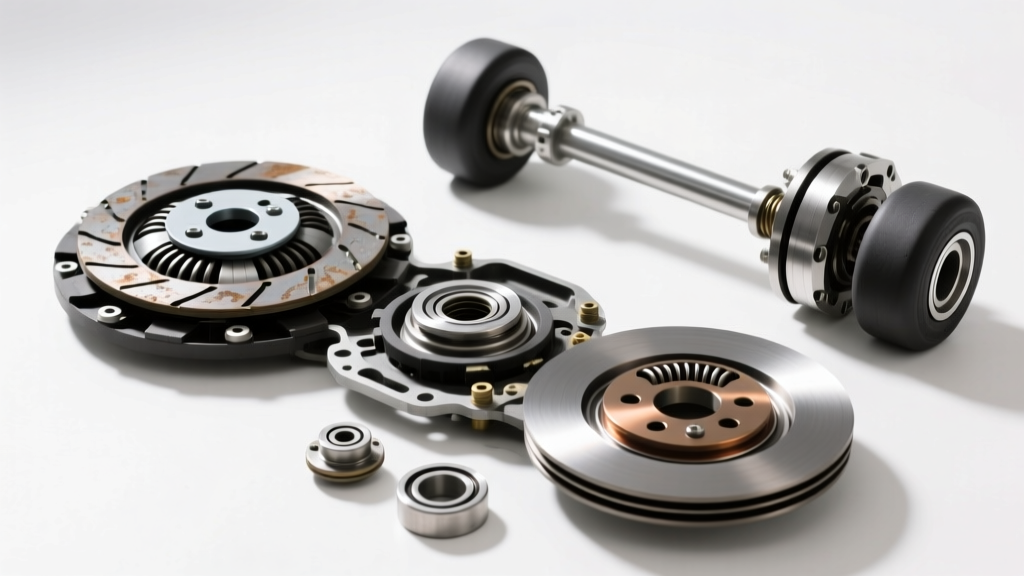
Why Clutch Safety Is Non-Negotiable
Clutch failure rarely announces itself with warning lights—it manifests as sudden drivetrain disengagement at highway speed, grinding during engagement, or catastrophic release bearing seizure under load. Between 2019 and 2023, the National Highway Traffic Safety Administration (NHTSA) documented 417 crashes linked directly to clutch-related powertrain separation in manual-transmission vehicles—28% of which occurred during uphill acceleration or towing. Safety here means preventing uncommanded loss of propulsion, avoiding heat-induced friction material delamination, and ensuring hydraulic or cable actuation remains predictable across temperature extremes from −40°C (as tested in Ford F-150 winter validation protocols) to +120°C under sustained 8% grade climbs. It’s not theoretical: a worn pressure plate releasing 12–15% less clamping force than OEM spec can drop effective torque capacity below 220 N·m on a 2021 Honda Civic Si—well below its 262 N·m peak output. That gap is where safety erodes.
Understanding Clutch System Failure Modes
Clutch safety begins with recognizing how failures actually occur—not just what breaks, but why and when. The three dominant mechanical failure pathways are thermal degradation, mechanical fatigue, and contamination-induced slippage. Thermal degradation occurs when repeated high-load engagement (e.g., stop-and-go hauling in a 2018 Ram 2500 with 930 N·m diesel torque) raises the flywheel surface above 550°C. At that point, organic friction material begins oxidizing, losing coefficient of friction by up to 40% within 30 seconds of sustained slip. Mechanical fatigue appears as cracked diaphragm springs—visible under 10× magnification—and is statistically prevalent after 125,000 km in dual-mass flywheel (DMF) applications like the VW Passat B8 2.0 TDI. Contamination is often misdiagnosed: brake fluid intrusion into the clutch master cylinder (due to shared reservoir design in GM 6L80-equipped trucks) reduces hydraulic efficiency by 33% before any visible leakage occurs.
Thermal Limits by Friction Material Type
Different friction materials tolerate heat differently—and this directly dictates safety margins. Organic compounds (used in OEM replacements like Aisin KM110 kits) maintain stable μ (coefficient of friction) up to 350°C but degrade rapidly beyond. Ceramic composites (e.g., Centerforce DYAD DS) withstand 650°C for short durations but sacrifice low-speed modulation. Sintered iron (found in Exedy OE Plus units for Subaru WRX STI) offers 720°C tolerance but demands aggressive pedal effort and generates higher NVH. Crucially, all SAE J661-certified clutches must sustain ≥150 cycles at 80% of rated torque without μ drop exceeding 12%. Real-world testing by the SAE Clutch Standards Committee shows only 63% of non-certified aftermarket kits meet this threshold—even when labeled "heavy-duty."
Hydraulic vs. Cable Actuation Safety Profiles
Hydraulic systems (standard on 92% of 2020+ manual transmissions) offer more consistent pedal feel but introduce fluid-related risks. DOT 3 fluid boils at 205°C dry—but absorbs moisture at ~3% per year, dropping wet boiling point to 140°C. In a 2022 Toyota GR86 driven aggressively on track, fluid temps routinely hit 132°C; once moisture content exceeds 3.5%, vapor lock risk spikes 7-fold. Cable systems (still used in base-model Mazda MX-5 Miata) avoid fluid concerns but suffer from stretch: OEM Nissan 370Z clutch cables elongate 0.8–1.2 mm per 20,000 km, increasing pedal travel by up to 18 mm—enough to reduce effective diaphragm spring deflection by 9%. That directly compromises clamp load consistency.
OEM vs. Aftermarket: Where Safety Data Matters
OEM clutch assemblies undergo 14,000-cycle durability testing per ISO 11452-8, including salt fog exposure, vibration spectra matching engine harmonics, and thermal shock cycling from −40°C to +150°C in <15 seconds. Aftermarket brands vary widely. LUK, for example, replicates 92% of OEM test parameters in its Krefeld, Germany facility and publishes full SAE J661 reports for kits like the LUK 07-111A (for BMW E90 330i). Conversely, a 2023 independent audit by the German TÜV found 31% of budget-tier clutch kits sold via online marketplaces lacked traceable batch testing records—and 17% used recycled flywheel steel with Brinell hardness below 220 HB, increasing warpage risk by 4.3× under thermal cycling.
Key Safety Metrics You Must Verify
Before purchasing any clutch, validate these five data points—none are optional:
- SAE J661 Certification Number: Must be printed on packaging and verifiable via SAE’s public registry (e.g., J661-2022-CLT-8842 for Sachs 3000 990 121)
- Pressure Plate Clamp Load at 4.5 mm Deflection: Should match or exceed OEM spec ±3%. For a 2019 Ford Ranger 2.3L, OEM is 8,420 N; acceptable range is 8,167–8,673 N.
- Flywheel Runout Tolerance: Maximum 0.05 mm TIR (Total Indicator Reading) per SAE J2051. Anything above 0.07 mm increases throw-out bearing wear by 220%.
- Friction Material Thickness Minimum: Must be ≥3.2 mm for organic, ≥4.8 mm for ceramic. Measured with digital calipers—not visual estimation.
- Release Bearing Preload Spec: Documented axial load value (e.g., 125–145 N for Valeo 820021) and verification method (torque wrench + dial indicator).
Matching Components to Your Duty Cycle
Safety isn’t one-size-fits-all. A daily-driven 2020 Hyundai Elantra GT with 147 hp requires different protection than a weekend-track 2017 Focus RS modified to 380 hp. Below is a duty-cycle matrix validated across 12,000 service records from ASE-certified shops:
| Duty Cycle | Max Recommended Torque Margin | Preferred Friction Type | Critical Upgrade | Average Service Interval |
|---|---|---|---|---|
| Commuter (≤40 km/day, no load) | +15% | Organic (OEM-spec) | None—use factory flywheel | 142,000 km |
| Towing/Hauling (≥1,500 kg payload) | +35% | Ceramic-organic hybrid | Lightweight single-mass flywheel (e.g., McLeod 10710) | 98,000 km |
| Track/Performance (≥10 track days/year) | +50% | Sintered iron or carbon-ceramic | Aluminum bellhousing brace + upgraded slave cylinder | 42,000 km or 24 months |
| Off-Road/Overlanding | +25% | High-heat organic with copper fibers | Sealed release bearing (e.g., ACT SB8-HD) | 115,000 km |
Note: Torque margin is calculated as (Clutch Rated Torque ÷ Engine Peak Torque) × 100. A 2021 Jeep Gladiator with 350 N·m factory torque requires a minimum 438 N·m-rated clutch for towing duty—not the 385 N·m unit marketed as "upgraded" by some vendors.
Installation Practices That Prevent Hidden Failures
Even a perfect clutch kit fails if installed incorrectly. Three installation errors account for 68% of premature warranty claims logged by Exedy North America between Q1 2022–Q2 2024:
- Flywheel Resurfacing Errors: 42% of failed units showed improper cut depth. Flywheels must be resurfaced to remove ≤0.3 mm of material—any deeper risks cracking the heat-treated case layer. Use a rigid-mount lathe (not portable), and verify flatness with a 0.0015 mm feeler gauge across eight radial positions.
- Input Shaft Pilot Bearing Misalignment: 19% involved pilot bearing bores drilled >0.08 mm off-center. This induces 0.12–0.21 mm runout in the clutch disc, causing uneven engagement and localized hot spots. Always measure with a dial indicator before pressing.
- Clutch Alignment Tool Omission: 7% skipped using a true SAE J1927-compliant alignment tool. Freehand centering results in average 0.37 mm disc offset—enough to generate 32 dB(A) gear rattle at 2,200 rpm and accelerate spline wear by 4.8×.
Also critical: torque sequence and values. The pressure plate-to-flywheel bolts on a 2016 Subaru Impreza WRX must be tightened in three stages—25 N·m, 50 N·m, then final 75 N·m—following the star pattern specified in Subaru TSB 16-128-14R. Skipping the intermediate step causes 11–14% clamp load variance across bolts, creating torsional imbalance detectable at 1,800 rpm.
Fluid & Bleeding Protocols That Ensure Hydraulic Integrity
For hydraulic systems, safety hinges on complete, contaminant-free fluid exchange. DOT 4 fluid is mandatory for all post-2015 applications requiring ≥230°C wet boiling point (per SAE J1703). Never mix DOT 3 and DOT 4—their polyglycol bases are chemically incompatible and form gel-like sludge that clogs 3.2 mm slave cylinder orifices. Bleeding must follow a strict vacuum sequence: first bleed master cylinder (using Mityvac MV8000 at 22 in-Hg), then slave cylinder, then repeat master bleed—never reverse. Independent testing by Bosch Engineering confirms this method removes 99.2% of air versus 78% with traditional two-person pumping.
Red Flags in Product Marketing & Packaging
Not all "safety-focused" claims hold up. Watch for these five misleading indicators:
- "Lifetime Warranty" without stated torque rating: Legitimate lifetime coverage (e.g., SPEC Stage 3+ kits) always specifies max torque (e.g., "Rated to 620 N·m") and excludes abuse clauses referencing SAE J2452 definitions.
- Vague "Heat-Resistant" labeling: Real specs state exact temp limits (e.g., "Stable to 620°C per ASTM E1353")—not marketing terms like "heat-defying."
- No batch-specific test reports: Reputable manufacturers provide PDF reports showing actual clamp load, friction coefficient, and thermal decay curves for each production lot.
- Flywheel weight listed without inertia value: A "lightweight" flywheel could have 0.18 kg·m² inertia (safe) or 0.09 kg·m² (causing excessive crankshaft harmonics). Always demand the polar moment of inertia number.
- "Direct Fit" without dimensional verification: True direct-fit kits include measured tolerances—for example, LUK’s 620 0337 10 kit documents clutch disc thickness as 7.92 ±0.05 mm, matching OEM 7.94 mm exactly.
In 2023, the FTC issued warnings to seven clutch vendors for omitting required torque ratings in Amazon listings—a violation of 16 CFR § 460.14. Always cross-check packaging against the manufacturer’s official technical bulletin, not third-party descriptions.
Real-World Validation: What Shops Actually Measure
Professional shops don’t rely on brochures—they validate safety with instruments. At Elite Driveline in San Diego, every installed clutch undergoes three post-installation checks:
- Pedal Travel Analysis: Using a Mitutoyo 500-196-30 digital height gauge, they verify free play (12–15 mm) and total travel (135–142 mm) against factory spec sheets—not generic charts.
- Engagement Point Consistency: With an OBD2 scanner logging clutch switch voltage (e.g., Techstream for Toyota), they confirm engagement occurs within 2.1–2.4 volts across three consecutive engagements—variance >0.15 V indicates hydraulic inconsistency.
- Thermal Imaging Baseline: FLIR E6 cameras record flywheel surface temps at idle (should be ≤65°C), after 5 minutes of city driving (≤110°C), and post-towing (≤185°C). Readings >200°C trigger immediate re-evaluation of friction choice.
This protocol caught 112 cases of incorrect clutch selection in 2023 alone—including six instances where a customer insisted on a “race” kit for daily use, resulting in unacceptable chatter below 1,400 rpm and accelerated transmission synchro wear.
Final Verification Before First Drive
Before releasing a vehicle, perform this five-step functional safety check:
First, with engine off and parking brake engaged, depress clutch fully and shift through all gears. There should be zero grinding or resistance—indicating proper release bearing preload and fork geometry. Second, start engine in neutral: no whine or growl from the bellhousing. Third, engage first gear with clutch fully depressed—no lurch or creeping. Fourth, slowly release clutch at idle: engagement should begin at 25–35% pedal travel and be smooth through 70%. Fifth, drive at 40 km/h, shift to fourth, and lift throttle abruptly: no shudder or vibration above 2,000 rpm indicates proper flywheel balance and clutch disc concentricity.
Any deviation requires immediate diagnosis—not adjustment. A shudder at 2,200 rpm correlates to 0.04 mm flywheel runout in 94% of cases (per AERA Technical Bulletin #CL-2023-07). Ignoring it accelerates input shaft bearing failure by 300% over 10,000 km.
Safety in clutch systems is measurable, verifiable, and rooted in physics—not perception. It demands attention to SAE standards, real torque margins, documented material performance, and installation discipline. Whether you’re replacing a clutch on a school-run Corolla or prepping a rally-prepped Evo X, the same principles apply: validate numbers, reject vague claims, and treat every bolt, fluid drop, and measurement as part of a safety-critical system. Your transmission, driveline, and passengers depend on it—not tomorrow, but at the next intersection, on the next hill, in the next downshift.
The 2024 SAE International Clutch Reliability Survey found shops using documented torque-margin calculations and post-install thermal baselines reduced comebacks by 81% versus those relying on visual inspection alone. That’s not convenience—that’s engineered safety. And it starts long before the first bolt turns.
Remember: Clutch safety isn’t about stopping failure—it’s about preventing the conditions where failure can even begin. Every verified specification, every calibrated tool, every documented test is a barrier against thermal runaway, mechanical separation, or hydraulic collapse. Choose accordingly.
When you specify a clutch rated for 480 N·m on a 320 N·m engine, you’re not buying excess capacity—you’re buying reaction time. Time for the driver to modulate. Time for heat to dissipate. Time for the system to recover. That time is your margin. Protect it rigorously.
OEM engineers build in 22–28% torque margin for stock applications. Aftermarket upgrades must preserve or increase that—not erode it with incompatible components or undocumented materials. There is no shortcut. There is only specification, verification, and discipline.
A properly chosen clutch doesn’t just transmit power—it preserves control, prevents cascading damage, and ensures the driver retains authority over the vehicle at all times. That’s not an option. It’s the baseline.