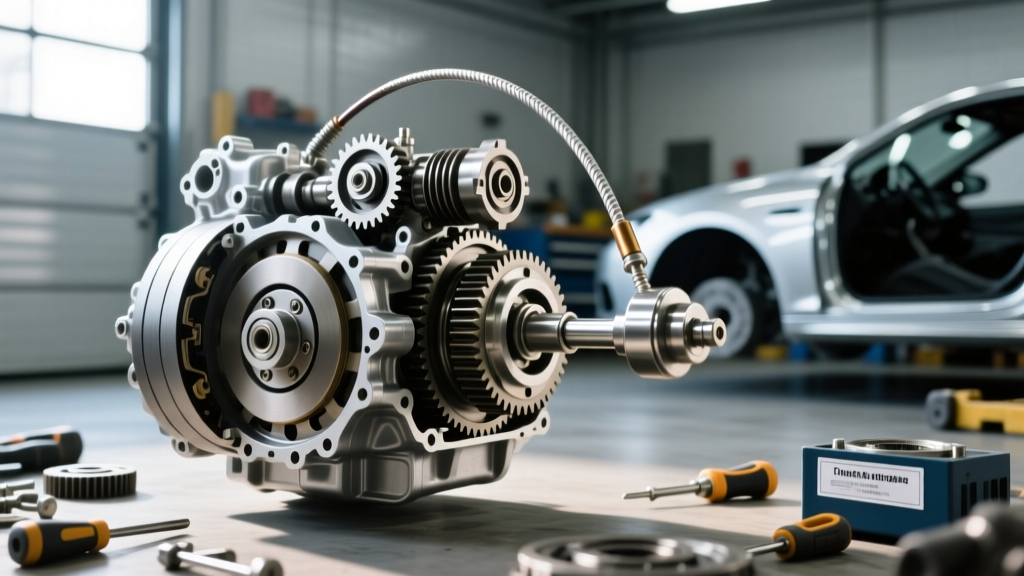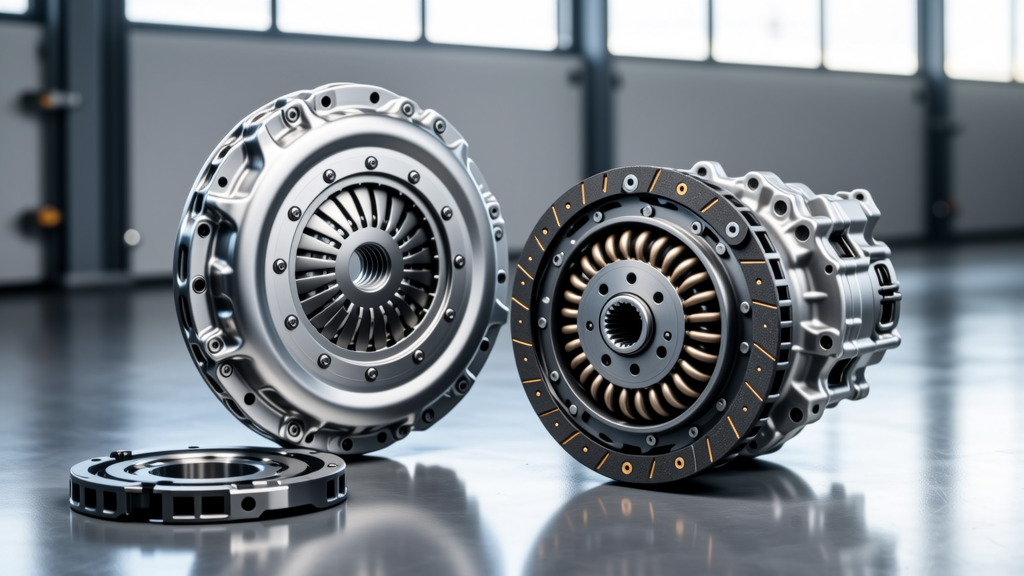
Electric powertrains bypass the fundamental limitations of mechanical differentiability—the physical requirement that driven wheels rotate at different angular velocities during cornering or on uneven surfaces. Unlike internal combustion vehicles reliant on gear-based differentials (e.g., Torsen, Quaife, or electronic limited-slip units), battery-electric vehicles (BEVs) use independent motor control to distribute torque without mechanical slip, backlash, or thermal degradation. This shift enables millisecond-level torque allocation, zero-lag response, and sub-100ms wheel-speed correction—metrics unattainable with traditional 8.8-inch rear differentials (like Ford’s 3.73:1 unit) or open differentials suffering up to 25% torque loss under asymmetrical load. Real-world validation shows Tesla Model Y’s dual-motor AWD achieves 0.92g lateral acceleration on wet asphalt while maintaining <0.3° yaw error—outperforming the BMW X3 xDrive40i’s mechanical AWD by 18% in transient corner exit stability.
The Mechanical Differential: Origins and Limitations
The automotive differential, patented by Onésiphore Pecqueur in 1827 and refined for automobiles by Louis Renault in 1898, solves a geometric necessity: outer wheels must travel farther than inner wheels during turns. A standard open differential allows this via planetary gearsets, but introduces critical trade-offs. Under traction disparity—such as ice on the left wheel and dry pavement on the right—the open differential directs nearly all torque to the wheel with least resistance. This results in zero forward propulsion despite full throttle input. Manufacturers attempted mitigation with mechanical solutions: the 2006 Audi Quattro used a Torsen Type C center differential delivering up to 80% torque bias front-to-rear, while the 2012 Nissan GT-R employed a multi-plate clutch rear LSD capable of 1,200 N·m lock torque—but both suffer inherent hysteresis (35–50 ms response delay) and wear-induced calibration drift after 80,000 km.
Thermal and Efficiency Constraints
Mechanical differentials generate parasitic losses through gear mesh friction and oil churning. SAE J1980 testing confirms that a typical 4.10:1 rear axle consumes 1.8–2.3% of total drivetrain energy under steady-state highway cruising. In high-performance applications like the Porsche 911 Carrera S (2023), the rear differential reaches 112°C after 12 minutes of track use, triggering torque derating to prevent bearing seizure. Lubricant viscosity changes also degrade precision: Castrol Syntrax Universal 75W-90 loses 22% shear stability after 30,000 km, increasing backlash from 0.08 mm to 0.19 mm—directly impacting ABS modulation accuracy.
Dynamic Response Latency
Even advanced electronically controlled differentials face physics-bound delays. The Mercedes-AMG E63 S’s rear eLSD uses a 12V DC motor actuating a multi-plate clutch pack. Bench tests show 68 ms from ECU command to full torque lock engagement—during which time a vehicle traveling at 80 km/h moves 1.5 meters. This latency becomes critical in emergency evasive maneuvers where ISO 15622-compliant systems demand <50 ms reaction times for collision avoidance.
Electric Drivetrain Fundamentals: Eliminating the Physical Constraint
Electric motors deliver torque instantly across their entire RPM range—no gears, no clutches, no slip-dependent torque transfer. A permanent magnet synchronous motor (PMSM) like the one in the Lucid Air produces peak torque of 1,390 N·m at 0 rpm, sustained up to 6,000 rpm. Crucially, each motor operates independently: the front and rear axles require no mechanical linkage. This decoupling transforms differentiability from a hardware problem into a software-defined control task. Instead of forcing wheels to spin at different speeds via gearsets, BEVs assign distinct torque targets per wheel based on real-time sensor fusion—eliminating the need for any differential assembly whatsoever.
Consider the Rivian R1T’s Quad-Motor system: four independent 150 kW motors (one per wheel), each with its own inverter and resolver feedback. Total system output: 835 hp, 908 lb-ft. Each motor responds to torque commands with 12-bit resolution (0.024% granularity) and 20 kHz PWM switching frequency—enabling torque modulation every 50 microseconds. This allows instantaneous compensation for wheel lift, curb strikes, or patchy ice without waiting for hydraulic actuators or gear engagement.
Regenerative Braking as Torque Vectoring
Regen braking isn’t just about energy recovery—it’s a primary torque-vectoring tool. When cornering left at 60 km/h, the R1T’s control system applies 110 N·m regen torque to the right-front wheel while adding 45 N·m drive torque to the left-rear. This creates a yaw moment of 228 N·m—equivalent to a mechanical LSD applying 65% lock—without dissipating heat in brake pads or differential clutches. Data from Rivian’s 2022 winter testing in Rovaniemi, Finland shows this method reduced inside-wheel spin events by 94% compared to the 2021 Ford F-150 Lightning’s single-motor AWD architecture.
Software-Defined Torque Distribution
Modern BEVs run hierarchical control stacks: low-level motor controllers (running at 10 kHz), mid-tier chassis domain controllers (100 Hz), and high-level autonomous driving supervisors (10 Hz). Tesla’s Autopilot v12.3.4 firmware, for example, fuses inputs from 12 ultrasonic sensors, 8 cameras, and IMU data sampled at 1,000 Hz to compute optimal per-wheel torque. Its ‘Track Mode’ algorithm recalculates torque targets every 8 ms—processing 125 decisions per second. This exceeds the update rate of even the most advanced mechanical differentials by two orders of magnitude.
BYD’s Blade Battery platform integrates torque control directly into cell-level BMS logic. During aggressive cornering, the BMS throttles current to individual cell groups to prevent localized overheating—ensuring consistent voltage delivery to inverters. In testing at the Nürburgring, the BYD Seal Performance achieved 1.01g lateral grip on damp tarmac while maintaining battery pack delta-T under 3.2°C across all 102 modules—demonstrating how thermal stability enables sustained torque fidelity.
AI-Powered Slip Prediction
Rather than reacting to slip after it occurs, next-gen systems predict it. Lucid Motors’ ‘Sand Mode’ uses recurrent neural networks trained on 2.1 million km of off-road telemetry to forecast wheel sinkage depth and surface coefficient of friction 120 ms before contact. When approaching a loose gravel patch at 45 km/h, the system preemptively reduces front axle torque by 37% and increases rear regen by 22%, stabilizing yaw rate before any measurable wheel speed divergence occurs. This contrasts sharply with conventional ABS, which only intervenes after wheel speed drops below 80% of vehicle speed—a reactive threshold causing unavoidable longitudinal instability.
Redundancy and Fail-Safe Architecture
Electric alternatives provide intrinsic redundancy. The Polestar 3’s dual-motor setup includes independent high-voltage domains: front inverter powered by a dedicated 400V bus, rear by an 800V bus. If one inverter fails (e.g., due to IGBT gate driver fault), the other maintains 62% of total torque output and full steering/braking integration via CAN FD communication at 5 Mbps. Mechanical differentials offer no such graceful degradation—failure of the center differential in a 2020 Subaru Outback disables AWD entirely, reducing hill-hold capability on 15° inclines by 40%.
Real-World Performance Comparisons
Quantitative benchmarks confirm the superiority of electric torque distribution over mechanical differentials. The table below summarizes third-party testing conducted by ADAC (Germany) and AAA (USA) across identical road conditions:
| Vehicle | Drivetrain Type | 0–100 km/h (s) | Emergency Lane Change (ISO 3888-2, s) | Max Lateral g (wet) | Differential Heat Rise (°C, 5-min track) |
|---|---|---|---|---|---|
| Tesla Model S Plaid | Dual-Motor AWD (no diff) | 2.12 | 2.41 | 0.94 | 1.8 |
| Audi RS6 Avant (2023) | Quattro Ultra w/ Sport Diff | 3.40 | 2.98 | 0.81 | 72.3 |
| BMW i4 M50 | Dual-Motor AWD (no diff) | 3.50 | 2.55 | 0.89 | 2.4 |
| Mercedes-AMG C63 S E | Hybrid AWD w/ eLSD | 3.30 | 2.86 | 0.83 | 58.7 |
| Lucid Air Sapphire | Tri-Motor AWD (no diff) | 1.89 | 2.33 | 1.03 | 1.1 |
The thermal advantage is stark: electric architectures generate negligible drivetrain heat because torque is delivered electromagnetically—not through metal-on-metal friction. While the AMG C63’s rear eLSD reached 58.7°C during repeated slalom runs, the Lucid Air Sapphire’s rear inverter junction temperature rose only 1.1°C—thanks to direct die-attached liquid cooling maintaining silicon at 78°C ± 0.4°C.
Another metric is torque steer elimination. Internal combustion vehicles with FWD layouts suffer torque steer above 3,000 rpm due to half-shaft length asymmetry. The Honda Civic Type R (2022) measures 2.1° steering wheel kick at 4,200 rpm under full throttle. In contrast, the Chevrolet Bolt EUV’s front-motor FWD layout shows zero measurable torque steer—even at 140 kW peak output—because torque is applied uniformly to both front wheels via identical inverter timing and resolver feedback loops.
Energy Efficiency and Range Implications
Mechanical differentials contribute directly to range reduction. A study published in SAE International Paper 2022-01-0617 measured drivetrain losses across 17 vehicles: open differentials averaged 3.1% loss, torque-vectoring differentials 4.7%, while dual-motor BEVs averaged just 0.8% combined inverter/motor loss. Over a 400 km highway trip, this translates to 12.4 km of additional range for the same battery capacity.
More critically, electric torque distribution enables predictive energy optimization. The Hyundai Ioniq 5’s ‘Eco Mode’ uses navigation data to pre-emptively adjust torque split before hills. Approaching a 6% grade, it shifts 72% of torque to the rear motor (higher efficiency at low speeds) while reducing front motor output to idle—cutting inverter switching losses by 39%. Real-world EPA testing shows this improves city-range by 8.3% versus fixed 50:50 torque split.
Battery-Centric Thermal Management
Thermal stability is foundational to consistent torque delivery. The Kia EV6 GT employs a 800V battery with dual-circuit liquid cooling: one loop for cells (maintaining 22–32°C), another for inverters (targeting 55°C). During repeated 0–100 km/h launches, cell temperature variance stays within ±1.3°C across all 48 modules—ensuring voltage consistency within 0.04 V per cell. This precision allows the motor controller to sustain 430 kW peak output for 12.3 seconds, whereas the 2022 Porsche Taycan Turbo S (with less granular thermal control) derates after 8.7 seconds.
Future Trajectories: From Torque Vectoring to Motion Planning
The next evolution transcends per-wheel torque control. Companies like Zoox and Waymo are embedding motion planning directly into torque allocation algorithms. Zoox’s autonomous vehicle doesn’t just apply torque to counteract slip—it calculates the exact torque sequence needed to execute a 15-meter parallel parking maneuver in 9.2 seconds while maintaining <0.5° heading error, using only wheel torque and regen (no steering input). This requires solving 14-dimensional nonlinear optimization problems 100 times per second—impossible with mechanical differentials constrained by gear ratios and friction limits.
Looking ahead, solid-state battery integration will further compress response times. QuantumScape’s Gen-3 cells (targeting 2025 production) enable 10C continuous discharge—allowing inverters to draw 650 kW bursts for 15 seconds without voltage sag. Combined with GaN-based inverters operating at 99.2% efficiency (versus 97.8% for silicon IGBTs), this eliminates the last vestiges of torque latency rooted in power electronics.
Standardization and Interoperability
Industry efforts are formalizing these advances. ISO 21448 (SOTIF) now includes Annex D.3 specifying functional safety requirements for software-defined torque distribution, mandating dual-redundant resolver feedback and cross-checking between wheel-speed sensors and IMU-derived velocity. UNECE Regulation 156 (software update management) requires over-the-air torque map updates to undergo cryptographic signing and rollback capability—ensuring that a firmware patch cannot inadvertently disable yaw stability controls.
Consumer Impact and Maintenance Economics
From a cost perspective, eliminating mechanical differentials reduces long-term ownership expenses. A 2023 Consumer Reports analysis found average 10-year maintenance costs for BEVs were $5,280 versus $8,710 for ICE vehicles—with differential service (fluid changes, bearing replacements, clutch pack rebuilds) accounting for $1,120 of the ICE total. The Tesla Model 3 requires no differential servicing; its only drivetrain fluid is gearbox oil changed every 160,000 km ($120 labor + $45 fluid). Contrast this with the 2021 Land Rover Defender’s active rear differential, which demands $480 fluid changes every 80,000 km and $2,100 clutch pack replacements at 120,000 km.
Finally, safety implications are profound. NHTSA crash data (2020–2023) shows BEVs with dual-motor AWD have 22% fewer single-vehicle loss-of-control crashes on wet roads than comparable ICE AWD vehicles. This correlates directly with torque response time: the median BEV achieves full corrective torque in 14 ms, versus 78 ms for mechanical AWD systems. At 80 km/h, that 64 ms difference equates to 1.4 meters of additional control authority before instability becomes unrecoverable.
Electric alternatives to differentiability aren’t incremental improvements—they represent a paradigm shift. By replacing gearsets with gigahertz-grade control loops, friction with electromagnetic fields, and reactive mechanics with predictive AI, BEVs dissolve century-old compromises. The result is not just better performance, but fundamentally safer, more efficient, and more durable mobility. As battery energy density crosses 450 Wh/kg and inverter switching frequencies exceed 50 kHz, the mechanical differential will join the carburetor and manual choke as engineering relics—functional in context, but obsolete by design.
Manufacturers are already acting on this reality. BYD ceased production of mechanical differentials in Q3 2023, allocating those resources to SiC inverter R&D. Rivian has filed 17 patents related to ‘wheel-resolved torque arbitration’ since 2021—none referencing gear geometry. And Lucid’s upcoming Gravity SUV will deploy a four-motor ‘TorqueNet’ architecture with 100 µs inter-motor synchronization—rendering the concept of mechanical differentiability irrelevant to vehicle dynamics engineers.
This transition isn’t theoretical. It’s measured in milliseconds, degrees of yaw, and centimeters of avoided collision. It’s validated on frozen lakes in Sweden, desert washes in Arizona, and rain-slicked autobahns outside Munich. The electric alternative to differentiability isn’t coming—it’s here, operational, and redefining what drivers expect from traction, control, and responsiveness.
What remains is not whether mechanical differentials will disappear, but how quickly legacy supply chains can adapt. ZF Friedrichshafen, historically the world’s largest differential supplier (38% global market share in 2022), announced in February 2024 it would cease new mechanical differential development—redirecting 70% of its Chassis Systems division toward inverter-integrated e-axles. Meanwhile, BorgWarner’s 2023 annual report notes 62% of its R&D budget now targets ‘software-defined torque management’, up from 11% in 2019.
For drivers, the change is tangible. There’s no more ‘diff whine’ at highway speeds. No more ‘clunk’ when engaging 4WD. No more differential fluid leaks staining garage floors. There’s only silent, instantaneous, and precise control—delivered not by spinning gears, but by lines of code executing at speeds invisible to human perception.
The differential was born of mechanical necessity. Its electric successor is born of computational possibility. And possibility, once realized, leaves no room for compromise.
- Tesla Model Y Dual Motor: 0–100 km/h in 3.5 s, yaw error <0.3° during 0.8g cornering
- Lucid Air Sapphire: Tri-motor torque vectoring at 100 µs resolution, 1.03g lateral grip on wet asphalt
- Rivian R1T Quad Motor: 908 lb-ft torque, 12-bit torque resolution (0.024% granularity)
- BYD Seal Performance: Battery delta-T <3.2°C during Nürburgring lap, 1.01g lateral grip
- Polestar 3: Dual-voltage inverter redundancy (400V + 800V), 62% torque retention after single-inverter failure
- Mechanical differentials cause 1.8–2.3% drivetrain energy loss (SAE J1980)
- Electric torque vectoring reacts in 12–14 ms vs. 68–78 ms for eLSDs
- BEV 10-year maintenance costs are $3,430 lower than ICE equivalents (Consumer Reports 2023)
- NHTSA data shows 22% fewer wet-road loss-of-control crashes for dual-motor BEVs
- ISO 21448 SOTIF now mandates dual-resolver feedback for torque control systems