The Enthusiast's Dilemma: Diagnosing the 'Speed Gear' Daily Driver
Every year, thousands of gearheads type what is the best gear ratio for speed into search engines, only to end up in a drivetrain shop six months later complaining about an unbearable daily driving experience. The pursuit of maximum acceleration often leads enthusiasts to install steep 4.10 or 4.56 ring and pinion sets in their street vehicles. While this yields brutal off-the-line performance, it fundamentally breaks the vehicle's highway manners, thermal management, and shift logic.
As we navigate the automotive landscape in 2026, the proliferation of deep-overdrive 8-speed (ZF 8HP75), 10-speed (GM 10L80, Ford 10R80), and even CVT transmissions means the final drive calculation has fundamentally changed. A gear ratio optimized for the drag strip is often a catastrophic mismatch for the daily commute. In this diagnostic guide, we will troubleshoot the specific symptoms of a mismatched daily driving gear ratio, outline the mathematical framework to find the correct setup, and provide the exact mechanical specifications required to fix it.
Symptom 1: Highway RPM Drone and NVH Resonance
The most immediate complaint from a driver who has installed race-oriented gears in a daily driver is Noise, Vibration, and Harshness (NVH) resonance at cruising speeds. Modern vehicle chassis and exhaust systems are tuned to dampen specific frequency ranges, typically between 1,600 and 2,200 RPM.
Diagnosing the Drone
When a customer complains of a 'humming' or 'buzzing' sensation in the cabin at exactly 65 to 75 MPH, check the axle ratio first. If the vehicle is equipped with 4.10 gears, a 28-inch tall tire, and a 10-speed transmission with a 0.63 10th-gear overdrive, the cruising RPM will be pushed well above 2,400 RPM. This pushes the engine out of its tuned NVH dampening zone, transferring high-frequency gear whine and exhaust drone directly through the polyurethane or hardened rubber drivetrain mounts into the cabin.
- Diagnostic Check: Use an OBD-II scanner to monitor actual engine RPM vs. vehicle speed (VSS) in top gear. If RPM exceeds 2,300 at 70 MPH on a standard passenger vehicle, the final drive is too steep for daily comfort.
- Common Culprits: Aftermarket 4.10 or 4.30 ring and pinion sets installed without recalculating the overdrive compensation.
Symptom 2: Torque Converter Clutch (TCC) Shudder and Lugging
Modern automatic transmissions rely heavily on early Torque Converter Clutch (TCC) lockup to meet stringent emissions and fuel economy standards. Transmissions like the GM 6L80 and the ZF 8HP are programmed to lock the converter in 3rd, 4th, or 5th gear at speeds as low as 35 MPH.
The Lugging Effect
If a daily driver is equipped with a numerically low gear (like a 2.73 or 3.08) paired with a tall overdrive and massive 35-inch off-road tires, the RPM at 45 MPH in 5th gear might drop below 1,200. At this low RPM, the engine produces insufficient torque to maintain vehicle speed against aerodynamic drag. The ECU commands the TCC to remain locked, but the engine begins to lug. This severe torsional vibration overwhelms the TCC friction material, resulting in a violent shudder that mimics driving over rumble strips.
Conversely, if the gear is too steep (e.g., 4.56), the transmission may 'hunt' between 4th and 5th gear on slight inclines, constantly unlocking and relocking the TCC, leading to premature solenoid wear and friction plate glazing.
Symptom 3: Thermal Overload and Fluid Degradation
Transmission overheating is a frequent, yet misdiagnosed, symptom of a poorly matched gear ratio. When a vehicle with steep 4.10 gears is driven in stop-and-go daily traffic, the transmission spends excessive time in lower gears with the torque converter unlocked.
Fluid Breakdown Diagnostics
In a GM 4L60E or 6L80 running Dexron VI, fluid temperatures exceeding 220°F (104°C) initiate rapid oxidation. At 240°F, the fluid's friction modifiers break down, leading to clutch pack slip. A customer complaining of 'slipping shifts' or a burnt smell after highway towing or city driving likely has a gear ratio that is forcing the transmission to generate excessive parasitic heat. If the transmission cooler is a standard in-radiator unit, it cannot shed the heat generated by a mismatched torque converter slip cycle caused by the wrong final drive ratio.
The Diagnostic Framework: Calculating the Correct Daily Ratio
To answer the question of what is the best gear ratio for speed versus daily driving, we must abandon the 'seat-of-the-pants' approach and use the fundamental RPM calculation formula. The goal for a daily driver is to achieve a cruising RPM between 1,600 and 2,000 at 70 MPH in top gear, ensuring adequate oil pressure, cooling flow, and NVH compliance.
Formula: RPM = (MPH x Gear Ratio x Transmission OD x 336) / Tire Diameter
For authoritative calculations, drivetrain engineers rely on tools like the Spicer Drivetrain Gear Ratio Calculator to map out exact RPM nodes across all gear ranges.
Daily Driving Gear Ratio Comparison Chart
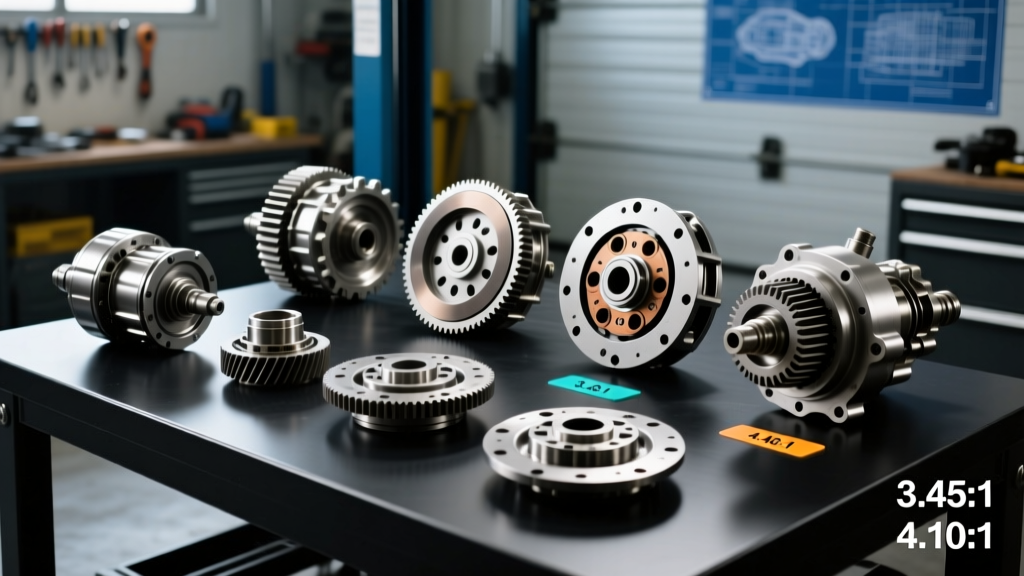
The following table demonstrates how different axle ratios affect a daily driver equipped with a GM 10L80 10-speed transmission (0.63 top gear OD) and 28-inch tires at a 70 MPH highway cruise.
| Axle Ratio | 1st Gear Launch (4.70) | Cruise RPM @ 70 MPH | Daily Driving Verdict |
|---|---|---|---|
| 3.23 | 15.18:1 | 1,615 RPM | Ideal for highway commuting and light towing. |
| 3.73 | 17.53:1 | 1,865 RPM | Best all-rounder. Excellent off-the-line response with acceptable highway NVH. |
| 4.10 | 19.27:1 | 2,050 RPM | Too steep for daily driving. Causes drone, excess heat, and poor fuel economy. |
As illustrated, while the 4.10 gear offers a marginally harder launch, the 3.73 ratio provides the optimal compromise for a vehicle that sees 90% street use and 10% track use.
Corrective Action: Ring and Pinion Swap Specifications
When diagnosis confirms that the current gear ratio is destroying the daily driving experience, a ring and pinion swap is required. Sourcing high-quality components from manufacturers like Yukon Gear & Axle or Motive Gear is critical. A complete master install kit (including Timken bearings, seals, crush sleeves, and shims) typically costs between $450 and $650, with professional installation labor ranging from $800 to $1,200 depending on the axle type.
Critical Torque Specs and Setup Procedures
Improper installation of the new gear set will result in catastrophic failure within 500 miles. When servicing a common GM 8.5-inch 10-bolt rear axle, adhere strictly to the following specifications:
- Ring Gear Bolts: Torque to exactly 65 lb-ft. You must apply Red Loctite 271 (high-strength threadlocker) to the threads. Never reuse stretched ring gear bolts.
- Pinion Bearing Preload: This is the most critical measurement. Using an inch-pound torque wrench, the pinion rotational drag must read between 15 and 25 in-lbs of resistance for used bearings, or 25 to 35 in-lbs for brand-new bearings. This is achieved by carefully crushing the new crush sleeve or adjusting the solid spacer shims.
- Pinion Nut Torque: Typically requires 200 to 250 lb-ft to achieve the correct bearing preload. Always use a new pinion nut and apply threadlocker to the splines.
- Backlash: Set ring gear backlash between 0.006" and 0.010" using a dial indicator mounted to the axle housing. Check backlash at four equidistant points around the ring gear to ensure zero runout.
- Gear Oil: Fill with a high-quality 75W-90 synthetic gear oil. If installing a clutch-type limited-slip differential (LSD), do not forget the required friction modifier additive to prevent chatter during low-speed daily driving turns.
Conclusion: Balancing the Equation
When enthusiasts ask what is the best gear ratio for speed, the honest engineering answer is that 'speed' means different things in different contexts. Quarter-mile times demand steep numerical ratios; highway passing and daily drivability demand mathematical harmony between the tire diameter, transmission overdrive, and axle ratio. By diagnosing the symptoms of NVH drone, TCC shudder, and thermal overload, you can accurately identify a mismatched drivetrain and restore the vehicle to its optimal, road-trip-ready state.