The Sensory Experience: When Your Car Refuses to Change Gears
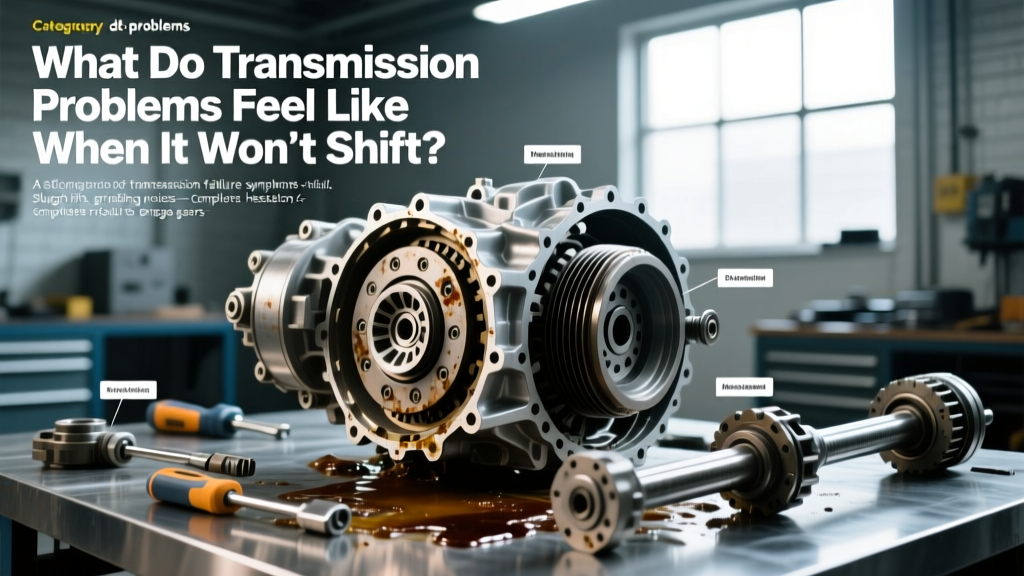
Driving is supposed to be a seamless, almost subconscious experience. You press the pedal, the engine hums, and the vehicle accelerates smoothly through its gears. But when your vehicle suddenly gets stuck in one gear, panic naturally sets in. For beginners and seasoned drivers alike, the immediate question is: what do transmission problems feel like when the gearbox simply refuses to shift?
A 'no-shift' condition is not just a mechanical failure; it is a distinct sensory event. You will feel a sudden disconnect between the engine's effort and the vehicle's momentum. The engine may scream at 5,000 RPM while you barely crawl past 20 MPH. Alternatively, the vehicle might lock itself into a single gear, resulting in sluggish, heavy acceleration from a stop and an abrupt, jarring downshift when you come to a halt. Understanding these physical sensations is the first step in diagnosing the root cause before you end up stranded on the side of the road.
Decoding the Feelings: The 3 Main 'No-Shift' Sensations
Before diving under the hood, pay attention to how the vehicle behaves. Modern transmissions, from the ubiquitous GM 4L60E to the highly complex ZF 8HP found in modern BMWs and Ram trucks, exhibit specific symptoms based on the failure point.
1. The 'Limp Mode' Lock (Stuck in 2nd or 3rd Gear)
If your car feels incredibly sluggish off the line, shifts harshly into a single gear, and refuses to go higher no matter how hard you press the throttle, you are likely in 'Limp Home Mode.' The Transmission Control Module (TCM) detects a critical fault—such as a failed speed sensor or a solenoid circuit open—and intentionally locks the transmission into 2nd or 3rd gear to prevent internal catastrophic damage. What it feels like: Towing a heavy trailer up a steep hill, even on flat ground.
2. The RPM Flare (Slipping Before the Shift Fails)
Sometimes, the transmission attempts to shift but fails to engage the next gear. You will feel the engine RPMs spike suddenly (flare) without a corresponding increase in vehicle speed, followed by a harsh, neck-snapping clunk as the transmission either catches the gear late or aborts the shift entirely. What it feels like: Stepping on the clutch pedal in a manual car and revving the engine while in neutral.
3. The Phantom Shifter (Linkage Disconnect)
You move the gear selector from Park to Drive, but the dashboard indicator stays on 'P' or 'N', and the car won't move. Alternatively, you put it in Drive, but the transmission physically remains in Reverse. What it feels like: Moving a joystick that has been disconnected from the machine.
Top Mechanical Culprits for a Transmission That Won't Shift
Now that you know what do transmission problems feel like in a no-shift scenario, it is time to look at the mechanical realities. Here are the most common reasons your vehicle is stuck, complete with specific technical data.
1. Starved Hydraulics: Low or Degraded Fluid
Automatic transmissions rely on pressurized fluid to actuate clutch packs and bands. If the fluid is low, the hydraulic pressure drops below the threshold required to engage the next gear.
- GM 4L60E / 4L80E: Requires Dexron VI. A common failure point is the rear main seal or the shift shaft O-ring leaking, dropping the pan level below the filter pickup.
- ZF 8HP (8-Speed): Requires specific ZF Lifeguard 8 fluid. These units are notorious for leaking at the Mechatronic unit sealing sleeve (torque spec for the sleeve retaining nut is precisely 8 Nm). If it leaks, the valve body starves, and 3rd-to-4th shifts fail first.
2. Failed Shift Solenoids
Solenoids are electro-mechanical valves that direct fluid flow to the correct clutch pack. If a solenoid sticks open or burns out, the gear associated with that solenoid will not engage.
Expert Insight: On the GM 4L60E, the 1-2 shift solenoid (ACDelco Part # 214-1893) is a frequent offender. When it fails, the transmission will start in 2nd gear, shift to 3rd, but will never shift into 4th (Overdrive), leaving you with high RPMs on the highway.
3. Shift Linkage or Cable Misalignment
The physical cable connecting your steering column or center console shifter to the transmission's manual valve can stretch, snap, or pop off its ball stud. The transmission physically remains in whatever gear it was last placed in, regardless of what the shifter inside the cabin indicates.
4. Transmission Control Module (TCM) or Wiring Faults
As vehicles have become more computerized through 2026, the TCM plays a massive role. Internal solder joint cracks on the TCM circuit board, or corrosion in the external 13-pin connector (common on older Mercedes 722.6 and Chrysler NAG1 transmissions), will sever communication between the brain and the gearbox, resulting in an immediate no-shift condition.
Beginner-Friendly Diagnosis: Your Step-by-Step Action Plan
You do not need to be a master mechanic to perform preliminary diagnostics. Follow these steps to narrow down the issue before paying a shop's $150/hour diagnostic fee.
Step 1: Pull the OBD2 Codes
Plug an OBD2 scanner into the port under your dashboard. While a basic scanner might only show a generic P0700 (Transmission Control System Malfunction), a bi-directional or enhanced scanner will reveal the specific sub-codes. Look for:
- P0756: Shift Solenoid 'B' Performance or Stuck Off.
- P0720: Output Speed Sensor Circuit Malfunction (The TCM doesn't know how fast the car is going, so it won't shift).
- P0871: Transmission Fluid Pressure Sensor/Switch 'C' Circuit Range/Performance.
For a comprehensive database of these codes, resources like OBD-Codes are invaluable for beginners trying to understand their scanner's readout.
Step 2: The Precision Fluid Check
Checking fluid isn't as simple as pulling a dipstick anymore. Many modern transmissions (like the GM 8L90 or Ford 10R80) are 'sealed' and use an overflow plug on the transmission pan.
- Ensure the vehicle is perfectly level on jack stands or a lift.
- Run the engine and cycle through the gears to circulate fluid.
- Using a scan tool, monitor the Transmission Fluid Temperature (TFT). The fluid must be between 86°F and 122°F (30°C - 50°C) for an accurate reading.
- With the engine running, remove the overflow plug. If a steady stream drips out, the level is correct. If nothing comes out, you are low and need to pump fluid into the fill hole until it drips.
- Safety Note: Always reinstall and torque the overflow plug to factory specs (typically 15-20 Nm depending on the application) to prevent a massive leak.
Step 3: Inspect the External Linkage
Have a friend move the shifter through the gears while you safely observe the transmission shift lever from underneath or beside the vehicle. If the cable moves but the lever on the transmission case does not, you have a detached or broken linkage bushing—a $10 part that takes 15 minutes to fix.
Repair Cost and Complexity Matrix
Understanding the financial and mechanical scope of your problem is crucial. Below is a breakdown of common no-shift repairs, estimated costs, and difficulty levels for the DIYer versus the professional.
| Failure Point | Common Vehicles | Estimated Part Cost | Estimated Labor Cost | DIY Difficulty |
|---|---|---|---|---|
| Shift Linkage Bushing/Cable | Ford F-150, Honda Accord | $10 - $85 | $80 - $150 | Easy (1/5) |
| Shift Solenoid Pack (e.g., 4L60E) | GM Silverado, Tahoe, Camaro | $45 - $120 | $250 - $400 | Moderate (3/5) |
| Output Speed Sensor | Chrysler/Dodge (NAG1), Ford | $25 - $60 | $100 - $200 | Easy (2/5) |
| ZF 8HP Mechatronic Sleeve Seal | BMW 3/5 Series, Ram 1500 | $30 - $75 | $400 - $700 | Hard (4/5) |
| Internal Clutch Pack / Valve Body | Any High-Mileage Automatic | $400 - $1,200+ | $1,200 - $2,500 | Expert (5/5) |
When to Call a Professional
If your OBD2 scanner reveals internal pressure switch codes, or if your fluid check reveals fluid that is black, smells burnt, and contains glitter-like metallic particulates, stop driving immediately. These are signs of catastrophic internal friction material failure. At this stage, no amount of solenoid replacements or fluid top-offs will fix the no-shift condition.
Internal rebuilds require specialized tools, clutch pack clearance measurements (often requiring feeler gauges down to 0.010-inch tolerances), and high-pressure air testing. For deep-dive technical specifications on valve body wear and internal clearances, industry authorities like Sonnax and the Automatic Transmission Rebuilders Association (ATRA) provide the blueprints that professional shops use daily.
Final Thoughts
Answering the question of 'what do transmission problems feel like' is about tuning into your vehicle's warnings before they become emergencies. A transmission that won't shift is terrifying, but by systematically checking your fluid levels, scanning for solenoid codes, and inspecting external linkages, you can confidently separate a $15 DIY fix from a $3,000 rebuild. Stay observant, keep your maintenance current, and never ignore the sensory clues your car is desperately trying to give you.