The Physics of Agricultural Drivetrain Degradation
Agricultural drivetrains endure high-inertia loads, severe shock loading from ground-engagement implements, and continuous high-torque PTO (Power Take-Off) operation. Unlike standard automotive applications, a tractor clutch repair is rarely a simple drop-in procedure. It typically requires 'splitting' the tractor chassis between the engine block and the transmission bell housing, making accurate diagnostics paramount before committing to a teardown.
Modern utility and row-crop tractors—such as the John Deere 5075E, Kubota M7 series, and Massey Ferguson 4700—rely heavily on dual-stage clutches or wet multi-plate powershift assemblies. Understanding the precise wear signs and quantitative lifespan indicators of these systems separates guesswork from professional-grade drivetrain management.
Primary Wear Signs Preceding Tractor Clutch Repair
Clutch degradation in heavy machinery rarely happens overnight. It manifests through specific mechanical and acoustic anomalies that trained technicians use to isolate the failing component.
1. Dual-Stage PTO Slippage
Most mechanical transmission tractors utilize a dual-stage (two-plate) clutch. The primary plate drives the transmission input shaft, while the secondary plate drives the independent or live PTO shaft via a stepped release bearing or a separate internal hydraulic circuit. If you notice the engine RPMs remaining steady but the PTO shaft speed dropping under heavy loads (e.g., engaging a rotary cutter in thick brush or running a square baler), the secondary PTO friction disc is slipping. This is a definitive lifespan indicator that the intermediate pressure plate or secondary friction material has exceeded its thermal and mechanical limits.
2. Pedal Free-Play Reduction and Release Bearing Wear
A healthy dry clutch requires 1.0 to 1.5 inches of pedal free-play before the throw-out bearing (release bearing) contacts the diaphragm spring fingers. As the friction disc wears, the pressure plate moves closer to the flywheel, causing the diaphragm fingers to pivot outward toward the bearing. If the pedal free-play disappears entirely, the release bearing is under constant load. This generates immense friction, leading to catastrophic bearing seizure and severe scoring of the transmission input shaft sleeve—a secondary failure that drastically inflates the final repair invoice.
3. Clutch Brake Failure in Synchronized Transmissions
Tractors equipped with synchronized manual or power-shuttle transmissions feature a clutch brake mechanism designed to halt the input shaft's rotation when the pedal is fully depressed, allowing for smooth gear engagement. If operators experience severe gear grinding when shifting into forward or reverse from a standstill, but the tractor still moves normally once in gear, the clutch brake friction ring has worn out or the pedal linkage is out of adjustment. While not always requiring a full chassis split, it is a critical wear sign that demands immediate linkage inspection.
Quantitative Lifespan Indicators: When to Rebuild vs. Replace
Visual inspection during a chassis split is insufficient. Precision measurement tools must be used to evaluate whether components can be reused or if a full LuK RepSet or OEM equivalent is required. Below are the definitive service limits for standard 11-inch and 12-inch heavy-duty agricultural clutches.
| Component | Nominal Dimension | Service Limit (Replace) | Diagnostic Tool |
|---|---|---|---|
| Friction Disc Lining Thickness | 0.315" (8.0mm) | Less than 0.060" (1.5mm) above rivets | Digital Caliper |
| Diaphragm Spring Finger Wear | Flush with wear ring | Greater than 0.080" (2.0mm) groove depth | Straight Edge & Feeler Gauge |
| Flywheel Face Runout | 0.000" | Greater than 0.006" (0.15mm) TIR | Dial Indicator (Magnetic Base) |
| Release Bearing Free-Play | 0.100" (2.5mm) | Less than 0.040" (1.0mm) | Feeler Gauge at Fork |
| Torsional Damper Spring Play | Zero axial movement | Visible axial shift or broken spring tabs | Visual / Pry Bar Inspection |
Expert Insight: Never assume a flywheel can be machined indefinitely. Most agricultural engine manufacturers specify a maximum material removal limit of 0.030" (0.75mm) from the friction face. Exceeding this alters the clutch geometry, reducing the clamping force of the diaphragm spring and guaranteeing premature slippage. If the step height exceeds the service limit, the flywheel must be replaced.
Thermal and Mechanical Failure Modes
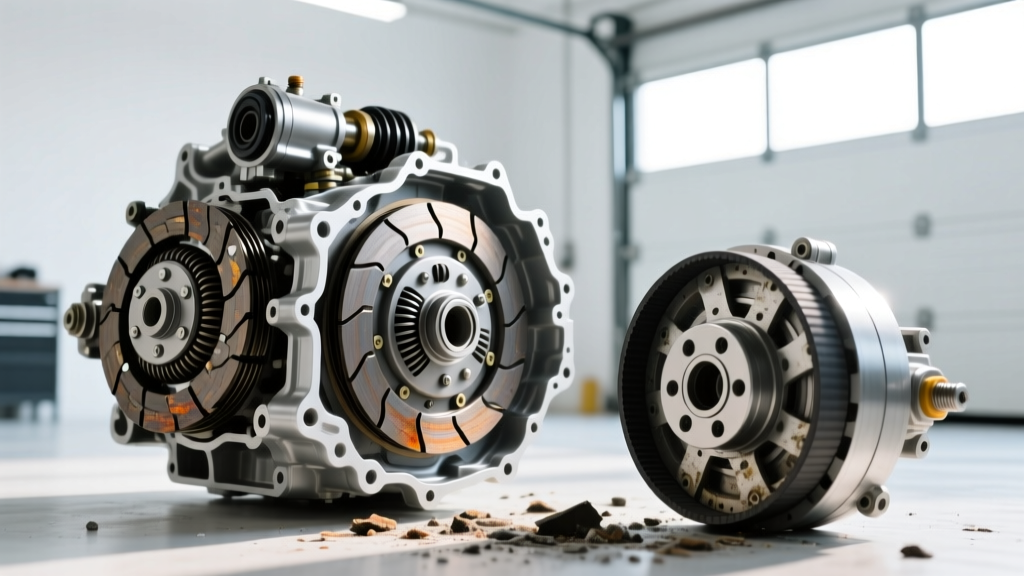
When inspecting a pulled clutch assembly, technicians must look for specific failure modes that indicate underlying operational issues:
- Thermal Cracking (Heat Checking): Concentric hairline cracks on the flywheel or pressure plate face indicate severe overheating, usually caused by 'riding' the clutch during heavy draft loading or improper inching. These micro-fractures cause clutch chatter upon engagement.
- Torsional Damper Failure: The hub of the friction disc contains heavy-duty coil springs designed to absorb engine firing impulses and driveline shock. If these springs are fractured, or if the hub exhibits excessive rotational backlash, the transmission input shaft and gears will suffer from high-frequency harmonic vibration, leading to premature bearing failure.
- Oil Contamination: Black, glazed friction material indicates contamination. In tractors, this is almost always caused by a leaking engine rear main seal or a compromised transmission input shaft seal. Replacing the clutch without addressing the seal will result in identical failure within 100 operating hours.
Precision Teardown and Reassembly Specifications
Executing a proper repair requires adherence to strict torque sequences and alignment protocols. According to TractorData and OEM service manuals, the following specifications apply to common 4-cylinder diesel platforms (e.g., John Deere 4045 / Cummins B3.3/B4.4 architectures):
Flywheel and Housing Torque Specs
- Flywheel to Crankshaft Bolts (M12x1.25 Grade 10.9): 120 lb-ft (163 Nm) + 60-degree angle turn. Must be tightened in a multi-pass star pattern.
- Clutch Cover to Flywheel: 35 to 45 lb-ft (47 to 61 Nm). Tighten evenly in a crisscross pattern to prevent warping the pressure plate housing.
- Bell Housing to Engine Block: 65 to 85 lb-ft (88 to 115 Nm). Misalignment here causes input shaft binding and rapid pilot bearing destruction.
The Alignment Imperative
Because the transmission input shaft is heavy and unsupported during the chassis mating process, relying on the friction disc to hold it in place will shear the hub. A heavy-duty, splined dummy alignment shaft must be used to center the friction disc to the pilot bearing. Once the bell housing is guided onto the engine dowel pins, the input shaft will slide seamlessly into the clutch spline. Forcing the halves together with the mounting bolts will instantly destroy the torsional damper hub.
2026 Cost Realities for Heavy-Duty Clutch Overhauls
The financial footprint of agricultural drivetrain service has shifted significantly. While a standard automotive clutch kit might cost a few hundred dollars, heavy-duty ag components command a premium due to their massive torque capacities (often exceeding 600 lb-ft) and specialized torsional damping requirements.
- Parts (OEM / Premium Aftermarket): A complete dual-stage clutch kit (including friction discs, pressure plate assembly, release bearing, and pilot bearing) typically ranges from $650 to $1,400. Flywheel replacements, if necessary, add another $800 to $1,500.
- Labor and Chassis Splitting: Splitting a 5,000+ lb tractor requires specialized hydraulic jacks, frame stands, and overhead hoists. The labor time for a complete split, teardown, machine shop verification, and reassembly averages 14 to 22 hours. At current 2026 mobile and shop diesel technician rates ($135 - $185/hr), expect labor costs to range between $1,890 and $4,070.
Ultimately, recognizing the early acoustic and mechanical wear signs of clutch degradation allows fleet managers and owner-operators to schedule the repair during off-season downtime, avoiding the catastrophic drivetrain failures that occur during critical planting and harvest windows.