The Great Debate: Toyota RAV4 Drivetrain vs. Powertrain
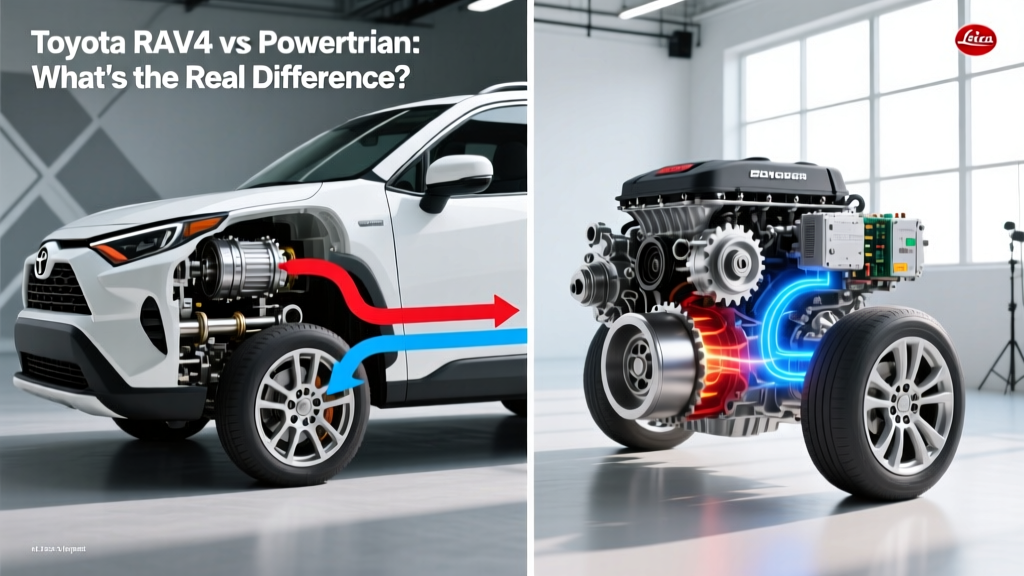
When you sit across from a dealership service advisor or browse extended warranty contracts, the terms 'powertrain' and 'drivetrain' are often tossed around interchangeably. For owners of America's best-selling non-truck, understanding the distinction is critical. If a warning light illuminates or a mechanical failure occurs, knowing exactly what constitutes the Toyota RAV4 drivetrain versus the broader powertrain can save you thousands of dollars in out-of-pocket repair bills.
As of 2026, the RAV4 lineup features a complex array of mechanical layouts, from the standard Front-Wheel Drive (FWD) gas models to the sophisticated Dynamic Torque Vectoring All-Wheel Drive (DTV AWD) and hybrid e-CVT systems. In this beginner-friendly explainer, we will dissect the mechanical boundaries of your RAV4, provide exact factory specifications, and clarify what is actually covered when a warranty claim is filed.
Defining the Powertrain: The Heartbeat of Your RAV4
Think of the powertrain as the 'power generation and multiplication' center of your vehicle. It encompasses every component responsible for creating kinetic energy and converting it into usable rotational force before it leaves the engine bay.
Core Powertrain Components
- The Engine: In the standard 2026 RAV4 gas models, this is the 2.5L Dynamic Force inline-4 (engine code A25A-FKS), producing 203 horsepower and 184 lb-ft of torque. In the RAV4 Hybrid, it is the Atkinson-cycle variant paired with electric motor-generators.
- The Transmission/Transaxle: Gas models utilize the UB80E Direct Shift-8AT (an 8-speed automatic with a physical launch gear), while hybrids use the P710 or P810 e-CVT transaxle.
- Engine Management: The ECUs, fuel injectors, and internal engine components (pistons, crankshaft, camshafts) that dictate how fuel and air are combusted.
In short, if a component is directly involved in making the power or gearing it down to a usable speed, it belongs to the powertrain.
Defining the Toyota RAV4 Drivetrain: Getting Power to the Pavement
If the powertrain generates the power, the drivetrain is the delivery network. The drivetrain consists of every mechanical link that transfers that rotational force from the transmission to the actual wheels. The complexity of the Toyota RAV4 drivetrain depends entirely on your trim level and chosen layout.
FWD vs. AWD Drivetrain Configurations
In a base FWD RAV4, the drivetrain is relatively simple. Because the transmission and drive axles are housed together in a single 'transaxle' unit, the drivetrain primarily consists of the front Constant Velocity (CV) axles and the wheel hubs.
However, if you step up to an Adventure or TRD Off-Road trim equipped with Dynamic Torque Vectoring AWD (DTV AWD), the drivetrain expands massively. It now includes:
- The Transfer Case: Bolted to the side of the UB80E transmission, this redirects power rearward.
- The Driveshaft: A two-piece steel propeller shaft running underneath the cabin to the rear axle.
- The Rear Differential: The DTV AWD system uses a highly advanced rear differential housing twin multi-plate clutches. This allows the RAV4 to vector torque side-to-side (up to 100% of rear power to a single wheel) and completely disconnect the rear driveline to save fuel on the highway.
- Rear CV Axles: The shafts connecting the rear differential to the rear wheels.
Expert Insight: The 'Drivetrain Malfunction' warning on your RAV4's dashboard is rarely an engine issue. It is typically triggered by the AWD control module detecting a slip fault, a failing rear differential clutch pack, or a transfer case speed sensor discrepancy.
Component Breakdown: Where Does the Powertrain End and Drivetrain Begin?
To visualize the boundary line, review the table below detailing specific RAV4 components, their system classification, and current 2026 replacement cost estimates.
| Component | System Classification | RAV4 Specific Part / Spec | Est. Replacement Cost (2026) |
|---|---|---|---|
| Engine Block & Internals | Powertrain | A25A-FKS 2.5L Dynamic Force | $4,500 - $6,500 |
| Transmission / Transaxle | Powertrain & Drivetrain (Overlap) | UB80E Direct Shift-8AT | $3,800 - $5,200 |
| Transfer Case Assembly | Drivetrain | PTO / Bevel Gear Assembly | $1,200 - $1,800 |
| Propeller Shaft (Driveshaft) | Drivetrain | Two-piece CV-jointed shaft | $800 - $1,300 |
| Rear Differential (DTV AWD) | Drivetrain | Twin-clutch vectoring unit | $2,500 - $3,500 |
| Front CV Axle (Half-shaft) | Drivetrain | Toyota OEM Front Axle Shaft | $350 - $600 (per side) |
Why the Distinction Matters: Warranties and Repair Bills
The most common point of confusion for RAV4 owners arises when reading the fine print of warranty coverage. According to the official Toyota Warranty Guide, Toyota provides a 5-year/60,000-mile Powertrain Limited Warranty.
Fortunately for Toyota owners, the manufacturer's definition of 'Powertrain' is incredibly generous and includes the drivetrain. Under the factory warranty, if your rear differential fails or your transfer case leaks, Toyota covers it. However, the danger lies in the extended warranty and used vehicle certification markets.
The Third-Party Warranty Trap
Many third-party extended warranty companies strictly separate the two. A basic 'Powertrain Plus' contract from a third-party insurer might cover the engine and the UB80E transmission, but explicitly exclude the driveshaft, rear differential, and CV axles, classifying them as 'chassis' or 'drivetrain wear items.' Always read the contract definitions. If a third-party policy does not explicitly list the AWD transfer case and rear differential under covered components, you are exposing yourself to massive financial risk on an AWD RAV4.
Wrenching on the RAV4: Drivetrain Maintenance Specs
For the DIY enthusiast, maintaining the Toyota RAV4 drivetrain is straightforward, provided you adhere to strict factory torque specifications and fluid requirements. Neglecting drivetrain fluids is the leading cause of premature DTV AWD clutch wear.
1. Rear Differential Service (DTV AWD Models)
The rear differential in the DTV AWD system is not just an open gearset; it contains sensitive multi-plate clutches. Using the wrong fluid will cause clutch chatter and eventual failure.
- Fluid Requirement: Toyota Genuine Hypoid Gear Oil SX (75W-85). Do not use standard off-the-shelf 75W-90 with generic friction modifiers.
- Capacity: Approximately 1.2 pints (0.57 Liters).
- Drain Plug Torque: 29 lb-ft (39 Nm).
- Fill Plug Torque: 29 lb-ft (39 Nm).
- Interval: Inspect every 15,000 miles; replace every 30,000 miles if towing or driving off-road.
2. Transfer Case Service (AWD Models)
Located on the passenger side of the transaxle, the transfer case requires the same meticulous attention.
- Fluid Requirement: Toyota Genuine Hypoid Gear Oil SX (75W-85).
- Capacity: Approximately 0.8 pints (0.38 Liters).
- Plug Torque: 29 lb-ft (39 Nm).
3. UB80E Transmission (Powertrain/Drivetrain Overlap)
While technically part of the powertrain, the transmission connects directly to the drivetrain. The UB80E features a separate thermal management system and requires specific low-viscosity fluid to operate the launch gear and standard planetary gears seamlessly.
- Fluid Requirement: Toyota Genuine ATF WS (World Standard).
- Drain Plug Torque: 30 lb-ft (41 Nm) with a new aluminum crush washer.
- Drain & Fill Capacity: ~3.5 quarts (Total dry fill is much higher, but a standard drain and fill yields about 3.5 quarts).
Summary: Knowing Your RAV4's Anatomy
Understanding the difference between the powertrain and the drivetrain transforms you from a passive vehicle owner into an informed advocate for your wallet. The powertrain (your A25A engine and UB80E transmission) generates the force, while the Toyota RAV4 drivetrain (your CV axles, driveshaft, and DTV rear differential) executes the delivery. By adhering to precise maintenance schedules, utilizing exact OEM fluids, and scrutinizing warranty definitions, you ensure your RAV4 remains capable, reliable, and ready for the road ahead.
For more detailed teardowns and reliability data on Toyota's AWD architectures, refer to ongoing automotive testing by authorities like Car and Driver and repair cost aggregators like RepairPal.