The Missing Link in Your Drivetrain: Identifying Your Axle Ratio
Whether you have just purchased a used Chevy Silverado, a Jeep Wrangler with an unknown history, or a Ford F-150 missing its window sticker, verifying your drivetrain gearing is critical before upgrading tires, towing heavy loads, or swapping transmission components. Many enthusiasts ask how to find overall gear ratio without cracking open the differential cover. The most reliable, non-invasive technique is the tire spin method.
However, as automotive transmission experts, we must first clarify a common terminology trap. The tire spin method specifically isolates your axle ratio (final drive ratio). To find your true overall gear ratio, you must multiply this axle ratio by your transmission's specific gear ratio and your transfer case ratio (if equipped). In this comprehensive 2026 guide, we will walk you through the exact physical procedure to find your axle ratio via the tire spin method, decode the results, and calculate your final overall gearing.
Safety Protocols and Drivetrain Preparation
Before crawling under a 5,000-pound vehicle, strict safety and mechanical preparation are mandatory. Incorrect preparation can lead to severe injury or drivetrain binding that skews your data.
- Lifting and Securing: Use a minimum 3-ton floor jack and secure the vehicle on heavy-duty jack stands rated for your vehicle's Gross Vehicle Weight Rating (GVWR). Never rely solely on a hydraulic jack.
- Transmission State: For automatic transmissions like the GM 6L80, Ford 10R80, or ZF 8HP70, the transmission must be placed in Neutral, not Park. Placing it in Park engages the parking pawl, which locks the output shaft and prevents the driveshaft from spinning.
- Transfer Case Position: If your vehicle is 4WD, the transfer case must be shifted into 2WD (2H). Leaving it in 4WD will bind the front and rear driveshafts against each other due to slight rotational speed differences, making the tire impossible to spin smoothly.
- Brake Release: Ensure the parking brake is fully disengaged. On vehicles with electronic parking brakes (EPB), you may need to use a bi-directional OBD2 scanner to retract the caliper pistons or put the EPB into service mode.
Step-by-Step: Executing the Tire Spin Method
The core concept is simple: rotate the tire a set number of times and count the corresponding rotations of the driveshaft. However, the exact execution changes depending on whether your differential is open, limited-slip, or a locking unit.
Scenario A: Open Differentials
If your vehicle has a standard open differential (common on base-model 2WD trucks and older passenger cars), spinning one tire will cause the opposite tire to spin in the opposite direction due to the spider gears inside the carrier.
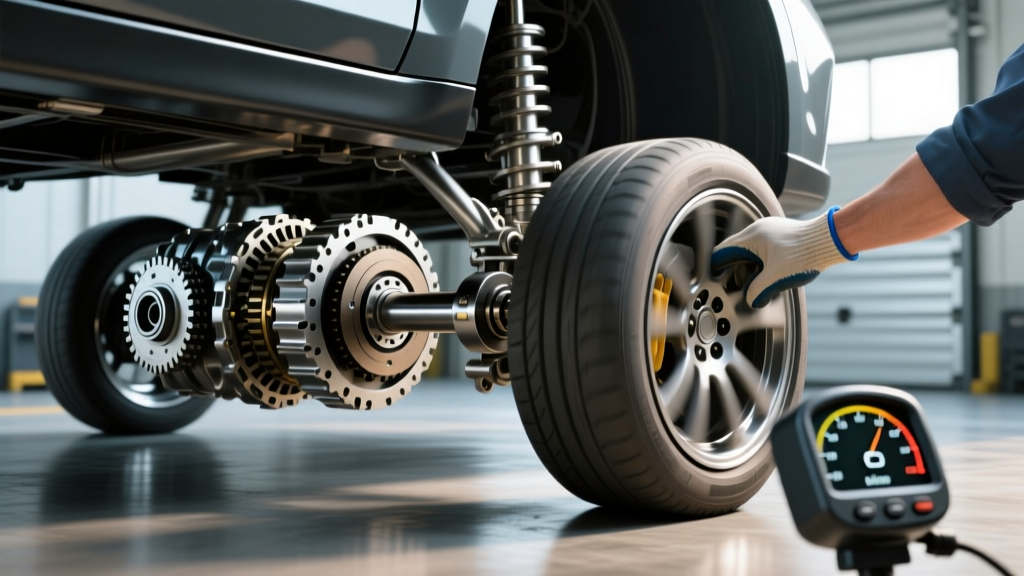
- Jack up both rear tires off the ground.
- Place a piece of chalk or painter's tape at the 12 o'clock position on the right rear tire.
- Place a corresponding mark on the driveshaft and the differential housing to use as a reference line.
- Rotate the marked tire forward exactly two (2) full revolutions. (Counting two revolutions cancels out the spider gear multiplication inherent in an open diff with one wheel held stationary, but lifting both wheels and spinning them together is even easier).
- Count the number of times the driveshaft crosses your reference mark.
Scenario B: Limited-Slip (Posi) and Locking Differentials
Vehicles equipped with clutch-type limited-slip differentials (like the Spicer Trac-Lok), automatic lockers (like the GM Eaton G80), or manual lockers (like an ARB Air Locker) will force both axles to turn together.
- You only need to lift one rear tire off the ground (leave the other on the ground to act as a brake, keeping the carrier stationary).
- Mark the lifted tire and the driveshaft.
- Rotate the lifted tire forward exactly one (1) full revolution.
- Count the driveshaft rotations.
Expert Tip: If you are unsure what type of differential you have, lift both rear tires. If you spin one tire forward and the opposite tire spins backward, you have an open differential. If the opposite tire spins forward (or resists heavily), you have a limited-slip or locking differential.
Decoding the Driveshaft Rotations
Once you have completed the spin, compare your driveshaft rotation count to the chart below. Because human counting is imperfect, you are looking for the nearest standard ratio. According to drivetrain specialists at Yukon Gear & Axle, factory ratios typically fall into these common increments.
| Target Axle Ratio | Driveshaft Turns (1 Tire Spin / Locker) | Driveshaft Turns (2 Tire Spins / Open Diff) | Common Applications |
|---|---|---|---|
| 3.08:1 | ~3.08 (approx 3 1/8) | ~6.16 | Highway cruising, light towing |
| 3.23:1 | ~3.23 (approx 3 1/4) | ~6.46 | Modern V8 half-ton trucks (e.g., 5.3L Silverado) |
| 3.42:1 | ~3.42 (approx 3 1/2) | ~6.84 | Standard tow packages |
| 3.73:1 | ~3.73 (approx 3 3/4) | ~7.46 | Heavy tow packages, older V6 trucks |
| 4.10:1 | ~4.10 (approx 4 1/8) | ~8.20 | 3/4-ton trucks, Jeep Wrangler Rubicon (Dana 44) |
| 4.56:1 | ~4.56 (approx 4 1/2) | ~9.12 | Aftermarket re-gears for 35-inch tires |
| 4.88:1 | ~4.88 (approx 4 7/8) | ~9.76 | Dedicated off-road crawlers, 37+ inch tires |
Calculating the True Overall Gear Ratio
Now that you have successfully identified your axle ratio using the tire spin method, you can calculate your overall gear ratio. The overall gear ratio determines the actual mechanical advantage multiplied from the engine's crankshaft to the contact patch of the tire.
The Formula:
Overall Gear Ratio = Transmission Gear Ratio × Transfer Case Ratio × Axle Ratio
Real-World Calculation Example
Let us assume you are driving a 2024 Ford F-150 equipped with the 10R80 10-speed automatic transmission, an NVG271 transfer case, and you just used the tire spin method to verify a 3.73:1 axle ratio.
- Transmission 1st Gear (10R80): 4.69:1
- Transfer Case Low Range (NVG271): 2.48:1
- Axle Ratio (Tire Spin Verified): 3.73:1
Overall Crawl Ratio Calculation:
4.69 × 2.48 × 3.73 = 43.39:1
This means that in 4-Low, 1st gear, the engine will turn 43.39 times for every single rotation of the tire. This metric is vital for off-road crawling and heavy-duty winching scenarios.
Expert Troubleshooting and Edge Cases
While the tire spin method is highly accurate, modern drivetrains present unique challenges that require expert troubleshooting.
Drivetrain Bind and Transfer Case Wind-Up
If you are testing a part-time 4WD system and the tire refuses to spin, or the driveshaft only moves an inch before stopping, you are experiencing driveline wind-up. Ensure the front hubs are unlocked (if equipped with manual Warn hubs) and the transfer case is definitively in 2-High. On full-time 4WD systems with a center differential (like the ZF-based BW4485 found in some luxury SUVs), you must ensure the center diff is not locked.
Electronic Parking Brakes (EPB)
Modern vehicles (2018 and newer) utilize electronic parking brakes integrated into the rear calipers. If the EPB actuator motor fails to fully retract, it will drag the rotor, making the tire incredibly difficult to spin and potentially damaging the EPB mechanism. Always verify caliper retraction before applying force to the tire.
Verifying Ring and Pinion Wear
While spinning the tire, listen closely to the differential. According to engineering data from Dana Incorporated, excessive backlash or worn ring and pinion teeth will manifest as a distinct 'clunk' or grinding sensation when you reverse the direction of the tire spin. If you feel more than 1/4 inch of rotational play at the tire before the driveshaft engages, your differential likely requires a backlash adjustment or a complete master rebuild kit (typically costing between $120 and $180 for Timken bearings and shims, plus $600-$900 in shop labor).
Final Thoughts on Drivetrain Verification
Understanding how to find overall gear ratio begins with accurately identifying your final drive. The tire spin method remains the gold standard for DIY mechanics and drivetrain specialists alike because it bypasses the need to drain gear oil, remove differential cover bolts (torqued to 20-25 lb-ft on most GM 10-bolts), or decode faded RPO stickers. By combining the physical tire spin data with your transmission's published gear ratios, you gain complete mastery over your vehicle's mechanical footprint, ensuring your next modification—whether it is a 6L80 TCM tune or a 35-inch tire upgrade—is perfectly calibrated for performance and reliability.