The Thermal Divide: Mid-Size Gas vs. Heavy-Duty Diesel
When mid-size truck owners search for a tacoma transmission cooler, they are typically addressing the thermal limits of the Toyota AC60E or older A340F transmissions. These gas-powered rigs, often towing 5,000 to 6,500 pounds, require a modest cooling upgrade—usually a simple 15,000 GVWR-rated tube-and-fin or basic plate-and-fin cooler mounted behind the grille. However, applying these light-duty thermal management principles to a transmission cooler for diesel trucks is a recipe for catastrophic drivetrain failure. Turbo-diesel platforms generate immense low-end torque and exhaust gas temperatures (EGTs) that severely tax the torque converter, demanding a radically different approach to transmission fluid cooling.
In 2026, with diesel trucks routinely towing 20,000+ pound fifth-wheel trailers and utilizing high-stall torque converters for heavy hauling, the thermal dynamics of the drivetrain have evolved. Understanding the engineering gap between a mid-size gas truck cooler and a heavy-duty diesel transmission cooler is critical for preventing fluid degradation, clutch pack glazing, and complete transmission burnout.
Thermal Demands and Transmission Specifications
To understand why a cooler designed for a mid-size gas truck fails on a diesel, we must examine the baseline hydraulic and thermal specifications of the transmissions in question. The table below contrasts the operational parameters of popular mid-size and heavy-duty automatic transmissions.
| Vehicle Class | Transmission Model | Fluid Capacity | Max Line Pressure | Required BTU/hr (Towing) |
|---|---|---|---|---|
| Mid-Size Gas (Tacoma) | Toyota AC60E | 11.4 qts | ~125 PSI | 150,000 |
| 3/4-Ton Diesel (Ram) | Aisin AS69RC / 68RFE | 12.5 - 14 qts | ~165 PSI | 320,000 |
| 1-Ton Diesel (Duramax) | Allison 1000 | 12.7 qts (Deep Pan) | ~225 PSI | 450,000+ |
| 1-Ton Diesel (Powerstroke) | Ford 10R140 | 13.1 qts | ~195 PSI | 400,000+ |
As documented in Allison Transmission official specifications, the Allison 1000 can spike line pressures up to 225 PSI during heavy towing or performance tuning. A standard cooler designed for a 125 PSI gas system will literally burst at the seams or blow out its internal brazed joints under these diesel hydraulic loads.
Why Light-Duty Coolers Fail on Diesel Trucks
Core Construction and Flow Restriction
The typical tacoma transmission cooler relies on a tube-and-fin or basic plate-and-fin design. While cost-effective and sufficient for low-viscosity fluids at low pressures, these designs introduce severe flow restriction when scaled up for diesel applications. Diesel transmissions, particularly the 10R140 and Allison 1000, require massive fluid volume turnover to cool the torque converter during high-stall towing scenarios.
If a cooler core is too restrictive, the transmission's internal pressure regulator valve compensates by bleeding pressure, leading to clutch pack slip. Conversely, if the cooler cannot shed heat fast enough, the Automatic Transmission Fluid (ATF) exceeds 240°F. At this threshold, synthetic fluids like TES 295 or MERCON ULV begin to oxidize rapidly, losing their shear stability and friction modifiers.
The Stacked-Plate Imperative
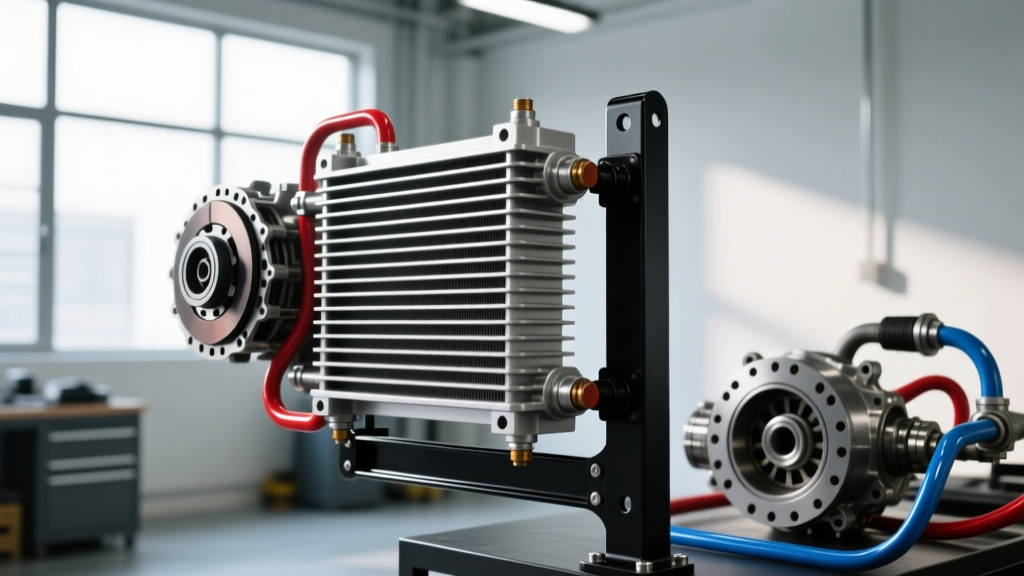
For diesel trucks, the stacked-plate transmission cooler is the only viable architecture. Brands like Derale and Mishimoto utilize furnace-brazed aluminum stacked-plate cores. According to the Derale Performance Transmission Cooler Guide, stacked-plate coolers feature internal 'turbulators'—micro-fins stamped into the fluid pathways that agitate the ATF. This agitation breaks up the boundary layer of fluid against the aluminum walls, increasing thermal transfer efficiency by up to 30% compared to smooth-tube designs, while simultaneously maintaining a high-flow, low-restriction pathway capable of handling 250+ PSI.
Sizing a Transmission Cooler for Diesel Applications
Sizing a cooler is not about physical dimensions; it is about Gross Vehicle Weight Rating (GVWR) and BTU dissipation. When selecting a transmission cooler for diesel trucks, adhere to the following GVWR-based framework:
- Class 3 (10,001 - 14,000 lbs GVWR): Requires a minimum 24,000 GVWR-rated cooler (e.g., Derale 13000 Series).
- Class 4/5 (14,001 - 19,500 lbs GVWR): Requires a 30,000+ GVWR-rated stacked-plate cooler (e.g., Derale Hyper-Cool 15000 Series).
- Heavy Towing (20,000+ lbs GCWR): Requires dual auxiliary coolers or a massive front-mount 40,000 GVWR unit with dedicated cooling fans for low-speed, high-load scenarios like steep grade climbing.
For modern applications like the 6.7L Powerstroke, direct-fit replacements like the Mishimoto Heavy-Duty Cooling Solutions lineup offer 60% greater core volume than OEM, utilizing multi-row stacked-plate designs that integrate directly with the factory thermal bypass valves.
Heavy-Duty Plumbing: Fittings, Hoses, and Torque Specs
The most common point of failure in diesel transmission cooler installations is the plumbing. OEM spring clamps and push-lock rubber hoses are entirely inadequate for the 200+ PSI line pressures and extreme under-hood ambient temperatures generated by turbo-diesel engines.
Upgrading to AN / JIC Fittings
Professional diesel drivetrain builders mandate the use of SAE 100R5 or PTFE-lined stainless steel braided hoses with crimped JIC (Joint Industry Council) or AN (Army-Navy) fittings. For the Allison 1000 and 68RFE, the return and feed lines should be upgraded to a minimum of AN-8 (1/2-inch) to prevent flow restriction. Using AN-6 (3/8-inch) lines on a high-volume diesel transmission will starve the lube circuit, causing premature planetary gear wear.
Adapter Plates and Torque Specifications
When installing cooler line adapter blocks onto the transmission case (e.g., the side-panel adapters used on the Allison 1000), precise torque is critical to avoid cracking the cast aluminum housing or stripping the threads, which leads to catastrophic fluid loss.
- Allison 1000 Case Adapters (M10x1.0 bolts): Torque to 18-22 lb-ft using a medium-strength threadlocker (e.g., Loctite 243).
- 68RFE Cooler Line Fittings (1/2'-20 UNF inverted flare): Torque to 25-30 lb-ft. Do not use Teflon tape on inverted flare or JIC fittings; use a dedicated hydraulic sealant or assemble dry if using O-ring boss (ORB) adapters.
- AN-8 Hose Ends to Adapter Fittings: Torque to 28-32 lb-ft using an aluminum AN wrench to prevent gouging the anodized finish.
Thermal Bypass Valve Dynamics in Cold Climates
A critical, often overlooked component in diesel transmission cooling is the thermal bypass valve. In sub-freezing temperatures, heavy-duty synthetic ATF (like TES 295 or Mobil 1 Synthetic ATF) becomes highly viscous. Forcing cold, thick fluid through the dense micro-channels of a 40,000 GVWR stacked-plate cooler can trigger the transmission's internal pressure relief valve, diverting unfiltered, uncooled fluid directly back to the sump, or worse, causing filter cavitation and pump starvation.
High-end diesel cooler kits incorporate an inline 180°F or 190°F thermal bypass valve. This wax-element valve routes fluid back to the transmission during cold starts, allowing the fluid to reach optimal operating temperature (180°F - 200°F) before engaging the massive auxiliary cooler core. This ensures immediate lubrication to the valve body and clutch packs while preventing cold-flow restriction.
Final Verdict: Matching the Cooler to the Drivetrain
While a tacoma transmission cooler upgrade is a straightforward, low-pressure endeavor focused on basic heat shedding for mid-size gas engines, engineering a transmission cooler for diesel trucks requires a comprehensive understanding of hydraulic pressure, fluid dynamics, and heavy-duty plumbing. By utilizing furnace-brazed stacked-plate cores, upgrading to AN-8 hydraulic lines, and integrating thermal bypass valves, diesel owners can confidently tow maximum payloads through extreme gradients without watching their transmission temperatures climb into the danger zone. Protecting a $10,000 diesel transmission requires more than a generic cooler; it demands a precision-matched thermal management system.