The Acoustic Signature of Rear Differential Failure
By 2026, the automotive landscape has shifted heavily toward smaller displacement, turbocharged engines paired with higher numerical axle ratios to maintain towing capacities. This engineering compromise places immense thermal and mechanical stress on the rear differential. When diagnosing rear axle noise, the first instinct of many DIYers is to drain and refill the housing. However, understanding the acoustic signature of your differential is critical before deciding if a premium synthetic differential fluid is a preventative cure or merely a band-aid for catastrophic mechanical failure.
Coast vs. Drive Whine
Ring and pinion gear wear manifests differently depending on the load state of the axle. Drive whine (noise that occurs while accelerating) typically indicates wear on the drive face of the gear teeth or a failing pinion bearing. Coast whine (noise that appears when you let off the throttle) points to wear on the coast face of the ring gear. If the whine is present in both states, the pinion bearing preload has likely degraded, or the gear pattern has shifted due to worn carrier bearings.
Chatter on Tight Turns
If your vehicle is equipped with a clutch-type Limited Slip Differential (LSD), such as the Ford Trac-Lok or Auburn Pro-Series, chatter during low-speed, tight-radius turns is a classic symptom of friction modifier depletion. The clutch packs bind and release rapidly. In these cases, swapping to a high-quality synthetic differential fluid and replenishing the limited-slip additive (LSA) often resolves the issue entirely.
Low-Speed Clunk and Backlash
A distinct clunk when shifting from reverse to drive, or when letting off the throttle, indicates excessive backlash. This is rarely solved by fluid alone. It points to worn spider gears, a degraded cross pin, or excessive wear in the side gear thrust washers. Fluid analysis will confirm this mechanical wear.
Fluid Analysis: What Your Drained Oil Tells You
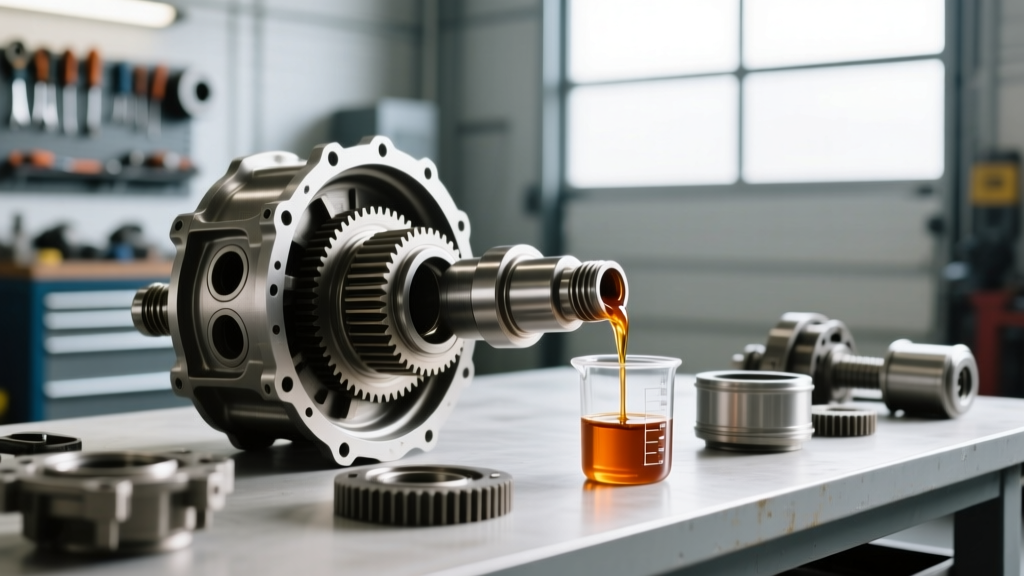
Before introducing new synthetic differential fluid, you must perform a forensic analysis of the drained oil. The condition of the fluid and the debris on the magnetic drain plug (if equipped) or the housing cover magnet will dictate whether your differential is serviceable or requires a teardown.
| Contaminant Found | Visual/Tactile Cue | Probable Mechanical Failure |
|---|---|---|
| Fine Glitter | Silver sheen in fluid, barely felt between fingers | Normal ring & pinion wear (especially during first 10k mile break-in) |
| Chunky Metal | Shards or flakes on magnetic plug | Pinion bearing cage failure or ring gear tooth spalling |
| Brass Flakes | Yellowish glint, non-magnetic | Spider gear thrust washer or carrier side bearing wear |
| Dark/Sludgy Oil | Burnt smell, highly viscous sludge | Severe overheating, conventional fluid oxidation, seal degradation |
The Role of Synthetic Differential Fluid in Troubleshooting
Conventional mineral-based gear oils suffer from rapid viscosity shear under the extreme hypoid sliding friction inherent to ring and pinion sets. Modern synthetic differential fluids utilize Polyalphaolefin (PAO) or Ester base stocks that maintain their 75W-90 or 75W-140 viscosity index even when pinion temperatures exceed 250°F (121°C) during heavy towing.
Expert Note: Torsen (helical gear) differentials, commonly found in modern performance SUVs and off-road trucks, do not use clutch packs. They require standard synthetic gear oil but must never be treated with friction modifiers, which can cause the helical gears to slip and fail to torque-bias correctly.
When troubleshooting thermal breakdown, switching to a synthetic formulation is the definitive fix for fluid-related whine caused by high-temperature thinning. Synthetic fluids contain advanced extreme pressure (EP) additives, typically sulfur-phosphorus compounds, that bond to the gear metal, preventing micro-welding and pitting under heavy load.
Step-by-Step Rear Differential Service Protocol
If your diagnostic points to fluid degradation rather than hard-part failure, follow this exact protocol to service the rear axle. Improper sealing or torque sequences are the leading causes of post-service leaks and bearing contamination.
- Preparation: Safely lift and support the vehicle. Ensure the axle is level to achieve an accurate fluid fill.
- Drain and Clean: Remove the differential cover bolts, leaving the top center bolt slightly loose to act as a hinge. Pry the cover gently to drain the fluid into a catch pan. Inspect the magnet.
- Surface Prep: Scrape the mating surfaces with a plastic gasket scraper. Clean both the axle housing and cover with brake cleaner. Do not use harsh abrasives that can leave debris in the housing.
- Sealing: If your axle uses a formed-in-place gasket, apply a continuous 1/8-inch bead of Permatex Ultra Black or The Right Stuff RTV silicone. Allow it to skin over for 10 minutes before mating. Alternatively, use a reusable elastomer gasket like the Lube-Locker.
- Torque Sequence: Reinstall the cover and hand-thread all bolts. Tighten in a crisscross star pattern to ensure even clamping force.
Common Axle Torque Specifications & Capacities
| Axle Model | Cover Bolt Torque | Fluid Capacity (Approx) | Recommended Viscosity |
|---|---|---|---|
| Ford 8.8-inch | 28 - 38 lb-ft | 2.5 - 3.0 Quarts | 75W-140 Synthetic (Towing) |
| GM 10-Bolt (8.5-inch) | 22 - 28 lb-ft | 2.0 - 2.5 Quarts | 75W-90 Synthetic |
| Dana 60 | 35 - 45 lb-ft | 3.5 - 4.0 Quarts | 75W-140 Synthetic |
| Chrysler 8.25-inch | 30 - 40 lb-ft | 2.2 Quarts | 75W-90 Synthetic |
When Fluid Will Not Save You: Hard Part Replacement
If your fluid analysis revealed chunky metal, or if the gear pattern inspection (using yellow marking compound) shows the contact patch running off the toe or heel of the gear teeth, synthetic differential fluid will not mask the problem. You are facing a rebuild.
A standard rear differential rebuild kit, such as a Dana Spicer or Yukon Gear master overhaul kit, includes new Timken or Koyo bearings, races, pinion shims, and crush sleeves. Expect to pay between $150 and $280 for a high-quality master kit. If the ring and pinion are pitted, a new gear set will add $200 to $400 to the parts cost. Labor for a professional setup, which requires dialing in the pinion depth and bearing preload to within thousandths of an inch, typically ranges from $400 to $800 depending on the shop rate and axle complexity.
Ultimately, rigorous adherence to 30,000-mile service intervals using top-tier synthetic differential fluid is the most cost-effective insurance policy against these catastrophic failures, especially for modern trucks tasked with heavy towing and off-road duties.