The Reality of P0846 in High-Output Drivetrains
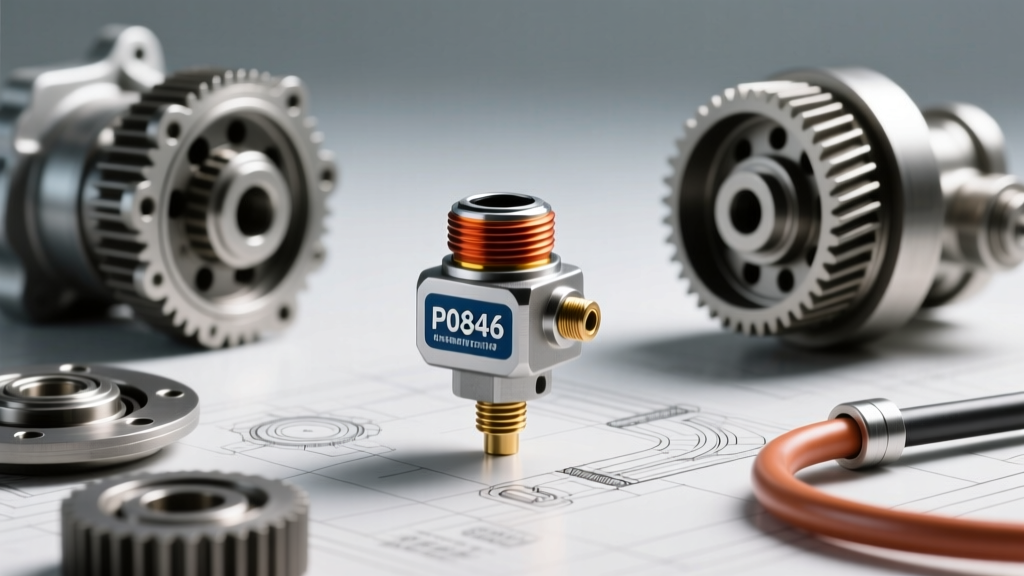
When pushing a vehicle beyond its factory output, the hydraulic integrity of the transmission becomes the ultimate bottleneck. Enthusiasts and tuners frequently encounter the transmission fluid pressure sensor switch p0846 diagnostic trouble code (DTC) after increasing boost, adding nitrous, or simply commanding firmer shifts via TCM tuning. Unlike a hard electrical failure (such as an open circuit), P0846 specifically denotes a 'Circuit Range/Performance' fault on the 'B' sensor circuit. This means the sensor is electrically functional, but the hydraulic pressure it reports fundamentally disagrees with the Transmission Control Module's (TCM) commanded line pressure or expected rationality model.
In performance applications, this code is rarely a simple case of a 'bad sensor.' It is usually the result of exceeding the OEM sensor's voltage scaling limits, degraded harness resistance skewing the 5V reference signal, or a TCM rationality table that is too restrictive for high-line-pressure shift schedules. This guide breaks down the exact diagnostics, heavy-duty part upgrades, and calibration strategies required to permanently eliminate P0846 and keep your drivetrain out of limp mode.
'A P0846 code on a built transmission is rarely a sensor failure; it is a calibration and hardware mismatch. The TCM is seeing a pressure spike that exceeds the OEM voltage curve, or a voltage drop caused by micro-chafing in the TEHCM harness. You must address the wiring and the tune before throwing parts at the valve body.'
— Drivetrain Calibration Engineering Consensus, 2025
Decoding 'Switch B': What the TCM is Actually Seeing
To properly upgrade the system, you must understand what 'Switch B' monitors. In popular performance platforms like the GM 6T40/6L80 and the Honda 5AT/6AT series, the transmission utilizes multiple pressure switches to verify clutch apply and line pressure. Switch 'A' typically monitors main line pressure or the 1st/3rd clutch feed, while Switch 'B' is dedicated to the 2nd/4th clutch feed or specific solenoid regulator circuits.
When the TCM commands a 1-2 or 3-4 shift, it pulses the corresponding pressure control (PC) solenoid. It then cross-references the commanded duty cycle against the physical feedback from the Switch B sensor. If you have increased the base line pressure via tuning to prevent clutch slip under high torque, the physical fluid pressure may hit 240 PSI. However, if the OEM sensor's internal diaphragm and voltage divider max out at 4.8V (representing 225 PSI), the TCM registers a rationality fault. The commanded pressure and actual reported pressure diverge, triggering P0846 and initiating immediate fail-safe (limp) mode.
Voltage-to-Pressure Mapping: The OEM Limitation
Understanding the 5-volt reference curve is critical for tuners using platforms like HP Tuners or EFI Live. Below is the standard GM/Honda TFPS (Transmission Fluid Pressure Sensor) scaling table. Notice how the upper limits compress, making high-pressure tuning highly susceptible to rationality faults.
| Sensor Voltage | Reported Pressure (PSI) | TCM State / Operational Context |
|---|---|---|
| 0.4V - 0.6V | 0 - 10 PSI | Key On, Engine Off (KOEO) / Fault Threshold |
| 1.1V - 1.3V | 45 - 55 PSI | Base Idle / Minimal Line Pressure |
| 2.4V - 2.6V | 110 - 125 PSI | Part-Throttle Cruising / Standard Shift |
| 3.8V - 4.0V | 180 - 195 PSI | Wide Open Throttle (WOT) Shift / Heavy Load |
| 4.7V - 4.9V | 230 - 250+ PSI | Maximum Line / P0846 Rationality Fault Zone |
OEM vs. Aftermarket: Selecting the Right Pressure Sensor
When replacing a degraded unit or upgrading for a high-horsepower build, part selection dictates your hydraulic reliability. While the aftermarket is flooded with cheap $15 replacements, these units frequently suffer from poor internal potting, leading to fluid intrusion and erratic voltage spikes when fluid temperatures exceed 220°F. For performance builds, stick to OEM or specialized heavy-duty calibrations.
Application-Specific Part Numbers & Pricing
- GM 6T40 / 6T45 (Cruze, Sonic, Equinox): The pressure switches are integrated into the TEHCM (Transmission Electro-Hydraulic Control Module) on later models, but standalone switch assemblies exist for earlier variants. OEM ACDelco Part #24236936 (Approx. $55 - $75). For high-HP builds, upgrading the entire TEHCM to an aftermarket calibrated unit (e.g., from Circle D or Yank) is often required to handle 250+ PSI line pressures.
- GM 6L80 / 6L90 (Silverado, Camaro, Corvette): The TFPS is mounted directly to the valve body. ACDelco Part #213-4677 / GM 24236936 (Approx. $60 - $85). Upgrading to a Sonnax reinforced line pressure regulator kit alongside a new OEM sensor is recommended for supercharged applications.
- Honda 5AT / 6AT (Accord, CR-V, Odyssey, J-Series Swaps): The 2nd Clutch Transmission Fluid Pressure Switch is an external, standalone unit. Honda OEM Part #28600-RAY-003 (Approx. $42 - $55). Do not use aftermarket equivalents for Honda applications; the TCM logic is hyper-sensitive to the exact resistance curve of the OEM Honda switch. Source directly from Honda Parts Now or a local dealer.
The Wiring Harness: Where 80% of P0846 Codes Originate
Before unbolting the transmission pan or dropping the valve body, you must audit the wiring. The 5V reference and signal return circuits are highly susceptible to electromagnetic interference (EMI) and physical chafing. On the GM 6T40, the internal harness routed through the TEHCM to the case connector is notorious for rubbing against the aluminum casting, creating micro-shorts that skew the signal return.
The Performance Wiring Upgrade Protocol:
- Inspect the Case Connector: Unplug the main transmission harness. Look for green crust (copper oxidation) or pushed-back pins. Clean with electrical contact cleaner and apply dielectric grease.
- Re-pin with PTFE Wiring: If you are running a standalone harness or repairing a chafed section, discard standard PVC-jacketed wire. Upgrade to 18 AWG PTFE (Teflon) jacketed wire. PTFE withstands transmission case temperatures of 250°F+ without melting or becoming brittle.
- Use Deutsch or OEM Sealed Connectors: Never use standard crimp butt-splices under the vehicle. Use solder-seal heat shrink connectors with an inner adhesive lining to prevent moisture wicking into the TCM.
Installation Protocol & Torque Specifications
Improper installation of pressure sensors and valve body components will induce immediate leaks or internal hydraulic cross-bleeds, guaranteeing a return of P0846 or worse. Always reference factory service data, such as the OBD-Codes P0846 Database and OEM service manuals, before wrenching.
Honda 5AT / 6AT External Switch Procedure
The Honda 2nd clutch switch is located on the front of the transmission case, near the bellhousing. It is relatively easy to access but requires precise sealing.
- Fluid Loss: Expect to lose roughly 0.5 quarts of Honda ATF DW-1. Top off via the dipstick tube post-installation.
- Crush Washer: You MUST use a new aluminum crush washer (Honda Part #90471-PX4-000). Reusing the old washer will result in a slow weep that attracts dirt and eventually shorts the sensor terminals.
- Torque Spec: Tighten the switch body to exactly 10 Nm (7.4 lb-ft). Over-torquing will crack the plastic sensor housing or strip the aluminum case threads.
GM 6L80 / 6T40 TEHCM & Valve Body Procedures
For GM units where the sensor is mounted to the valve body or integrated into the TEHCM, the procedure requires dropping the transmission pan and removing the valve body assembly.
- Fluid Capacity: A pan drop on the 6L80 yields roughly 6.0 quarts; the 6T40 yields about 4.5 quarts. Refill exclusively with Dexron VI or a validated high-performance synthetic equivalent (e.g., Amsoil Signature Series Fuel-Efficient Synthetic ATF).
- TEHCM Bolt Torque: The bolts securing the TEHCM to the valve body are incredibly sensitive. Torque to 8 Nm (71 lb-in) for the 6T40, and 10 Nm (89 lb-in) for the 6L80. Note: These are inch-pounds, not foot-pounds! Over-torquing will crack the TEHCM plastic, ruining the $400+ module.
- Sensor O-Rings: If replacing a standalone valve-body-mounted TFPS, lubricate the new Viton O-rings with a dab of Dexron VI fluid before seating. Never install them dry, as the aluminum bore will slice the O-ring during insertion, causing an immediate internal pressure leak.
TCM Calibration: Closing the Loop on Performance Builds
If you have verified the wiring is pristine and installed a brand-new OEM sensor, but P0846 still triggers during wide-open-throttle (WOT) pulls, your issue is purely in the TCM calibration. This is incredibly common in modified vehicles running ACDelco heavy-duty parts or aftermarket torque converters.
Tuning Adjustments for HP Tuners / EFI Live:
- Expand Rationality Windows: Navigate to the Transmission > Diagnostics > Pressure Sensor Rationality tables. The OEM tune might allow a maximum deviation of 15 PSI between commanded and actual pressure. In a high-line-pressure build, hydraulic overshoot during a WOT shift can easily exceed 20 PSI momentarily. Widen this rationality window to 25-30 PSI to account for hydraulic shock.
- Adjust Fault Delay Timers: Change the 'Time to Set DTC' for P0846 from the OEM 1.5 seconds to 3.0 or 4.0 seconds. This prevents the TCM from throwing the code during the transient pressure spike of a 1-2 shift, requiring the fault to be sustained and genuine before triggering limp mode.
- Verify Sensor Scaling: If you have physically installed an aftermarket 300 PSI or 500 PSI scaled sensor (common in dedicated drag racing transmissions using standalone controllers), you must flash the custom linear scaling table into the TCM. If the TCM still expects the OEM 250 PSI curve, it will read the higher voltage as a fault.
Summary: Protecting Your Drivetrain Investment
Ignoring a transmission fluid pressure sensor switch P0846 code is a fast track to burning up clutch packs. When the TCM detects this fault, it defaults to maximum line pressure and freezes shift adapts, resulting in brutal, tire-chirping shifts that can shatter driveline components, or it defaults to a low-pressure limp mode that will glaze your clutches in a matter of miles. By upgrading to OEM-spec sensors, utilizing PTFE wiring harnesses, adhering to strict inch-pound torque specifications, and properly widening your TCM rationality tables, you can reliably command the hydraulic pressure required to hold high horsepower without triggering the ECU's fail-safes.