Understanding P0713 and Transmission Limp Mode
When your dashboard illuminates with a check engine light and your vehicle suddenly refuses to shift past second or third gear, you are likely experiencing transmission limp mode. For many modern and legacy automatic transmissions, a primary culprit behind this failsafe state is a P0713 diagnostic trouble code. The OBD-Codes P0713 guide defines this as 'Transmission Fluid Temperature (TFT) Sensor A Circuit High.' Essentially, the Transmission Control Module (TCM) is seeing an open circuit or a voltage spike near the 5-volt reference maximum, indicating that the sensor is no longer providing valid thermal data.
Why Does a Bad TFT Sensor Trigger Limp Mode?
The TCM relies heavily on fluid temperature data to calculate precise shift points, torque converter clutch (TCC) lockup timing, and line pressure modulation. If the fluid is too cold, the TCM delays upshifts and prevents TCC lockup to promote engine and transmission warm-up. If the fluid is excessively hot, the TCM will command maximum line pressure and early upshifts to reduce thermal load. When a P0713 code sets, the TCM loses this critical data point. To protect the clutches from burning up due to incorrect line pressure, the TCM defaults to a fail-safe state: limp mode. In this mode, the transmission typically locks into a single gear (often 3rd or 4th), disables the torque converter clutch, and commands maximum mainline pressure, resulting in harsh shifts and severe drivability limitations.
Where is the P0713 Transmission Fluid Temperature Sensor Located?
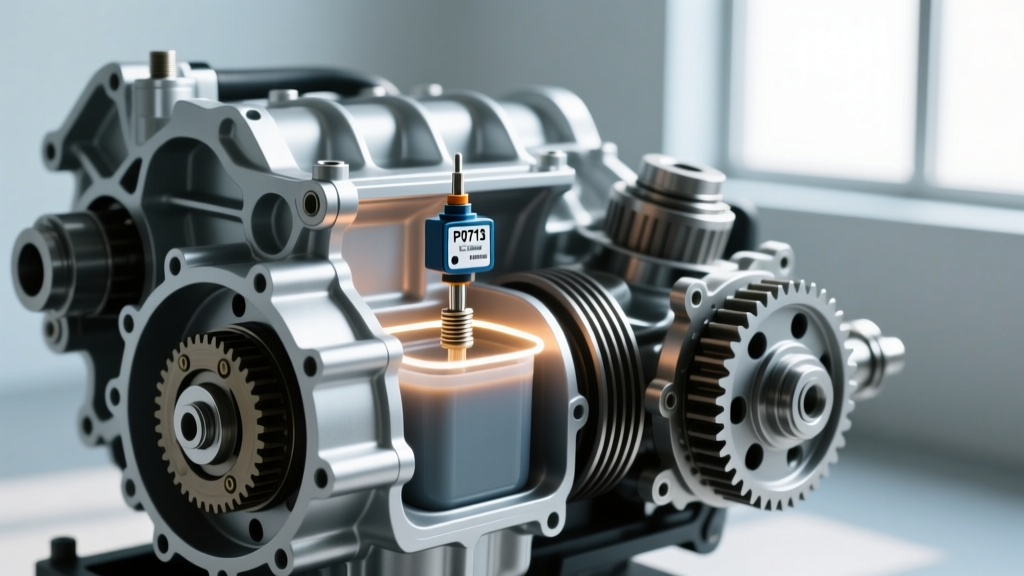
Finding the exact P0713 transmission fluid temperature sensor location depends entirely on your vehicle's transmission model. Unlike engine coolant sensors that are easily accessible on the engine block, the TFT sensor is almost always located internally, submerged in transmission fluid. Below is a breakdown of common transmission architectures and their specific TFT sensor configurations.
| Transmission Model | TFT Sensor Location | Replacement Strategy | Estimated Part Cost (2026) |
|---|---|---|---|
| GM 4L60E / 4L80E | Integrated into the internal wiring harness, bolted to the valve body. | Replace entire internal wire harness. | $45 - $85 |
| GM 6L80 / 6L90 | Integrated into the Transmission Control Module (TEHCM) assembly. | Replace TEHCM (requires programming). | $350 - $600 |
| Ford 6R80 | Integrated into the internal wiring harness and solenoid body. | Replace internal harness/solenoid block. | $120 - $210 |
| ZF 8HP (Chrysler/Dodge) | Embedded within the Mechatronic unit (valve body/TCM). | Replace entire Mechatronic assembly. | $1,200 - $2,200 |
As noted by transmission engineering analyses published via SAE International technical papers, the industry shift toward integrating the TFT sensor directly into the TCM or Mechatronic unit (as seen in the GM 6L80 and ZF 8HP) reduces wiring harness failure points but drastically increases the financial stakes of a P0713 diagnosis.
Essential Tools for P0713 Diagnosis
Diagnosing a transmission electrical fault requires more than a basic code reader. To properly trace a P0713 code and avoid throwing unnecessary parts at the vehicle, ensure your toolkit includes the following:
- Bi-Directional Scan Tool: Necessary to view live TFT PID data, command solenoids, and perform TCM adaptation resets (e.g., Autel MaxiSys or Snap-on Zeus).
- Digital Multimeter (DMM): Must have a high-impedance input (10 Megohms) to avoid damaging the TCM's internal 5V reference circuit during back-probing.
- Terminal Pin Kit & Back-Probes: Never pierce wire insulation with a T-pin; this invites moisture and future corrosion. Use proper back-probes to test connectors from the rear.
- Infrared Thermometer: Useful for verifying the actual transmission pan temperature to cross-reference against the scan tool's TFT PID data during initial diagnosis.
Step-by-Step Diagnosis: Multimeter Testing the TFT Circuit
Before dropping the transmission pan or ordering a $1,500 Mechatronic unit, you must verify the circuit. A P0713 code means 'Circuit High,' which almost always points to an open circuit, a broken wire, or a corroded connector rather than a failed internal thermistor. Follow this diagnostic sequence.
Step 1: Inspect the External Case Connector
The most common failure point for a P0713 code on GM 4L60E and Ford 6R80 transmissions is the external pass-through connector on the transmission case. Over time, vibration and thermal cycling cause the pins to back out or corrode.
- Action: Disconnect the main transmission harness plug at the case.
- Inspect: Look for green crust (copper oxidation) or pushed-back pins on the TFT circuit terminals.
- Fix: If corroded, use an electrical contact cleaner and a terminal pick tool to re-tension the pins. If the harness side is melted or severely corroded, a pigtail repair kit (e.g., ACDelco PT2255) is required, costing around $25.
Step 2: Resistance Testing the Sensor (Cold vs. Hot)
If the external connector is pristine, you must test the thermistor itself. The TFT sensor is a Negative Temperature Coefficient (NTC) thermistor, meaning its electrical resistance drops as the fluid temperature rises. You will need a digital multimeter (DMM) set to Ohms.
Access the TCM or PCM harness connector (refer to your specific vehicle's factory service manual for the exact pinout). Measure the resistance across the TFT signal and TFT ground pins.
| Fluid Temperature (Approx.) | Expected Resistance (Ohms) | Voltage Signal to TCM |
|---|---|---|
| 20°C (68°F) - Cold | 3,200 - 3,800 Ω | ~ 3.8V - 4.2V |
| 50°C (122°F) - Warm | 850 - 1,050 Ω | ~ 2.1V - 2.5V |
| 80°C (176°F) - Operating | 300 - 400 Ω | ~ 0.9V - 1.2V |
| 100°C (212°F) - Hot | 150 - 190 Ω | ~ 0.4V - 0.6V |
Diagnostic Verdict: If your multimeter reads 'OL' (Out of Limits) or infinite resistance, you have an open circuit. This confirms the internal wire harness is broken, or the sensor itself has failed internally, necessitating a teardown.
Step 3: Checking for 5V Reference and Ground
If the resistance test yields normal numbers but the P0713 code persists, the issue may lie in the wiring between the TCM and the transmission. With the key in the 'ON' position (engine off), back-probe the TCM connector.
- Verify you have exactly 5.0V (± 0.2V) on the reference wire.
- Verify you have a clean, low-resistance path to ground on the sensor return wire.
- If the 5V reference is missing, check for a short to ground elsewhere on the 5V reference bus, which may have caused the TCM to shut down the voltage regulator to protect itself.
Replacing the Internal TFT Sensor: Teardown and Torque Specs
If your testing confirms an internal failure on a serviceable transmission (like the GM 4L60E or Ford 6R80), you must replace the internal harness or solenoid block. Here is the professional procedure for a GM 4L60E internal harness replacement, a frequent repair in our shop.
- Drain and Disassemble: Remove the transmission pan and filter. Drain the fluid into a clean receptacle to check for clutch debris.
- Valve Body Removal: Disconnect the internal harness from the solenoids. Remove the valve body-to-case bolts. Torque Spec Note: When reinstalling the valve body, the 10mm bolts must be torqued to exactly 11 Nm (8 lb-ft). Over-torquing will warp the valve body casting, causing cross-leaks and harsh shifts.
- Swap the Harness: Unclip the old harness. Route the new harness (e.g., Dorman 645-502) exactly as the original. Ensure the TFT sensor bracket is securely bolted to the valve body.
- Pass-Through Seal: Replace the external case connector O-rings. A leaking pass-through connector will allow fluid to wick up into the main wiring harness via capillary action, eventually destroying the TCM.
- Reassembly: Install a new filter and pan gasket. Torque the pan bolts to 10 Nm (88 lb-in) in a crisscross pattern.
The ZF 8HP Exception: Mechatronic Replacement
For technicians and DIYers working on Chrysler, Dodge, or BMW vehicles equipped with the ZF 8HP transmission, the P0713 transmission fluid temperature sensor location is a point of major contention. The TFT sensor is permanently soldered onto the Mechatronic unit's internal circuit board. You cannot buy just the sensor from the OEM.
If you confirm a P0713 open circuit on a ZF 8HP, the entire Mechatronic unit (valve body and TCM combined) must be replaced. This part typically costs between $1,400 and $2,200 in 2026. Furthermore, the new unit requires proprietary security access and programming via a J2534 passthrough device or OEM scan tool to marry it to the vehicle's immobilizer system and calibrate the clutch adaptions.
Clearing Codes and Verifying the Repair
Once the hardware is replaced and the transmission is refilled with the correct OEM-specified fluid (e.g., Dexron ULV for GM 6-speed/8-speed, or ZF LifeguardFluid 8 for the 8HP), you must clear the TCM memory.
Start the engine and allow the vehicle to idle. Using a bi-directional scan tool, monitor the TFT PID (Parameter Identification). Compare the scan tool temperature reading to the ambient air temperature and engine coolant temperature. If the vehicle has been sitting overnight, all three sensors should read within 3°C (5°F) of each other. If the TFT PID immediately reads -40°C or 300°C, your repair was unsuccessful or the new component is defective.
Finally, perform a road test. The TCM requires a specific drive cycle to reset the limp mode flag and re-enable torque converter lockup. Drive the vehicle until the TFT reaches at least 60°C (140°F), then perform several light-throttle upshifts and downshifts. If the shifts are smooth and the check engine light remains off, your P0713 diagnosis is complete, and the transmission is safely out of limp mode.