The FS5R71B Transmission: Understanding the Nissan D21 Hardbody
The Nissan D21 Hardbody, produced from 1986 through 1997, remains one of the most reliable and utilitarian compact pickups ever built. At the heart of its drivetrain is the legendary FS5R71B 5-speed manual transmission. Known for its robust cast-iron case and aluminum top cover, this gearbox can easily surpass 300,000 miles. However, age, heavy towing, and neglected maintenance eventually take their toll. If you are experiencing gear pop-out, synchro crunching, or input shaft bearing whine, a teardown is imminent.
Tackling a Nissan D21 5 speed transmission rebuilding project in your home garage is highly feasible for a weekend mechanic with basic automotive experience and a comprehensive service manual. Unlike complex modern automatics like the ZF 8HP or the 6L80, the FS5R71B is a straightforward, mechanical, constant-mesh manual gearbox. In this 2026 buyer's guide and DIY comparison, we break down the costs, necessary rebuild kits, and critical technical specifications you need to restore your Hardbody to factory-shifting perfection.
Common FS5R71B Failure Points
Before ordering parts, it is vital to understand what typically fails in these units. Based on decades of fleet and enthusiast data, the FS5R71B exhibits three primary failure modes:
- 5th Gear Pop-Out: The 5th gear mainshaft locknut is notorious for backing off if not properly staked during previous services or from heavy engine braking. When it loosens, the 5th gear assembly wobbles, destroying the needle bearings and stripping the mainshaft splines.
- 2nd and 3rd Synchro Wear: The brass blocker rings wear down over time, leading to grinding during downshifts. This is often exacerbated by the use of incorrect GL-5 gear oils, which chemically attack the yellow metals.
- Input Shaft Bearing Whine: The front input shaft bearing (typically a 6206 or 6207 series) is subjected to high radial loads. When it fails, you will hear a distinct whine in neutral that disappears when the clutch is depressed.
2026 Cost Breakdown: DIY vs. Professional vs. Remanufactured
When deciding how to address your failing transmission, cost is usually the primary driver. Below is a comparison of the three main routes available to D21 owners in 2026.
| Option | Parts / Kit Cost | Labor Cost | Total Estimated Cost | Warranty |
|---|---|---|---|---|
| DIY Master Rebuild Kit | $280 - $450 | $0 (Your Time) | $280 - $450 | None (Parts only) |
| Professional Shop Rebuild | $350 - $500 | $900 - $1,400 | $1,250 - $1,900 | 12-24 Months |
| Remanufactured Unit (e.g., Jasper) | $1,600 - $2,100 | $400 - $700 (R&R) | $2,000 - $2,800 | 3 Years / 100k Miles |
Note: Pricing reflects 2026 market averages. Professional labor rates vary heavily by region. Always factor in the cost of a core deposit and new fluids.
Buyer's Guide: Selecting the Right Rebuild Kit
Not all rebuild kits are created equal. When shopping on platforms like RockAuto or specialized manual transmission retailers, you will encounter 'Master Bearing Kits' and 'Overhaul Kits'. Here is what to look for:
Bearing Quality Matters
Avoid no-name white-box bearing kits sourced from overseas marketplaces. The FS5R71B relies heavily on precise bearing preloads to maintain gear alignment. Insist on kits that utilize Timken, SKF, Koyo, or NTN bearings. A high-quality master kit will include the input shaft bearing, counter gear bearings, mainshaft rear bearing, and all necessary needle bearings for the gear journals.
OEM vs. Aftermarket Synchros
While aftermarket brass synchros are readily available, many veteran D21 mechanics recommend sourcing OEM Nissan blocker rings or high-end carbon-lined alternatives if your budget permits. OEM brass rings offer the most predictable friction coefficients for the factory shift detents. You will need six synchro rings total (one for each forward gear, plus two for the 2nd/3rd or 4th/5th hubs depending on the exact hub configuration of your model year).
DIY Nissan D21 5 Speed Transmission Rebuilding: Expert Tips
If you choose the DIY route to save money and gain intimate knowledge of your truck, adhere strictly to these technical procedures. For exact exploded diagrams and step-by-step teardown sequences, always cross-reference the NicoClub FSM Archive for your specific model year.
1. Teardown and Synchro Clearance Measurement
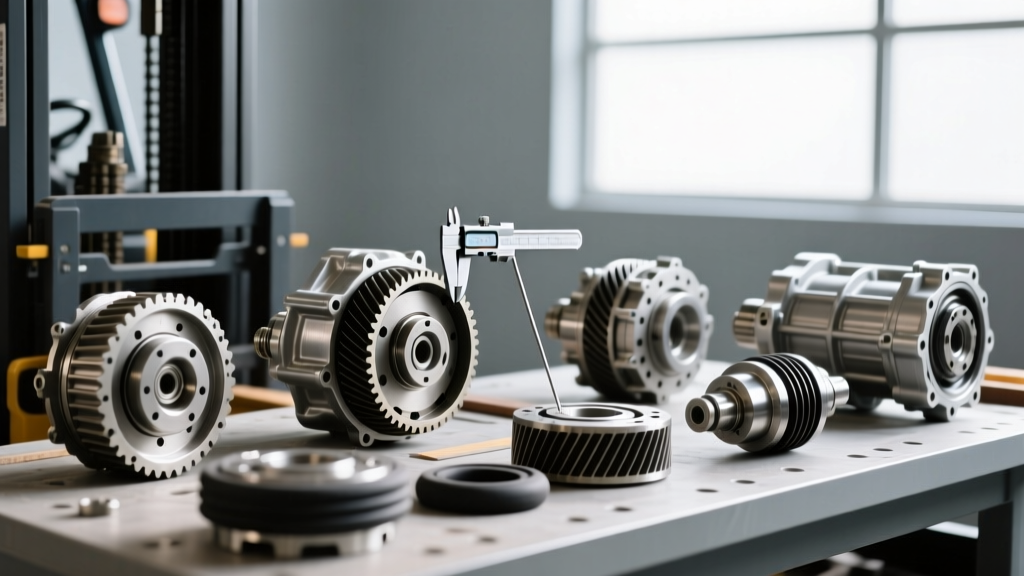
During disassembly, do not simply throw parts into a bin. Use a magnetic parts tray and label everything. When you remove the synchro hubs and sleeves, pay close attention to the blocker ring clearances.
Expert Spec: Push the synchro ring firmly against the gear cone and measure the gap with a feeler gauge. The standard factory clearance is 1.0 mm to 1.8 mm (0.040" - 0.070"). The absolute wear limit is 0.5 mm (0.020"). If the gap is smaller than 0.5mm, the synchro is bottoming out on the gear cone, causing the grinding you experience on the road. Replace all rings that fail this test.
2. The Infamous 5th Gear Mainshaft Nut
The 5th gear assembly is located outside the main transmission case, under the rear extension housing. This makes it a common point of failure. When reassembling the 5th gear mainshaft locknut, you must use a new nut.
Apply a high-strength threadlocker (like Loctite Red 271) to the threads before installation. The torque specification for the 5th gear mainshaft locknut is typically 101 ft-lbs (137 Nm). Once torqued, you must stake the collar of the nut into the groove on the mainshaft using a proper staking tool or a blunt cold chisel. Failure to stake this nut will result in 5th gear pop-out within 500 miles.
3. Counter Gear Bearing Preload and Snap Rings
The FS5R71B uses selective snap rings and thrust washers to set the endplay and preload on the counter gear and mainshaft. Do not assume the snap ring you removed during teardown is the correct one for reassembly; bearing tolerances vary slightly between new OEM and aftermarket bearings.
Mount the transmission case on a bench, install the counter gear assembly, and use a dial indicator to measure endplay. Nissan specifies an endplay of 0.004" to 0.010" (0.10 - 0.25 mm) for the counter gear. Select the appropriate thickness snap ring from your kit (usually ranging from 2.0mm to 2.4mm in 0.1mm increments) to achieve this spec. Guessing here will lead to either gear binding (too tight) or excessive case wear from gear slap (too loose).
The Fluid Debate: GL-4 vs. GL-5
One of the most critical decisions post-rebuild is fluid selection. The factory manual calls for API GL-4 gear oil (often Nissan Matic-D or a 75W-90 equivalent). Many DIYers mistakenly fill their rebuilt manual transmissions with GL-5 75W-90 because it is more readily available at local auto parts stores and labeled for 'hypoid differentials and manual transmissions'.
Do not use standard GL-5 in your FS5R71B. GL-5 gear oils contain high levels of sulfur-phosphorus extreme pressure (EP) additives. When heated, these sulfur compounds actively corrode and eat away at the soft yellow metals (bronze/brass) used in your brand-new synchro rings. Instead, opt for a dedicated GL-4 fluid like Red Line MT-90 or a modern synthetic GL-4/GL-5 compatible fluid that explicitly states it is 'yellow-metal safe'. The FS5R71B holds approximately 5.3 pints (2.5 liters) of fluid, so order three quarts to ensure you can fill it to the bottom of the fill plug threads.
Final Verdict: Is the DIY Route Worth It?
For the mechanically inclined D21 owner, a DIY Nissan D21 5 speed transmission rebuilding project offers immense satisfaction and significant financial savings. By investing $350 in a premium Timken/SKF bearing kit, OEM synchros, and the correct GL-4 fluid, you can restore the shift quality to better-than-new condition. However, if you lack a dial indicator, a bench vise, snap ring pliers, and a torque wrench capable of 100+ ft-lbs, the professional route remains a safer investment to guarantee longevity. Whichever path you choose, respecting the FS5R71B's specific clearances and assembly procedures will ensure your Hardbody stays on the road for decades to come.