The Synergy Between Range and Pressure Sensors in Mercedes AMG Builds
When pushing a Mercedes-Benz vehicle beyond its factory output—whether it is a tuned OM642 diesel, a supercharged M156 V8, or a highly modified M157 biturbo—the transmission becomes the ultimate bottleneck. While many enthusiasts focus on upgrading clutch packs or installing billet input shafts, the true nerve center of the 7G-Tronic (722.9) and 9G-Tronic (722.5) transmissions lies in the integrated conductor plate. This single component houses both the Mercedes transmission range sensor and the critical transmission fluid pressure sensor. In a performance application, the synergy between these two electronic components dictates whether your high-torque build launches cleanly or defaults into limp-home mode.
From a performance and upgrade perspective, understanding how the transmission control module (TCM) utilizes data from the fluid pressure sensor to modulate line pressure is paramount. If you increase engine torque by 30% but fail to address the hydraulic feedback loop, the TCM will detect clutch slip via the speed sensors and immediately pull timing or trigger a protective limp mode. This guide explores the technical depths of upgrading your transmission fluid pressure monitoring systems, recalibrating the range selector, and fortifying the 722.9 valve body for extreme duty cycles.
Why the 722.9 Conductor Plate is Your Performance Bottleneck
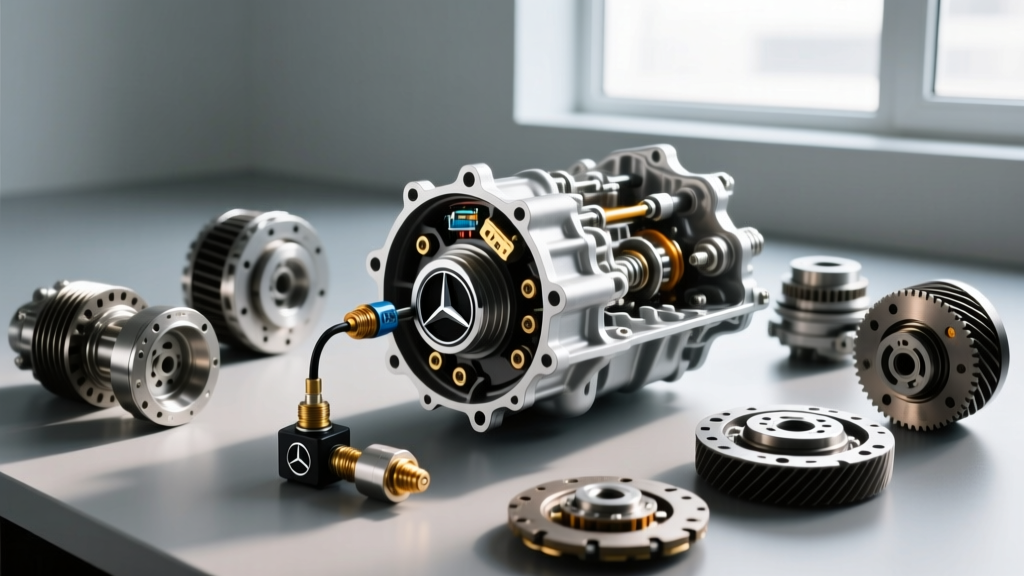
In the 722.9 transmission, Mercedes-Benz integrated the TCM directly onto the valve body inside the transmission pan. This conductor plate contains the microprocessors, the shift solenoids, the Mercedes transmission range sensor (often referred to as the Integrated Range Selector Module), and the transmission fluid pressure sensor. While this design reduces wiring harness complexity and improves signal latency, it creates a massive vulnerability in high-heat, high-pressure performance environments.
The stock transmission fluid pressure sensor is calibrated for a maximum hydraulic line pressure of approximately 18 to 20 bar (260-290 psi). When performance tuners increase the clamping force required to hold the B2 and K2 clutches during wide-open-throttle (WOT) shifts, the hydraulic system must exceed these baseline pressures. If the fluid pressure sensor maxes out its voltage feedback loop, the TCM loses its ability to accurately monitor and adjust the Electrohydraulic Pressure Control Solenoids (EDS). The result is erratic shift timing, harsh engagements, and eventual clutch glazing.
OEM vs. Performance Conductor Plate Specifications
Upgrading the conductor plate is not just about replacing a faulty sensor; it is about expanding the operational envelope of the entire hydraulic circuit. Below is a comparison of the baseline OEM setup versus a fully built performance configuration.
| Component / Metric | OEM 722.9 Conductor Plate | Revised OEM (Late Model) | Performance Upgraded Valve Body |
|---|---|---|---|
| Part Number Reference | A 220 270 26 21 | A 220 270 32 21 | Custom / Sonnax Zip-Kit Modified |
| Max Line Pressure Capacity | ~20 Bar (290 PSI) | ~22 Bar (319 PSI) | 28+ Bar (400+ PSI) |
| Pressure Sensor Diaphragm | Standard Polymer | Reinforced Polymer | Steel-Braided / High-PSI Alloy |
| Range Sensor Contacts | Hall-Effect (Prone to Heat Fade) | Improved Hall-Effect | Gold-Plated / High-Temp Ceramic |
| Estimated Cost (2026) | $450 - $550 | $600 - $750 | $1,800 - $2,500+ |
Upgrading the Transmission Fluid Pressure Sensor for High Line Pressure
For builds exceeding 600 lb-ft of torque at the crank, the transmission fluid pressure sensor must be upgraded or recalibrated to handle increased hydraulic demands. In the aftermarket performance space, companies like Sonnax offer line pressure booster kits and upgraded valve body components that physically increase the base hydraulic pressure. However, physical upgrades must be paired with electronic sensor compatibility.
When installing an upgraded valve body with heavy-duty pressure regulator springs, the fluid pressure sensor will read higher baseline voltages at idle and during gear engagement. If the TCM's internal maps are not flashed to accept this new voltage-to-pressure curve, it will throw a P0846 (Transmission Fluid Pressure Sensor/Switch B Circuit Range/Performance) code. To resolve this, performance tuning suites (such as those used by specialized Mercedes ECU/TCM calibrators) must rewrite the 'Pressure Sensor Characteristic Map' within the TCM. This ensures the computer understands that a 4.2V signal now represents 350 PSI of clamping force, rather than a sensor short-circuit.
Preventing Fluid Wicking and Sensor Failure
A notorious failure mode of the early 722.9 conductor plates is 'fluid wicking.' Transmission fluid migrates past the pressure sensor seals and travels through the microscopic gaps in the sensor housing, eventually reaching the main 13-pin electrical connector. Once ATF contaminates the TCM pins, it causes cross-talk between the Mercedes transmission range sensor circuits and the pressure sensor circuits. Upgrading to the revised A 220 270 32 21 plate features improved epoxy sealing around the pressure sensor diaphragm, but for extreme track use, applying a dielectric grease barrier and utilizing a sealed 13-pin adapter sleeve from FCP Euro is mandatory.
Range Sensor Calibration and SCN Coding Requirements
You cannot simply unbolt the conductor plate, swap the fluid pressure sensor, and bolt it back on. The Mercedes transmission range sensor (Y3/8n4) is physically integrated into this board. Any time the valve body is removed or replaced, the mechanical linkage between the manual valve and the range sensor is disturbed.
Upon reassembly, the TCM must undergo a rigorous 'Teach-In' process using the Mercedes-Benz XENTRY DAS diagnostic system. This process involves:
- SCN Coding: Verifying the software control module number matches the physical hardware revision of the new conductor plate.
- Range Selector Adaptation: Moving the shifter through the P-R-N-D gate while the XENTRY system records the exact Hall-effect voltage thresholds for each detent.
- Fill Pressure Adaptation: Commanding the fluid pressure sensor to monitor the 'touch point' of the forward and reverse clutches to establish baseline hydraulic fill volumes.
'Ignoring the XENTRY adaptation process after a pressure sensor or conductor plate upgrade is the number one reason high-horsepower Mercedes builds suffer from delayed reverse engagements and 2-3 shift flares. The TCM needs to physically feel the new hydraulic pressure limits.' — Master Mercedes-Benz Drivetrain Technician
Step-by-Step Installation & Torque Specifications
When performing a transmission fluid pressure sensor upgrade via a full conductor plate replacement, precision is non-negotiable. The 722.9 valve body is cast from a soft aluminum alloy that is highly susceptible to thread stripping and warping. Below are the critical factory torque specifications required for a performance rebuild.
- Transmission Oil Pan Bolts (M6): 4 Nm (35 in-lbs). Do not exceed; the pan gasket relies on even clamping force, not high torque.
- Valve Body to Transmission Case Bolts (M6): 8 Nm (71 in-lbs). Tighten in a crisscross pattern starting from the center to prevent warping the valve body casting.
- Torque Converter Drain Plug: 14 Nm (10 ft-lbs) with a new crush washer.
- 13-Pin Connector Sleeve Lock Nut: Hand-tighten, then secure with a 7mm hex socket to exactly 2 Nm to prevent cracking the ceramic guide ring.
Furthermore, fluid selection is critical when running elevated line pressures. The early 7G-Tronic requires MB 236.14 specification fluid. However, if you are upgrading to the late-model revised conductor plate and pushing higher hydraulic pressures, flushing the system and refilling with MB 236.15 (Shell ATF 134) or a high-performance equivalent like Liqui Moly Top Tec ATF 1600 provides superior shear stability and anti-foaming properties under extreme hydraulic stress.
Diagnostic Troubleshooting: Pressure vs. Range Codes
When tuning a Mercedes for performance, you will inevitably encounter diagnostic trouble codes (DTCs) as you push the boundaries of the factory programming. Differentiating between a failing Mercedes transmission range sensor and a maxed-out transmission fluid pressure sensor is vital for track-day troubleshooting.
P0705 (Transmission Range Sensor Circuit Malfunction): In a performance context, this rarely means the sensor itself is dead. Instead, it usually indicates that the TCM is seeing a voltage overlap between two gear positions due to a misadjusted shift linkage or excessive drivetrain movement under hard launch conditions tearing at the wiring harness.
P0846 & P0933 (Hydraulic Pressure Sensor Range/Performance): If these codes appear immediately after a WOT pull, your transmission fluid pressure sensor has hit its hardware voltage ceiling (typically 4.8V). The TCM commanded more pressure than the sensor can physically measure. The immediate fix is to install a high-PSI aftermarket sensor and flash the TCM's pressure limit maps via OBD-II.
Sourcing Parts and 2026 Pricing Realities
As we navigate the 2026 aftermarket landscape, the availability of standalone, high-PSI transmission fluid pressure sensors for the 722.9 remains limited due to Mercedes' integrated conductor plate design. Most performance shops opt to purchase a complete revised OEM conductor plate (approx. $650) and send it to a specialized transmission builder who solders in heavy-duty, motorsport-grade pressure transducers and reinforced range sensor Hall-effect chips. While this pushes the initial investment past the $1,200 mark, it is the only reliable method to ensure the TCM receives accurate hydraulic feedback when your engine is generating 800+ lb-ft of torque. For comprehensive OEM replacement parts and wiring adapters, Mercedes-Benz USA Owner Resources and specialized European parts distributors remain your most reliable sourcing channels.
Ultimately, treating the transmission fluid pressure sensor and the Mercedes transmission range sensor as an integrated performance system—rather than mere replacement wear items—is the hallmark of a truly optimized, high-horsepower Mercedes-Benz build.