The Hidden Financial Impact of Hill Parking
For automotive enthusiasts and daily commuters alike, the debate between manual and automatic transmissions often centers on driving dynamics, fuel efficiency, and initial purchase price. However, one of the most overlooked aspects of manual ownership is the long-term maintenance cost associated with improper parking habits. Specifically, understanding the mechanical and financial implications when parking downhill in a car with manual transmission is critical for preserving your drivetrain and avoiding catastrophic repair bills in 2026 and beyond.
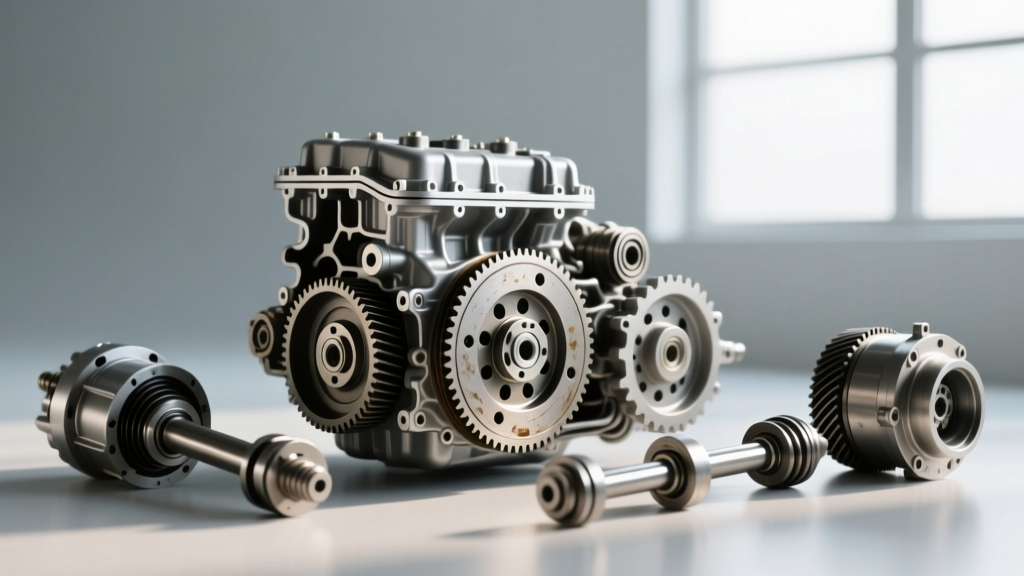
Unlike automatic transmissions that utilize a hardened steel parking pawl to lock the output shaft, manual transmissions rely on the engagement of the gear teeth, the synchronizer assemblies, and the engine's compression to hold the vehicle's weight. When executed incorrectly, this static loading can lead to accelerated wear on the clutch disc, transmission input shaft, and rear braking components. According to safety and maintenance guidelines outlined by the National Highway Traffic Safety Administration (NHTSA), improper parking procedures are a leading cause of unintended vehicle rollaways, which not only pose severe safety risks but also result in immediate, high-cost drivetrain shock damage.
The Physics of Static Drivetrain Loading
When you leave a manual vehicle in gear on an incline, the entire weight of the car is transferred through the tires, into the wheel hubs, through the axles, into the differential, and finally into the transmission's output shaft. From there, the load is distributed across the engaged gear set, the layshaft (in traditional longitudinal layouts), the input shaft, the clutch friction disc, and the flywheel.
If you are facing downhill, the natural rotational force of the vehicle wants to turn the transmission output shaft forward. Standard mechanical doctrine dictates that you should leave the vehicle in Reverse gear when facing downhill. Why? Because in most manual gearboxes, such as the Tremec T56 Magnum or the Mazda M5OD, the reverse gear ratio is numerically higher (e.g., 3.53:1) than first gear (e.g., 2.97:1). This higher numerical ratio provides greater mechanical resistance against the engine's compression. Furthermore, leaving the car in reverse means the engine would have to rotate backward to allow the car to roll, which is heavily resisted by the closed throttle body and intake vacuum.
However, if the parking brake is not engaged, this static torque is held entirely by the transmission's dog teeth and the clutch disc's torsional springs. Over months and years, this constant static load can cause micro-deformations in the gear teeth and premature fatigue in the clutch hub springs.
Component Wear & Repair Cost Breakdown
To understand the true cost analysis, we must look at the specific components that take the abuse when drivers rely solely on the transmission gears to hold a 3,500-pound vehicle on a 15-degree grade. Below is a 2026 market breakdown of repair costs associated with hill-parking wear and tear, compared to automatic transmission parking pawl failures.
| Component | Failure Mode from Hill Parking | Example Part Number | Part Cost (Est.) | Labor Time | Total Repair Cost |
|---|---|---|---|---|---|
| Clutch Disc (Torsional Springs) | Spring fatigue, hub rattle, premature slip | LUK 624318800 (Subaru WRX) | $450 (Kit) | 6.5 Hours | $1,425 |
| Transmission Dog Teeth | Shearing or rounding from roll-shock | OEM Synchro Assembly (Honda B-Series) | $185 | 12 Hours (Teardown) | $2,100 |
| Drum-in-Hat Parking Brake Shoes | Seizure/Rust from lack of use | ACDelco 171-1234 | $45 | 1.5 Hours | $270 |
| Auto Trans. Parking Pawl (Comparison) | Sheared pawl pin from rolling into gear | GM 24236933 (6L80) | $35 | 14 Hours (Trans R&R) | $2,350 |
As the data illustrates, while the manual transmission avoids the notorious $2,350+ parking pawl replacement cost inherent to automatics like the GM 6L80 or ZF 8HP (which requires complete transmission removal and teardown just to access the pawl pin), the manual is not immune to expensive failures. Shock-loading the transmission—caused when a car rolls slightly and slams against the engaged gear because the parking brake wasn't set—can round off the dog teeth on the main shaft, requiring a full transmission rebuild.
The Hidden Tax: Drum-in-Hat Parking Brake Neglect
The most significant maintenance cost associated with downhill parking in a manual car stems from driver negligence regarding the parking brake. Many manual drivers develop a habit of simply throwing the car into gear and turning off the ignition, bypassing the mechanical parking brake entirely. According to maintenance experts at Consumer Reports, skipping the parking brake leads to severe secondary issues.
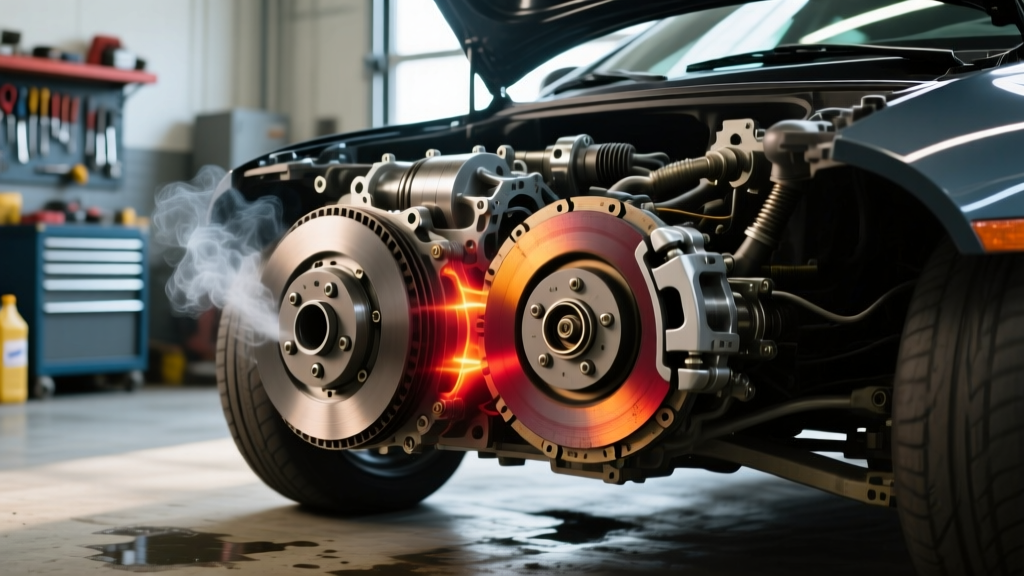
Most modern rear-disc-brake vehicles utilize a "drum-in-hat" design for the parking brake. Inside the center hat of the rear brake rotor, there is a small set of drum brake shoes. If the driver never pulls the lever or presses the pedal, these shoes accumulate rust, seize to the backing plate, and the actuator arms corrode in place. When an emergency eventually requires the parking brake to hold the car on a steep downhill grade, the mechanism fails.
Cost of Neglect: Replacing seized drum-in-hat hardware requires pressing off the rear wheel bearings (on many solid-axle or semi-trailing arm setups), replacing the backing plates, and installing new hardware kits. What should be a $45 brake shoe replacement turns into a $600+ axle-service job. To prevent this, the parking brake must be engaged every single time you park, which keeps the cables stretched and the shoes adjusted via the automatic star-wheel adjusters.
Clutch Torsional Spring Fatigue
Deep inside the clutch friction disc is a series of heavy-duty coil springs known as torsional dampers. Their job is to absorb the harmonic vibrations and shock loads from the engine's power pulses. When you park on a steep hill and let the car's weight rest against the clutch disc (by releasing the clutch pedal while in gear and without the parking brake), you are applying a continuous, static torque load to these springs.
Over thousands of parking cycles, these springs can lose their temper and sag. The resulting symptom is a distinct metallic rattle at idle that disappears when the clutch pedal is depressed. While this rattle is often misdiagnosed as a failing throw-out bearing or a dual-mass flywheel (DMF) failure, it is frequently the result of static hill-loading. Replacing a DMF and clutch kit on a vehicle like a Ford Mustang equipped with the MT-82 transmission can easily exceed $1,800 in parts and labor.
The Zero-Cost Protocol: Proper Downhill Parking
Eliminating these drivetrain and braking costs requires a specific, sequential parking procedure. This method transfers the vehicle's weight to the brakes, completely unloading the transmission and clutch before the engine is shut off.
- Come to a complete stop using the service brakes.
- Shift into Neutral and keep your foot firmly on the brake pedal.
- Engage the parking brake fully (pull the lever to the top detent or press the pedal to the floor).
- Release the service brake pedal. You will feel the car settle slightly; this is the weight of the vehicle transferring onto the parking brake shoes/pads.
- Turn the steering wheel so the front tires are angled toward the curb (if facing downhill).
- Press the clutch, shift into Reverse (to oppose the forward roll direction).
- Turn off the ignition and slowly release the clutch pedal.
By following this sequence, the transmission gears act only as a redundant safety backup. The static load is entirely managed by the brake system, which is designed to hold thousands of pounds of clamping force indefinitely without suffering mechanical fatigue.
Routine Maintenance Intervals and Fluid Costs
Proper parking habits must be paired with rigorous manual transmission maintenance to ensure longevity. The synchronizers and gear sets rely on a precise film of gear oil to prevent metal-on-metal wear. For 2026, adherence to OEM fluid specifications is non-negotiable.
- Fluid Selection: Never substitute standard GL-5 gear oil in a manual transmission that calls for GL-4 or specific Manual Transmission Fluid (MTF). GL-5 contains high levels of sulfur-phosphorus additives that can corrode yellow metals (brass/bronze) used in manual synchronizer rings. For example, Honda manuals require genuine Honda MTF, while many Tremec units require Dexron III ATF or specific Tremec fluid.
- Service Interval: Drain and fill the manual transmission every 30,000 to 60,000 miles. Fluid costs range from $15 to $25 per quart. A typical Subaru TY85 6-speed requires 3.9 liters of 75W-90 GL-5 (differential) and specific MTF for the gearbox.
- Torque Specifications: When performing a drain and fill, always use a torque wrench on the drain and fill plugs. Over-torquing can crack the aluminum transmission casing. For instance, the drain plug on a Ford MT-82 requires exactly 33 lb-ft, while the fill plug requires 33 lb-ft. The flywheel bolts, which endure the shock loads of improper parking, must be torqued to exact OEM specs (e.g., Honda K20 flywheel bolts require 76 lb-ft, while many Subaru applications require a torque-to-yield sequence of 59 lb-ft plus 90 degrees of rotation).
Conclusion
The financial advantages of a manual transmission are quickly erased by poor parking habits. When parking downhill in a car with manual transmission, the reliance on gear engagement without the proper use of the parking brake introduces static torque loads that degrade clutch components, fatigue synchronizers, and allow rear brake mechanisms to seize. By understanding the physics of your drivetrain, utilizing the proper load-transfer parking sequence, and adhering to strict fluid maintenance schedules, you can ensure your manual transmission outlasts the vehicle itself, saving thousands of dollars in avoidable mechanical repairs.