Electro-Hydraulic PTO Systems: A Technical Overview
Modern agricultural drivetrains, particularly those found in the John Deere 5R, 6R, and 7R series tractors, rely on sophisticated electro-hydraulic wet multi-disc clutches to engage the Power Take-Off (PTO). Unlike traditional mechanical dry clutches found in manual automotive transmissions, these PTO clutches operate completely submerged in transmission fluid. They utilize a Pulse Width Modulated (PWM) solenoid to meter hydraulic pressure, allowing for smooth engagement and precise slip control during high-inertia implement startups. However, this continuous slip-and-catch cycle generates immense thermal energy, making the PTO clutch pack one of the most heavily stressed wear components in the rear axle assembly. Recognizing the early wear signs and lifespan indicators is critical to avoiding catastrophic rear axle failure and knowing precisely when to schedule a John Deere PTO clutch repair.
Electronic Diagnostics: Reading the PWM Duty Cycle
Before unbolting the rear PTO housing or draining the hydraulic sump, a proper technical diagnosis requires interfacing with the tractor's Controller Area Network (CAN) bus. Using the John Deere Service Advisor (SA) software, technicians must monitor the PTO clutch solenoid's PWM duty cycle in real-time while the PTO is engaged under load.
In a healthy system, the duty cycle should stabilize between 45% and 65% once the clutch is fully locked and the implement is at operating speed. If the SA software indicates a duty cycle consistently exceeding 85% to maintain engagement, the transmission control unit (TCU) is actively compensating for mechanical wear. The TCU increases hydraulic pressure to squeeze the worn friction discs tighter, masking the physical degradation until the valve body reaches maximum pressure output. Once the solenoid maxes out its duty cycle, abrupt and severe slipping will occur, often accompanied by PTO-related diagnostic trouble codes (DTCs) such as PTO Clutch Solenoid Current Fault or PTO Speed Sensor Discrepancy.
Physical Wear Signs and Operational Symptoms
While software provides the first layer of diagnosis, physical symptoms manifest in distinct ways depending on the failure mode of the friction materials and separator plates.
1. High-Inertia Slipping and Thermal Fade
The most common indicator of advanced clutch wear is slipping under high-inertia loads. When engaging a heavy implement like a 15-foot rotary mower or a large round baler, a worn clutch pack will exhibit a 'soft' engagement. The engine RPM will rise, but the PTO shaft speed will lag, accompanied by a distinct burning odor emanating from the rear axle breather tube. This odor is the result of the John Deere Hy-Gard fluid flashing and degrading due to excessive localized heat on the friction surfaces.
2. Engagement Chatter and Glazed Friction Discs
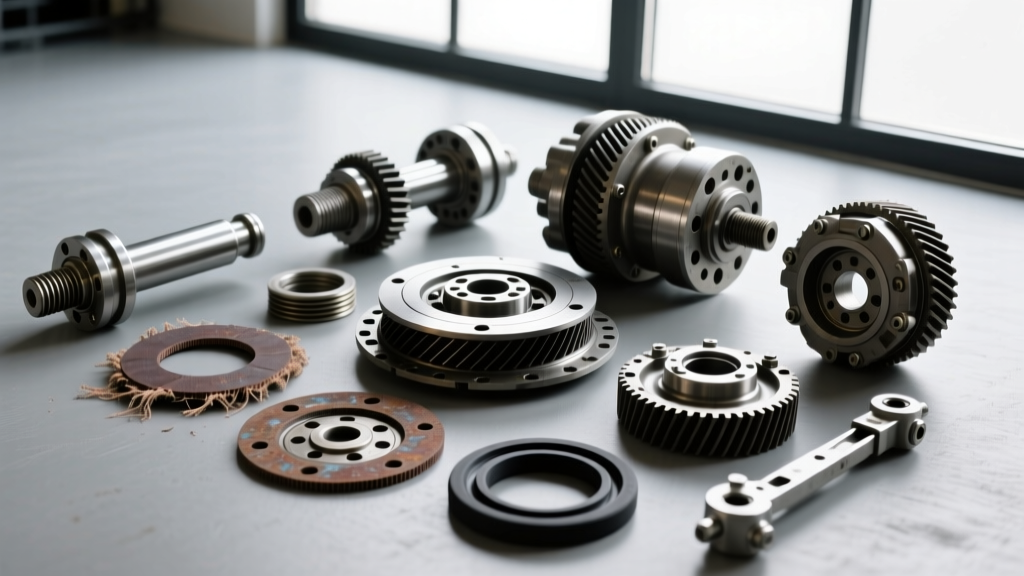
If the tractor exhibits a violent shudder or 'chatter' upon initial PTO engagement, the friction discs (often part number RE222651) have likely become glazed. Glazing occurs when the clutch is repeatedly 'feathered' or subjected to chronic low-pressure slip, melting the resin binders in the friction material and creating a hard, glass-like surface. Chatter can also indicate warped separator plates (RE215890), which no longer provide a flat clamping surface, causing the hydraulic piston to pulse as it attempts to seat the uneven discs.
3. Delayed Engagement and Solenoid Lag
A noticeable delay between flipping the PTO switch in the cab and the actual mechanical engagement of the shaft usually points to hydraulic starvation or solenoid spool scoring. Over time, microscopic friction material debris bypasses the filter and scores the delicate spool valve inside the PTO control manifold, causing internal hydraulic bypass and delayed pressure buildup.
Lifespan Indicators and Hourly Benchmarks
The lifespan of a John Deere PTO clutch is highly variable and depends heavily on operator habits, implement types, and fluid maintenance intervals. Below is a benchmark table detailing expected lifespans and critical wear thresholds across major John Deere tractor series.
| Tractor Series | Typical PTO Clutch Type | Expected Lifespan (Hours) | Critical Wear Threshold (Pack Clearance) |
|---|---|---|---|
| 5R Series (75-125 HP) | Standard Electro-Hydraulic Wet | 4,000 - 6,000 | > 2.0mm (0.079 in) |
| 6R Series (130-250 HP) | Heavy-Duty Wet Multi-Disc | 6,000 - 8,500 | > 2.5mm (0.098 in) |
| 7R / 8R Series (210-410 HP) | High-Capacity Wet Clutch | 8,000 - 12,000 | > 3.0mm (0.118 in) |
Note: Tractors utilized primarily for PTO-intensive tasks (e.g., silage harvesting, continuous baling) may reach critical wear thresholds up to 30% faster than those used primarily for draft pulling or loader work.
Teardown Specifications: Clearances, Torques, and Part Numbers
When diagnostic data and physical symptoms confirm the need for a John Deere PTO clutch repair, precise teardown and measurement protocols must be followed. The rear PTO housing must be removed, requiring the complete drainage of the rear axle and transmission sump.
Friction Plate Clearance and Measurement
Once the clutch pack is extracted, the total pack clearance must be measured using a dial indicator. A new OEM clutch pack kit (typically RE231385 for many 6R models) is designed to operate with a total clearance between 1.5mm and 2.0mm (0.060" - 0.079"). As the friction material wears, this clearance increases. If the measured clearance exceeds the critical thresholds listed in the table above, the hydraulic piston must travel further to engage the clutch, resulting in the delayed engagement and high PWM duty cycles mentioned earlier.
Crucial Torque Specifications
Reassembly requires strict adherence to John Deere's torque specifications to prevent catastrophic driveline separation or housing leaks:
- PTO Shaft Retaining Nut: 350 Nm (258 lb-ft) - Must be staked or secured with high-strength threadlocker depending on the exact shaft generation.
- PTO Clutch Piston Retaining Bolts: 25 Nm (18 lb-ft) - Apply medium-strength threadlocker (e.g., Loctite 243) to prevent backing out under high-frequency torsional vibration.
- Rear PTO Housing to Axle Housing Bolts: 110 Nm (81 lb-ft) - Apply a continuous bead of RTV silicone (John Deere TY22620 or equivalent) to the mating flange to prevent Hy-Gard leaks.
Expert Drivetrain Insight: Never reuse the PTO shaft O-rings or the housing gasket during a clutch repair. The O-rings (often part number RE19688) take a permanent compression set over thousands of hours. Reusing them guarantees a slow external hydraulic leak that will eventually draw air into the PTO clutch circuit, causing aeration, spongy engagement, and accelerated clutch burnout.
Fluid Chemistry and Contamination Factors
The friction modifiers present in John Deere Hy-Gard (J20D Low Viscosity or J20C Standard) are specifically engineered to interact with the cellulose and Kevlar-based friction materials used in their PTO clutches. Using an off-brand universal tractor transmission fluid (UTTO) that lacks the precise coefficient of friction required by John Deere's wet brake and clutch systems will result in immediate engagement chatter and a drastically reduced lifespan.
Furthermore, the clutch acts as a centrifuge. Heavy metallic debris from the rear axle planetary gears and worn friction resin tend to settle in the PTO clutch drum recesses. During a repair, the drum must be thoroughly flushed with clean solvent and blown out with compressed air. Failing to clean the drum recesses will result in immediate contamination of the new friction discs and the fresh hydraulic fluid upon startup.
Cost Analysis: Dealership vs. Independent Repair
Understanding the financial scope of a John Deere PTO clutch repair is essential for fleet managers and owner-operators. The cost varies significantly based on the repair avenue chosen:
- OEM Parts Cost: A complete OEM clutch pack kit (friction discs, separator plates, and seals) generally ranges from $450 to $850, depending on the tractor series. Add approximately $150 for a 5-gallon pail of J20D Hy-Gard fluid and $50 for filters and O-rings.
- Independent Mechanic / DIY: For a skilled operator with access to a service manual, torque wrenches, and a dial indicator, the total out-of-pocket cost remains under $1,100. However, the physical labor of splitting the rear axle or maneuvering the heavy PTO housing requires specialized lifting equipment.
- Authorized Dealership Repair: Dealership labor rates typically range from $140 to $180 per hour. Because the repair involves draining the entire rear axle, removing the PTO housing, and performing a software recalibration of the clutch engagement parameters via Service Advisor, expect a billed labor time of 8 to 12 hours. Total dealership invoices frequently land between $1,800 and $3,200.
Conclusion: Proactive Drivetrain Management
The PTO clutch is the vital mechanical bridge between the tractor's engine and the implement. By monitoring PWM duty cycles, respecting fluid change intervals with specification-compliant lubricants, and measuring pack clearances against strict OEM benchmarks, technicians can accurately predict failure before it leaves an operator stranded in the field. For deeper insights into wet clutch fluid dynamics and thermal degradation, refer to industry resources like Farm Progress and official John Deere technical service bulletins. Addressing wear signs early not only saves the clutch pack but protects the vastly more expensive rear axle and transmission components from collateral thermal damage.