The Baseline: Front-Wheel Drive System Operation
To accurately diagnose modern all-wheel and four-wheel drive systems, a technician must first possess a master-level understanding of baseline front-wheel drive system operation. In transverse-engine architectures, the transmission and differential are housed within a single transaxle casing. Power flows from the engine through the torque converter (or clutch pack in DCTs), into the planetary gearsets or parallel shafts, and finally through a helical-cut final drive gear set. This layout inherently packages the entire propulsion system over the front axle, optimizing interior space but creating unique diagnostic challenges when a rear-bias 4wd drivetrain is integrated into the platform.
According to engineering white papers published by SAE International, over 75% of modern unibody crossovers utilize a transverse front-wheel drive baseline. When drivers report drivetrain binding, vibration, or power loss, the fault is frequently misattributed to the rear differential or transfer case, when the root cause actually lies in the front transaxle's internal chain drive or half-shaft kinematics.
Half-Shaft Kinematics and CV Joint Dynamics
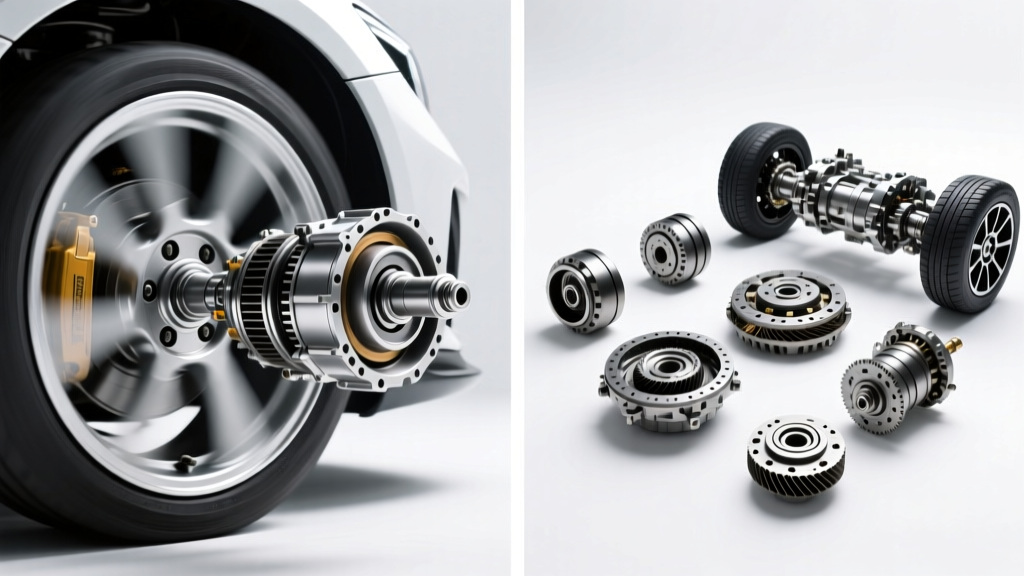
Front-wheel drive system operation relies heavily on constant velocity (CV) half-shafts to transfer torque while accommodating suspension travel and steering angles. The inner CV joint is typically a tripod (tulip) design, allowing for in-and-out plunge movement as the suspension compresses. The outer joint is a Rzeppa ball-type joint, engineered to handle extreme steering angles up to 47 degrees. Diagnosing vibrations requires isolating these specific kinematic behaviors. A worn inner tripod housing will manifest as a lateral shudder strictly under acceleration (load), whereas a failing outer Rzeppa cage will produce a rhythmic clicking noise during tight, low-speed steering maneuvers.
Bridging FWD to a 4WD Drivetrain Architecture
When manufacturers adapt a transverse FWD platform to support a 4wd drivetrain, they must extract torque from the front transaxle and route it rearward. This is achieved via three primary mechanisms:
- Power Transfer Units (PTU): Common in Ford and Lincoln transverse applications (e.g., Edge, Explorer). A gear-driven PTU bolts directly to the transaxle case, routing power through a rear driveshaft to a Rear Drive Module (RDM).
- Chain-Driven Transfer Cases: Utilized heavily by General Motors (e.g., the 6T70/6T75 transaxles in the Acadia and Traverse). An internal chain drives a secondary output shaft that exits the transaxle housing.
- Electro-Hydraulic Couplings (Haldex): Found in VW, Audi, and Volvo transverse platforms. A mechanical takeoff from the front differential drives a propshaft to a rear-mounted Haldex clutch pack, which variably engages the rear axle based on slip data.
Understanding these integration points is critical. A whining noise at 45 MPH in a Ford Edge is rarely a failing RDM; it is almost always the PTU suffering from severe fluid shearing and bearing starvation. Similarly, a 'dead' rear axle in a Volvo XC90 is frequently traced back to a clogged suction strainer in the Haldex Gen 5 pump, not a failure of the 4wd drivetrain clutches themselves.
Diagnostic Matrix: FWD vs. 4WD Drivetrain Symptoms
Use the following matrix to quickly isolate whether a symptom originates from the baseline front-wheel drive system operation or the added 4wd drivetrain components.
| Symptom Profile | FWD Baseline Culprit | 4WD Drivetrain Culprit | Diagnostic Verification Method |
|---|---|---|---|
| Binding on tight, low-speed turns | Incorrect front differential fluid / Limited Slip additive depletion | Haldex clutch pack contamination / PTU gear bind | Remove rear driveshaft or pull PTU/RDM fuse. If binding ceases, fault is rear-bias 4wd drivetrain. |
| High-frequency whine (200+ Hz) at highway speeds | Differential bearing wear / Helical gear lash error | PTU output shaft bearing failure / RDM pinion bearing wear | Use chassis ears. PTU whine correlates directly to front axle RPM, RDM whine correlates to driveshaft RPM. |
| Lateral shudder under heavy acceleration | Inner tripod CV joint housing wear / Engine mount collapse | Transfer case chain stretch (GM 6T70) | Inspect inner CV joint for pitting. Check transfer case fluid for metallic glitter indicating chain guide wear. |
| Delayed engagement into reverse | Transaxle low-reverse clutch pack failure | N/A (Rear modules typically do not affect reverse engagement timing) | Perform transaxle line pressure test and scan for TCM slip rate codes (e.g., P0736). |
Acoustic and Vibration Analysis Protocol
When troubleshooting front-wheel drive system operation alongside a 4wd drivetrain, NVH (Noise, Vibration, and Harshness) analysis is your most powerful tool. Driveline vibrations are categorized by their frequency order relative to wheel speed.
First-Order vs. Second-Order Vibrations
A first-order vibration occurs once per revolution of the component. In FWD operation, an out-of-balance front tire or a warped front brake rotor will produce a first-order vibration. However, if the vibration only occurs under load (acceleration) and disappears when coasting, the fault is almost certainly the inner CV joint or a transaxle differential side-gear issue. Second-order vibrations (twice per revolution) are rare in FWD half-shafts but common in the rear driveshaft of a 4wd drivetrain setup, typically pointing to a failing rear driveshaft center support bearing or improper pinion angle at the RDM.
Critical Torque Specifications and Fluid Data
Proper reassembly is vital to maintaining the integrity of both the FWD and 4wd drivetrain components. Below are factory-verified specifications for common transverse AWD/4WD platforms. Always verify with the specific OEM service manual, but these represent the industry standard baselines.
- GM 6T70/6T75 Transaxle (AWD):
- Front Axle Nut (36mm): 155 lb-ft + 60 degrees of rotation.
- Transfer Case Fluid: Dexron ULV. Capacity: ~0.5L (PTO section).
- Common Failure: Chain stretch causing slippage under high torque, throwing P0730 codes.
- Ford Edge/Explorer (3.5L V6 PTU):
- Front Axle Nut: 221 lb-ft.
- PTU Fluid: Motorcraft 75W-85 Synthetic. Capacity: Extremely low at ~11.8 oz (350ml).
- Common Failure: Fluid degradation due to proximity to the catalytic converter. If not serviced every 30,000 miles, the PTU bearings will fail, requiring a $2,200+ replacement.
- VW/Audi Haldex Gen 5 (Transverse AWD):
- Haldex Fluid: G055175A2 (or equivalent). Capacity: ~0.85L.
- Pump Strainer Maintenance: The Gen 5 system eliminated the accumulator, relying entirely on the pump. The suction strainer must be physically cleaned every 20,000 miles to prevent rear-axle disengagement.
Expert Troubleshooting Framework: The Coast-Down Test
To definitively separate a front-wheel drive system operation fault from a 4wd drivetrain fault, execute the Coast-Down Test. Accelerate the vehicle to 60 MPH on a flat, safe roadway. Shift into neutral and coast down to 30 MPH.
Diagnostic Rule of Thumb: If the vibration or whine persists while coasting in neutral, the fault is related to rotating mass (wheel bearings, tires, or differential bearings). If the noise or vibration completely vanishes the moment you lift off the throttle or shift to neutral, the fault is strictly load-bearing. In a FWD-based 4wd drivetrain, load-bearing faults point directly to the transaxle internal chain, the PTU helical gears, or the inner CV tripod joints.
Repair Economics and Decision Making
Understanding the financial implications of these repairs is essential for accurate customer consultation. Rebuilding a transverse transaxle to address internal FWD differential wear typically ranges from $2,800 to $3,500. Conversely, replacing a neglected Ford PTU costs between $1,800 and $2,400, while a Haldex Gen 5 pump replacement is relatively affordable at $450 to $650, provided the clutch pack hasn't been damaged by prolonged FWD-only operation.
For comprehensive technical service bulletins and fluid specifications, technicians should regularly consult Ford Motor Company Support and Haldex Traction Systems documentation. Mastering the nuances of front-wheel drive system operation is the only reliable pathway to accurately diagnosing the complex, multi-layered 4wd drivetrain architectures that dominate today's roads.