The Short Answer: Do Ford Escapes Have Transmission Problems?
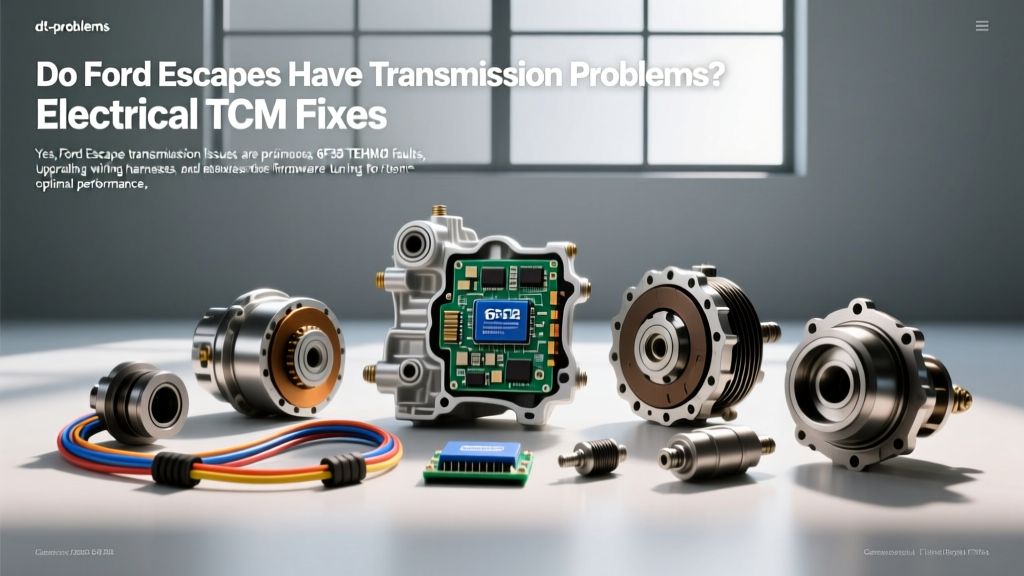
When shopping for a compact crossover or looking to extract more reliable performance from your current daily driver, a common question arises: do ford escapes have transmission problems? The short answer is yes, but the reality is far more nuanced than the catastrophic mechanical failures seen in other brands. For the Ford Escape—particularly models from 2013 to 2020 equipped with the ubiquitous 6F35 6-speed automatic, and the newer 8F35 8-speed—the vast majority of 'transmission failures' are actually electrical and electro-hydraulic in nature.
As of 2026, the aftermarket and performance tuning communities have developed robust solutions for these electrical gremlins. Rather than pulling the transmission and replacing hard parts, addressing the Transmission Electro-Hydraulic Control Module (TEHCM), upgrading the wiring harness, and optimizing solenoid duty cycles can restore your Escape to factory performance—and even improve its durability under aggressive driving conditions.
Why the 6F35 and 8F35 Suffer Electrical Gremlins
To understand the performance bottlenecks, we have to look at how Ford designs its modern transaxles. The 6F35 utilizes a TEHCM that mounts directly to the side of the transmission case, submerged in transmission fluid. While this eliminates the need for external wiring harnesses that pass through the transmission case (a common leak point), it exposes the printed circuit board (PCB), microprocessors, and solenoid driver chips to extreme thermal cycling and fluid-borne vibration.
The TEHCM Thermal Bottleneck
The TEHCM houses the Transmission Control Module (TCM) and the solenoid body. When the Escape is driven hard, or when towing near its 2,000 lb limit, transmission fluid temperatures can exceed 220°F (104°C). Over time, this heat degrades the solder joints on the TEHCM PCB, leading to intermittent communication drops. This triggers 'limp mode' and throws codes like P0753 (Shift Solenoid A Electrical) or P2701 (Intermediate Shaft Speed Sensor Circuit Range/Performance).
Wiring Harness Degradation
For the engine-to-TEHCM external wiring harness, Ford's OEM wire insulation becomes brittle after years of under-hood heat exposure. Micro-fractures in the copper strands cause resistance spikes. Because the TCM monitors solenoid resistance to verify circuit health, even a 0.5-ohm spike from a frayed wire will cause the TCM to abort a shift command, resulting in the notorious 'shift flare' or hard clunk that owners frequently misdiagnose as worn clutch packs.
Diagnostic Data: Pinpointing Electrical Faults
Before throwing parts at the vehicle, performance enthusiasts and master technicians use advanced OBD2 software like ForScan to monitor live PIDs (Parameter IDs). You must verify if the issue is a mechanical hydraulic leak or an electrical fault. Below are the factory electrical specifications for the 6F35 solenoids. If your multimeter readings deviate from these baselines, the TEHCM solenoid body requires replacement.
| Solenoid Type (6F35) | Function | Target Resistance (at 68°F / 20°C) | Common Failure DTC |
|---|---|---|---|
| Shift Solenoid A (SSA) | Controls Clutch Apply/Release | 2.0 - 4.0 Ohms | P0750, P0753 |
| Shift Solenoid B (SSB) | Controls Clutch Apply/Release | 2.0 - 4.0 Ohms | P0755, P0758 |
| Pressure Control Solenoid A (PCSA) | Regulates Main Line Pressure | 4.5 - 6.5 Ohms | P077A, P077B |
| Torque Converter Clutch (TCC) | Applies TCC for Lockup | 4.5 - 6.5 Ohms | P0741, P0743 |
| Transmission Fluid Temp Sensor | Provides Temp Data to TCM | ~2,200 Ohms (at 68°F) | P0711, P0712 |
Performance Upgrades to Eliminate Electrical Weak Points
If you are building an Escape for performance, towing, or simply want bulletproof reliability, you must upgrade the electro-hydraulic control systems. Here is how the aftermarket approaches the 6F35's electrical limitations in 2026.
1. Upgraded Solenoid Bodies and Zip Kits
While the OEM solenoid body (Part # DG9Z-7G234-A) is adequate for stock driving, performance builds benefit from addressing the hydraulic leaks that force the electrical solenoids to overwork. By installing a Sonnax Zip Kit or upgraded valve body sleeve, you seal hydraulic cross-leaks. This allows the TCM to command lower, more stable electrical duty cycles to the Pressure Control Solenoids, drastically reducing the heat generated by the solenoid driver chips inside the TEHCM.
2. High-Temp Wiring Harness Upgrades
Replace the brittle OEM engine-to-transmission harness with a custom-fabricated harness using 16 AWG TXL (cross-linked polyethylene) high-temperature wire and Deutsch-style sealed connectors. This upgrade drops circuit resistance by up to 15% compared to a 10-year-old OEM harness, ensuring the TCM receives pristine voltage signals for lightning-fast, crisp shifts.
3. TCM Tuning for Thermal Management
Using HP Tuners or ForScan, you can modify the TCM's thermal management strategy. From the factory, the Escape's TCM will not trigger the transmission cooler bypass until fluid reaches 190°F. By flashing a custom tune that forces cooler flow at 150°F and increases line pressure during 2-3 and 3-4 upshifts, you reduce clutch slip time. Less slip equals less heat, which directly extends the lifespan of the TEHCM's internal electronics.
Step-by-Step TEHCM Replacement & Calibration
If your diagnostics point to a fried TEHCM PCB, replacement is mandatory. However, the 6F35 TEHCM is a 'married' component. It contains the solenoid strategy data and the vehicle's immobilizer (PATS) information. Here is the professional upgrade and replacement protocol:
- Preparation: Disconnect the battery and remove the driver-side wheel and inner fender liner to access the side-mounted TEHCM.
- Removal: Unbolt the 10mm TEHCM retaining bolts. Torque Spec Note: These bolts are only torqued to 8 Nm (71 lb-in) from the factory. Do not overtighten during reassembly, or you will crack the aluminum case.
- Solenoid Strategy Backup: Before removing the old unit, use a Ford VCM II or compatible J2534 pass-through device to download the existing Solenoid Strategy ID. If the old TCM is completely dead, you must locate the strategy ID printed on the TEHCM sticker or download it from the Ford module delivery server using the VIN.
- Installation: Install the new TEHCM. Apply a thin bead of dielectric grease to the main harness connector to prevent moisture intrusion and terminal corrosion.
- Flashing & Adaptation: Flash the new TCM with the latest OEM calibration via NHTSA or Ford's official database, input the Solenoid Strategy ID, and perform a transmission adaptive learning drive cycle.
Cost Breakdown: OEM vs. Upgraded Electrical Repairs
Understanding the financial investment is critical for your performance build. Here is what you can expect to pay in 2026 for electrical diagnosis and upgrades:
- OEM TEHCM Replacement (Dealer): $1,200 - $1,600 (Includes part, labor, and proprietary IDS programming).
- Aftermarket Remanufactured TEHCM: $450 - $650 (Requires user to program the solenoid strategy via a J2534 tool).
- Custom High-Temp Wiring Harness: $150 - $250 (Materials and fabrication time).
- ForScan / HP Tuners TCM Calibration: $100 - $300 (Software licensing and dyno/tuning time).
- Sonnax Valve Body / Zip Kit Upgrade: $250 - $400 (Parts only, requires pan drop and valve body removal).
Final Verdict on Escape Transmission Reliability
So, do Ford Escapes have transmission problems? Yes, but they are largely confined to the electrical and electro-hydraulic control domains rather than catastrophic gear or hard-part failures. By treating the TEHCM and its associated wiring as a wear item, upgrading to high-temp materials, and utilizing custom TCM tuning to manage thermal loads, you can transform the 6F35 and 8F35 into incredibly robust, high-performing transaxles capable of handling aggressive driving and heavy utility use for well over 200,000 miles.