The Universal Physics of Gearing: From Baitcasters to Differentials
At first glance, a high-performance baitcasting reel and a heavy-duty automotive differential seem to occupy entirely different universes. However, the fundamental physics governing both are identical. When anglers and outdoor enthusiasts search for what does gear ratio mean fishing, they are typically trying to understand how many times the spool rotates per single turn of the handle. In the automotive world, we apply this exact same mathematical principle to determine how many times the driveshaft must rotate to turn the wheels a single time.
As a senior drivetrain specialist, I often use fishing reel mechanics to explain complex transmission and axle math to first-time off-road builders. Whether you are selecting a 7.5:1 Shimano Curado for flipping heavy cover or choosing a 4.10:1 ring and pinion for a Dana 60 axle, the underlying gear ratio formula remains the universal constant of mechanical advantage. This 2026 buyer's guide bridges the gap between these two worlds, breaking down the math, the formulas, and the hard specs you need to make an informed purchase.
The Core Gear Ratio Formula
Before diving into buyer specifications, we must establish the foundational math. The universal gear ratio formula is remarkably simple:
Gear Ratio = Number of Teeth on Driven Gear ÷ Number of Teeth on Drive Gear
In a fishing reel, the drive gear is attached to the handle, and the driven gear (or spool gear) turns the line. In an automotive differential, the drive gear is the pinion (attached to the driveshaft), and the driven gear is the ring gear (attached to the wheels).
- High Numeric Ratio (e.g., 5.38:1 axle or 8.1:1 reel): Massive torque multiplication and rapid retrieval, but lower top speed and higher engine RPM at highway speeds.
- Low Numeric Ratio (e.g., 3.08:1 axle or 5.1:1 reel): Lower torque multiplication, slower retrieval, but excellent high-speed efficiency and fuel economy.
Mathematical Comparison: IPT vs. Torque Multiplication
In the fishing world, buyers use Inches Per Turn (IPT) to understand real-world retrieval speed. The formula is: IPT = Spool Circumference × Gear Ratio. A 34mm (1.34-inch) spool on a 7.1:1 reel yields roughly 29.9 inches of line per handle crank.
In the automotive sector, we calculate Final Drive Torque Multiplication. The formula is: Transmission Gear Ratio × Axle Ratio = Final Drive Ratio. If you are pairing a ZF 8HP70 transmission (4.714:1 first gear) with a 4.10:1 Dana 60 axle, your final torque multiplication at the wheel hub in first gear is 19.32:1. This mathematical synthesis is critical for sizing tires and selecting the right drivetrain components for your 2026 build.
Side-by-Side Data: Reel Math vs. Axle Math
| Metric | High-Speed Baitcaster (e.g., Lew's) | Highway Automotive Axle (GM 8.5 inch) | Off-Road Automotive Axle (Dana 60) |
|---|---|---|---|
| Numeric Ratio | 8.1:1 | 3.08:1 | 5.38:1 |
| Drive Teeth | 11 (Pinion Gear) | 13 (Pinion Gear) | 9 (Pinion Gear) |
| Driven Teeth | 89 (Main Gear) | 40 (Ring Gear) | 48 (Ring Gear) |
| Primary Goal | Maximize retrieval speed | Minimize highway RPM | Maximize crawling torque |
| Trade-off | Low cranking power | Poor off-road performance | High highway RPM / Heat |
Buyer's Guide: Sourcing Automotive Ring and Pinion Sets
Understanding the math is only half the battle; sourcing the correct hardware and installing it to OEM tolerances is where the real expertise lies. If your mathematical calculations dictate a gear swap, here is what you need to know about purchasing and installing ring and pinion sets in the current market.
Part Numbers, Pricing, and Brand Selection
For heavy-duty applications like the Dana 60 or the GM 14-bolt, Yukon Gear & Axle and Motive Gear remain the industry standards. As of early 2026, expect the following pricing for premium forged sets:
- Dana 60, 5.38 Ratio: Yukon Part # YG D60-538. Average retail price: $345 - $380.
- GM 8.5 inch 10-Bolt, 4.10 Ratio: Motive Gear Part # GMS85-410. Average retail price: $230 - $260.
- Master Install Kits: Never reuse old bearings. A Timken master kit (Yukon Part # YK D60-F) includes shims, crush sleeves, pinion seals, and carrier bearings. Budget an additional $175 - $210.
Critical Installation Torque Specs and Tolerances
The mathematical precision of your gear ratio means nothing if the physical installation is flawed. A poorly set up ring and pinion will whine, overheat, and catastrophically fail within 500 miles. When installing a new setup, adhere strictly to these baseline torque specifications (always verify with your specific OEM service manual):
- Ring Gear Bolts (7/16'-20): 75 lb-ft. Must be applied with Loctite 242 (Blue) to prevent backing out under high-torque multiplication.
- Differential Bearing Cap Bolts: 110 lb-ft (Dana 60) / 70 lb-ft (GM 10-Bolt). Over-torquing can distort the bearing bores, ruining your gear pattern.
- Pinion Nut Torque (Crush Sleeve Method): 250 to 300 lb-ft. This massive torque is required to collapse the crush sleeve and achieve the correct pinion bearing preload (typically 15 to 25 inch-pounds of rotational drag).
- Backlash Specification: 0.006' to 0.010'. Measured at the ring gear's outer edge using a dial indicator. Backlash outside this window will result in improper tooth contact.
Matching Your Transmission to Your Axle Ratio
When planning a drivetrain overhaul, you must factor in your transmission's gear spread. Modern 8-speed and 10-speed automatics feature massive overdrive ratios, which changes the traditional axle-buying calculus.
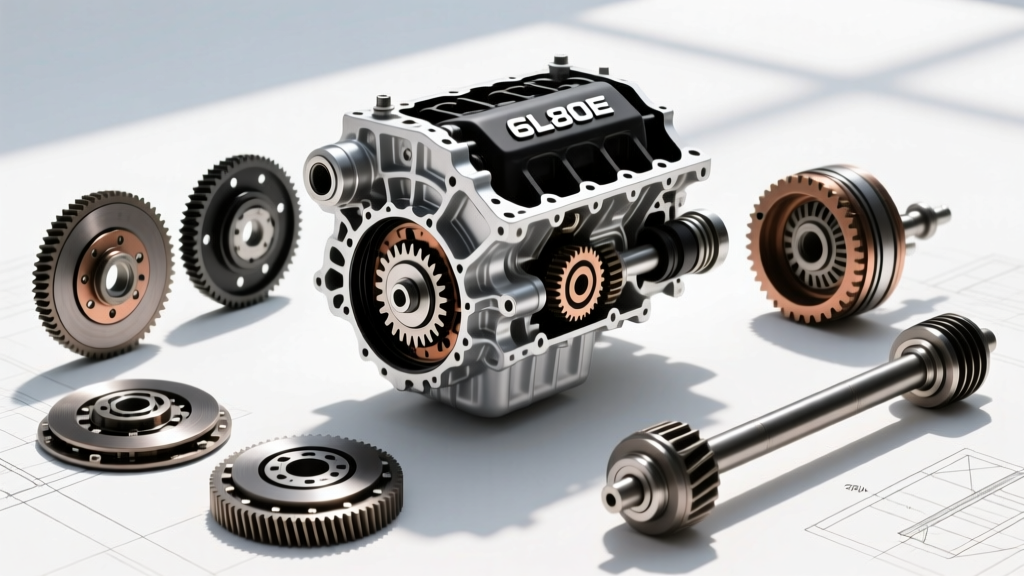
The ZF 8HP and GM 6L80 Factor
Take the ubiquitous ZF 8HP70 found in modern Rams and heavy-duty SUVs. Its 8th gear is a staggering 0.67:1 overdrive. If you install a deep 4.88:1 axle ratio for 38-inch off-road tires, your effective highway cruising ratio is 4.88 × 0.67 = 3.26:1. This keeps your RPMs manageable at 70 MPH while delivering monstrous low-end crawling ability.
Conversely, the older GM 6L80 transmission features a much shorter overdrive spread (0.67:1 in 6th, but a 4.027:1 first gear). If you pair a 6L80 with a 4.10 axle, your first gear final drive is 4.027 × 4.10 = 16.51:1. This is the mathematical sweet spot for daily-driven trucks running 33-inch to 35-inch tires, providing excellent off-the-line torque without requiring an immediate transfer case gear reduction.
Final Thoughts on Mechanical Advantage
Whether you are analyzing the retrieval speed of a baitcaster or calculating the final drive torque of a Dana 60, the gear ratio formula is the ultimate equalizer. By mastering the math behind driven and drive teeth, you can accurately predict vehicle behavior, optimize fuel economy, and select the exact aftermarket parts required for your build. Always invest in premium Timken bearings, adhere strictly to torque specs, and let the mathematics guide your drivetrain purchases.