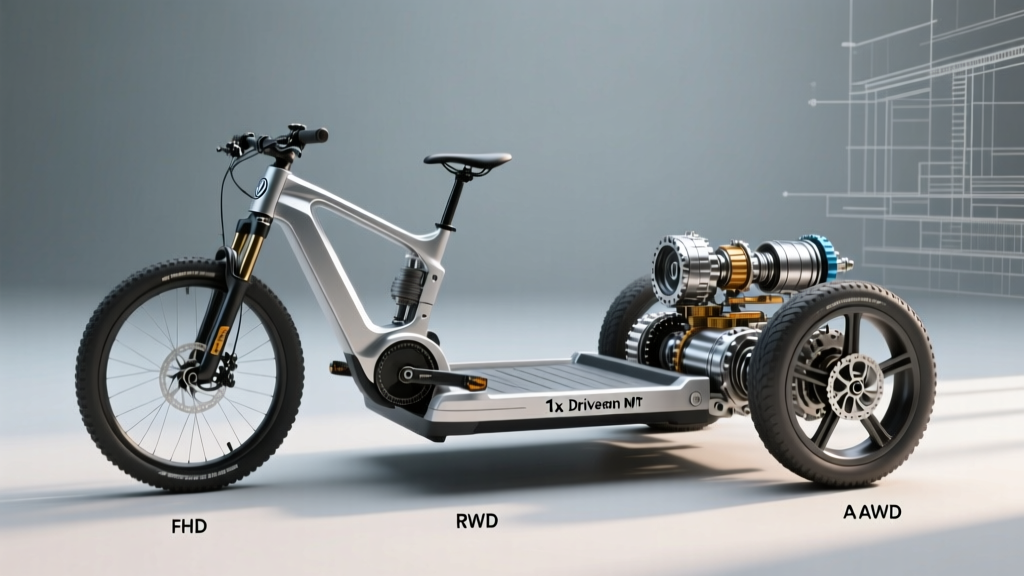
The transition from internal combustion engines to battery electric vehicles (BEVs) has fundamentally rewritten the rules of drivetrain configuration. Without the need to keep a narrow-band gas engine within a specific RPM power band, automotive engineers have largely abandoned multi-speed transmissions. Instead, they have embraced a philosophy that mirrors a well-known revolution in the cycling world: the 1x drivetrain MTB concept.
Just as the 1x drivetrain MTB setup eliminated the front derailleur and complex multi-chainring setups in favor of a single optimized front gear and a wide-range rear cassette, modern EVs utilize a single-speed reduction gear. This '1x' automotive approach prioritizes weight reduction, packaging efficiency, and the elimination of parasitic drivetrain losses. In this 2026 model-specific repair guide, we will compare FWD, RWD, and AWD layouts through this single-speed lens, with a deep-dive technical teardown of the Volkswagen MEB platform (ID.4) to provide actionable diagnostic and repair data for automotive technicians.
The Engineering Parallel: Why EVs Mirror the 1x Drivetrain MTB Philosophy
When mountain bike engineers developed the 1x drivetrain MTB standard, the goal was to shed weight, improve chain retention, and reduce mechanical failure points by relying on the wide torque curve of the rider paired with a massive rear cog range. In the EV sector, Permanent Magnet Synchronous Motors (PMSM) and Asynchronous Induction Motors (ASM) deliver maximum torque at 0 RPM and maintain a broad, flat power curve up to 15,000+ RPM.
Because the electric motor acts as both the powerplant and the 'wide-range cassette,' the automotive equivalent of the 1x setup is a single-ratio reduction gearbox (typically ranging from 9:1 to 11:1). According to SAE International technical papers on EV powertrain efficiency, eliminating a 2-speed transmission (like the rear axle setup found in the Porsche Taycan) saves roughly 15-20 kg of mass and reduces drivetrain parasitic losses by up to 4%. This single-speed '1x' architecture dictates how FWD, RWD, and AWD layouts are packaged and serviced.
FWD vs RWD vs AWD: Single-Speed Layout Comparison
While the single-speed reduction gear is universal across most modern BEVs, the physical placement of the motor and the driven wheels drastically alters vehicle dynamics, packaging, and repair complexity. Below is a technical comparison of the three primary layouts as of 2026.
| Layout | Reference Platform | Motor Type & Placement | Packaging & Dynamics | Repair Complexity |
|---|---|---|---|---|
| FWD | GM Ultium (Chevy Bolt/EUV) | Single PMSM, front-mounted, coaxial or parallel reduction. | Maximizes interior cabin space. Prone to torque steer and traction loss under hard acceleration. | Moderate. Requires dropping the front subframe; half-shafts endure high torque loads. |
| RWD | VW MEB (ID.4 RWD) | Single PMSM, rear-mounted, parallel-axis reduction gear. | Optimal weight distribution. Superior traction. Allows for tighter front steering angles. | High. Rear subframe drop required. High-voltage (HV) cables and cooling lines complicate extraction. |
| AWD | VW MEB (ID.4 AWD) / Tesla Model Y | Rear PMSM + Front ASM (Induction). Dual '1x' reduction units. | Maximum traction. Front ASM can freewheel (disconnect) to eliminate drag during cruising. | Very High. Two separate drive units, dual cooling circuits, and complex HV routing. |
Model-Specific Repair Guide: VW MEB Platform (ID.4)
To understand the real-world servicing of these '1x' EV drivetrains, we must look at specific hardware. The Volkswagen MEB platform powers the ID.4, ID.5, and Audi Q4 e-tron. For the 2024-2026 model years, VW transitioned from the APP310 rear drive unit (310 Nm of torque) to the significantly more powerful APP550 (550 Nm of torque). Both utilize a single-speed parallel-axis reduction gear, but the APP550 features an improved oil-cooling system and a more robust stator.
Fluid Specifications and Capacities
Unlike ICE vehicles where engine oil and transmission fluid are separate, the MEB rear drive unit uses a specialized fluid to cool the stator and lubricate the reduction gears and bearings.
- Fluid Specification: VW G 052 182 A2 (or the updated G 060 182 A2 for specific 2025+ APP550 variants). Never substitute with generic ATF or gear oil; the dielectric properties are critical for the internal stator cooling.
- APP310 Capacity: 3.1 Liters
- APP550 Capacity: 3.4 Liters (features an active oil scavenge pump)
- Front e-Axle (AWD ASM) Capacity: 2.8 Liters
Critical Torque Specifications
When performing half-shaft or drive unit replacement, adhering to EV-specific torque sequences is mandatory to prevent HV cable terminal fatigue and bearing misalignment.
- Rear Drive Axle Nut (M27x1.5): 200 Nm + 180° (Always use a new 12-point stretch nut; verify via ERWIN as 2026 APP550 hubs may require 220 Nm base torque).
- Drive Unit to Subframe Mounts: 90 Nm + 90°
- Half-Shaft to Drive Unit Flange (12-point M10): 70 Nm
- HV Cable Terminal to Drive Unit Inverter: 15 Nm (Critical: Over-torquing will crack the ceramic isolation board inside the inverter cap).
Diagnosing the '1x' Reduction Gear: NVH and Bearing Failures
Because there are no shifting clutches or bands to fail, the primary mechanical failure points in a single-speed EV drivetrain are the high-speed bearings and the helical cut reduction gears. As reported by InsideEVs in their long-term fleet analysis, high-frequency whine is the most common drivetrain complaint.
The Diagnostic Framework
When a customer reports a 'whining' or 'howling' noise, technicians must isolate the frequency to determine the culprit.
- Motor Bearing Whine (High kHz): If the noise scales linearly with motor RPM (up to 16,000 RPM) and sounds like a high-pitched dentist's drill, the PMSM rotor bearings are failing. This requires a complete drive unit replacement or specialized teardown, as the bearings are pressed onto the rotor shaft behind the inverter.
- Reduction Gear Whine (Mid kHz): If the noise is slightly lower in pitch and correlates to the wheel speed multiplied by the final drive ratio (e.g., 9.39:1), the helical gear mesh is wearing, or the fluid level is low, causing cavitation and micro-pitting on the gear teeth.
- Half-Shaft Spline Clunk: A metallic 'clunk' upon regenerative braking engagement usually indicates worn half-shaft splines where they mate to the drive unit flange. Repair Tip: Always apply a 2-gram bead of VW G 052 137 A2 spline grease during reassembly to prevent micro-corrosion and clunking.
AWD Front e-Axle: The Freewheel Clutch Advantage
In AWD configurations like the ID.4 AWD, the front motor is an Asynchronous Induction Motor (ASM). Unlike the rear PMSM, an ASM does not have permanent magnets. When the vehicle is cruising and front traction is not needed, the front inverter cuts power to the stator. The rotor simply freewheels inside the magnetic field, generating zero cogging torque and eliminating the parasitic drag that plagues traditional mechanical AWD systems.
However, from a repair standpoint, the front e-axle introduces a unique failure mode: the freewheel disconnect bearing. If the front drive unit is subjected to water ingress due to a compromised half-shaft seal, the internal bearings will spall. Because the front unit sits lower and closer to the leading edge of the subframe, it is highly susceptible to rock strikes and road debris. Technicians should inspect the front drive unit skid plate and lower seals at every 15,000-mile interval.
2026 Repair Costs and Parts Sourcing
As the EV market matures, the aftermarket for single-speed reduction gears is expanding, though OEM dealerships still hold a monopoly on complete drive unit assemblies.
2026 Estimated Repair Pricing (Parts & Labor):
- APP550 Rear Drive Unit (OEM Remanufactured): $4,800 - $6,200
- Front ASM e-Axle (AWD): $3,900 - $5,100
- Half-Shaft Assembly (Rear): $650 - $850 per side
- Reduction Gear Fluid Service (Drain & Fill): $180 - $250
According to the Volkswagen Newsroom, the modular nature of the MEB platform was designed to allow the APP310 and APP550 to share identical mounting points and half-shaft geometries. However, the internal inverter mapping and cooling pump connectors differ. Always verify the PR codes on the vehicle's build sticker before ordering a replacement '1x' drive unit.
Conclusion
The automotive industry's adoption of the single-speed reduction gear is a direct parallel to the 1x drivetrain MTB revolution: a triumph of simplicity, efficiency, and wide-band torque utilization over mechanical complexity. Whether you are diagnosing a high-frequency bearing whine on a RWD VW ID.4 or servicing the front freewheeling e-axle on an AWD variant, understanding the unique fluid requirements, torque specifications, and NVH characteristics of these '1x' layouts is essential for the modern drivetrain technician. As EV platforms continue to evolve through 2026, the single-speed paradigm remains the undisputed king of electric mobility.