The Paradigm Shift: From Friction Clutches to Hydrodynamic Coupling
In the early 2000s, continuously variable transmissions (CVTs) relied heavily on wet multi-plate start clutches to manage vehicle launch and low-speed creep. Platforms like the Audi Multitronic and early Honda CVTs utilized these friction-based clutches to connect the engine to the variator pulleys. However, as automotive engineering pushed toward higher torque capacities and smoother drivability, the industry underwent a massive shift. Today, the modern cvt transmission torque converter has almost entirely replaced the start clutch in mainstream passenger vehicles. Understanding the mechanical and diagnostic differences between these two launch devices is critical for drivetrain technicians and automotive engineers navigating the 2026 service landscape.
Core Architecture: Hydrodynamic Multiplication vs. Friction Coupling
To accurately diagnose drivability complaints, one must first understand the fundamental physics separating a torque converter from a start clutch.
The CVT Start Clutch (Legacy & DCT Applications)
A wet start clutch operates on direct friction. Hydraulic pressure clamps alternating friction and steel plates together, creating a rigid mechanical link. While efficient when fully locked, the slip phase (during vehicle launch) generates immense localized heat. In early CVTs, this heat required aggressive cooling circuits and often led to premature glazing of the friction material, resulting in the notorious 'start shudder'.
The Modern CVT Transmission Torque Converter
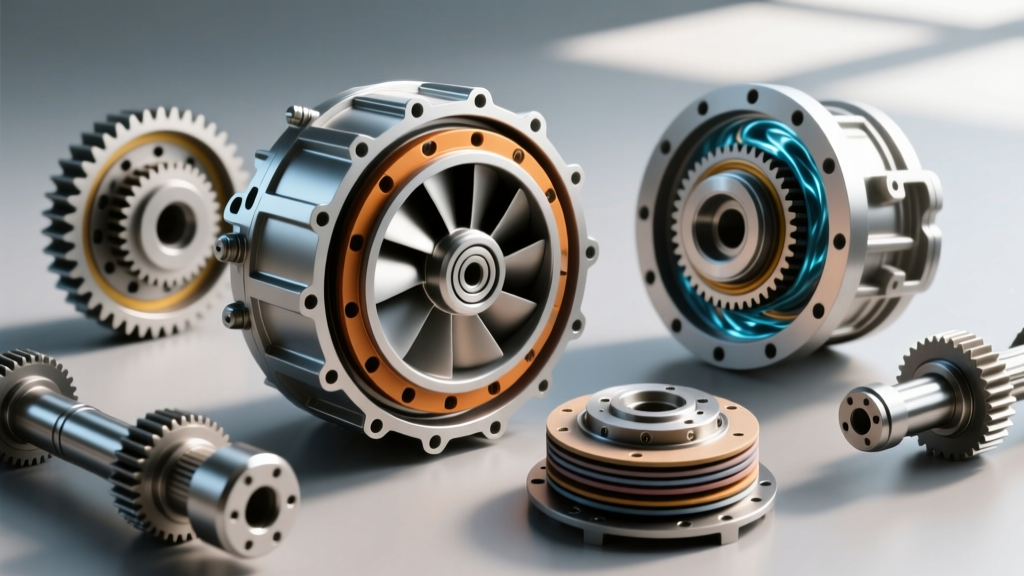
Modern CVTs, such as the Jatco CVT8 (JF016E/JF017E) and Subaru Lineartronic (TR690), utilize a scaled-down hydrodynamic torque converter. The impeller drives transmission fluid into the turbine, multiplying torque (typically at a 1.8:1 to 2.2:1 ratio) without physical contact. This eliminates the low-speed friction heat that plagued early start clutches. Furthermore, modern CVT torque converters feature an advanced Torque Converter Clutch (TCC) with 'flex-lockup' capabilities, allowing controlled micro-slip at speeds as low as 15 mph to expand the lockup range and maximize fuel economy.
'The transition from start clutches to torque converters in CVTs was not merely about durability; it was a thermal management necessity. Hydrodynamic coupling absorbs the kinetic energy of launch as fluid shear heat, which is vastly easier to dissipate via the transmission cooler than the localized surface heat of a slipping friction clutch.' — SAE International Technical Papers
Symptom Divergence: Diagnosing TC Shudder vs. Clutch Slip
Because the launch mechanisms differ fundamentally, their failure modes and resulting symptoms present uniquely on the road and via OBD-II telemetry.
| Feature | CVT Start Clutch Failure | CVT Torque Converter (TCC) Failure |
|---|---|---|
| Primary Symptom | Low-speed judder (0-15 mph), RPM flaring on launch, delayed engagement. | Mid-speed shudder (25-45 mph), feeling like 'rumble strips', TCC slip codes. |
| Thermal Signature | Rapid CVTF temperature spikes during stop-and-go traffic. | Gradual fluid degradation; localized hotspots on the TCC friction lining. |
| Diagnostic PID Focus | Start Clutch Pressure Command vs. Actual RPM (Slip > 150 RPM at launch). | TCC Slip RPM (Oscillating between -50 and +50 RPM during steady cruise). |
| Fluid Contamination | Heavy metallic debris and dark, burnt-smelling CVTF. | Glazed friction material; fine particulate suspension in fluid. |
Advanced Diagnostics: Reading the Telemetry
When a customer complains of 'shudder,' a technician must differentiate between a failing variator chain/pulleys, a degrading start clutch (on older models), or a failing TCC inside the CVT transmission torque converter. Using a bi-directional scan tool, monitor the TCC Slip Speed PID. During steady-state cruising (e.g., 40 mph in simulated 5th gear), the TCC should be fully applied, showing a slip speed of less than 20 RPM. If the PID oscillates wildly (e.g., -80 to +120 RPM) while the throttle position sensor (TPS) remains steady, the TCC friction material is failing to maintain hydrodynamic lock, or the apply valve in the valve body is suffering from bore wear.
Conversely, if diagnosing a legacy start clutch system (like a 2008 Honda Civic CVT), monitor the Start Clutch Pressure and Input Shaft Speed vs. Engine RPM. A healthy start clutch will show a smooth, linear convergence of engine and input shaft speeds. A failing clutch will show 'stair-step' convergence, indicating the clutch plates are grabbing and releasing due to uneven wear or contaminated hydraulic fluid.
Platform-Specific Engineering Realities
Jatco CVT8 (JF016E / JF017E) - Nissan & Chrysler
The Jatco CVT8 utilizes a compact torque converter (approx. 230mm diameter) to reduce rotational inertia. According to Jatco Global engineering documentation, the CVT8's TCC is designed to engage earlier than traditional automatics to offset the inherent efficiency losses of the belt-and-pulley variator. A common failure point is the degradation of the TCC friction lining, which contaminates the NS-3 CVTF. This debris migrates to the valve body's lockup control valve, causing secondary shudder even after a TC replacement if the valve body is not flushed or replaced.
Subaru Lineartronic (TR690) - High-Torque Applications
Subaru's TR690 CVT, found in the Ascent and WRX, pairs a high-capacity torque converter with a chain-driven variator to handle up to 300 lb-ft of torque. The Subaru Lineartronic system relies heavily on the torque converter's stator clutch to manage low-speed torque multiplication. Failure here doesn't just cause shudder; it results in a severe loss of low-end launch authority, often misdiagnosed as engine misfires or AWD transfer clutch binding.
Toyota Direct Shift-CVT (K120) - The Hybrid Approach
Toyota's K120 introduces a physical 'launch gear' alongside the torque converter. This system uses the mechanical gear for 0-20 mph launches, entirely bypassing the variator pulleys during high-stress acceleration, before seamlessly handing off to the belt drive. The torque converter in this system operates under vastly different thermal loads compared to a standard CVT, requiring specialized Toyota CVTF TC fluid to manage the unique lockup slip profiles.
Replacement Economics and Service Procedures
The financial and labor implications of replacing these components differ drastically due to their physical placement and integration.
- CVT Torque Converter Replacement (e.g., Nissan Altima 2.5L / JF016E):
- Part Cost: $550 - $850 (Remanufactured OEM-spec TC).
- Labor: 6.0 - 7.5 hours (Requires subframe drop and transaxle removal).
- Fluid: 8-10 Quarts Nissan NS-3 (~$120).
- Total Estimated: $1,400 - $2,100.
- Start Clutch Replacement (e.g., Early Honda CVT):
- Part Cost: $200 - $350 (Clutch pack kit).
- Labor: 12.0 - 16.0 hours (Requires full transmission teardown on a bench, or complete unit replacement).
- Total Estimated: $2,500+ (Often exceeds vehicle value, leading to scrap-yard transmission swaps).
Summary Framework for Drivetrain Technicians
The evolution from the wet start clutch to the modern cvt transmission torque converter represents a triumph of thermal management and drivability engineering. While start clutches offered direct mechanical coupling, their inability to handle modern torque loads and low-speed heat generation led to their obsolescence. For today's technician, recognizing the distinct telemetry signatures of TCC micro-slip failures versus legacy clutch judder is paramount. Always pair a torque converter replacement with a rigorous valve body inspection and a dual-cycle fluid flush to ensure the microscopic friction debris does not compromise the new hydrodynamic unit.