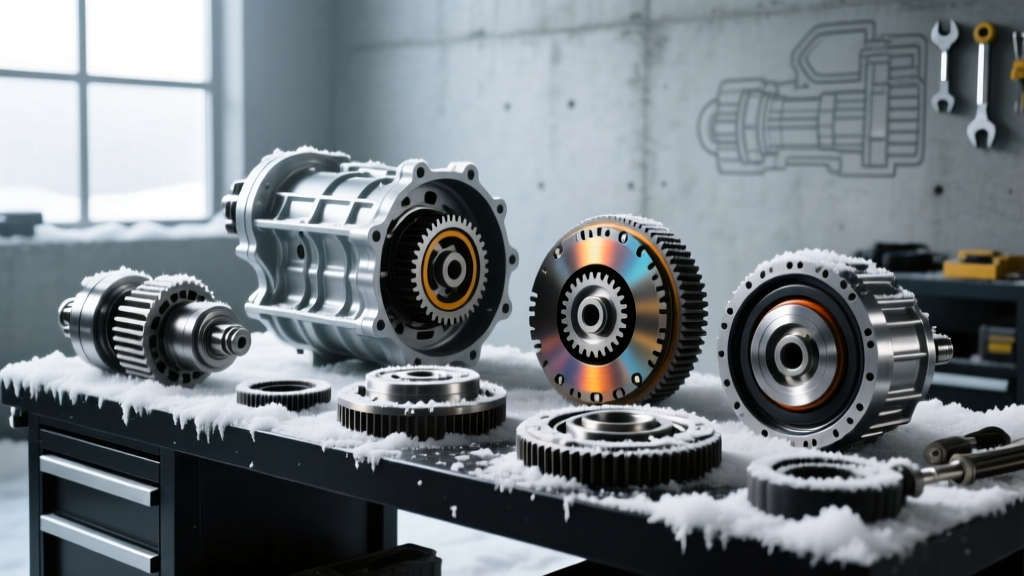
Winter weather introduces a unique set of variables to automotive drivetrains. When drivers and technicians try to determine what can cause transmission problems exclusively during sub-freezing morning commutes, the diagnostic path diverges significantly from standard wear-and-tear troubleshooting. Cold temperatures alter fluid rheology, cause microscopic contractions in sealing surfaces, and trigger thermal management faults that remain completely dormant once the powertrain reaches operating temperature.
As of 2026, the industry-wide shift toward Ultra-Low Viscosity (ULV) fluids and complex thermal bypass systems has made cold-weather diagnosis more nuanced than ever. This step-by-step guide will walk you through the physics of cold Automatic Transmission Fluid (ATF), provide a structured diagnostic protocol, and detail model-specific failure modes with exact part numbers and torque specifications.
Phase 1: Understanding Cold ATF Rheology and Thermal Dynamics
Before turning a wrench, it is critical to understand how temperature affects hydraulic pressure and clutch apply rates. Modern transmissions rely on highly engineered synthetic fluids like ACDelco Dexron ULV, ZF LifeguardFluid 8, and Toyota WS. These fluids are designed with specific viscosity indexes (VI) and pour points.
- Viscosity Index (VI): Dictates how much the fluid's thickness changes with temperature. A high VI fluid resists thinning at high heat but remains fluid enough to flow at -20°F.
- Pour Point: The lowest temperature at which the fluid will still flow under gravity. If ambient temperatures approach the pour point, the pump will cavitate, leading to immediate clutch starvation and burnt friction materials.
- Thermal Contraction: Aluminum valve bodies and steel solenoid plungers expand and contract at different rates. In extreme cold, clearances tighten, causing valves to stick in their bores until the fluid warms and acts as a thermal transfer medium.
Phase 2: Step-by-Step Cold Weather Diagnostic Protocol
Follow this sequence to isolate the root cause of cold-start shift delays, harsh engagements, or torque converter clutch (TCC) shudder.
Step 1: Verify Fluid Level Using Cold vs. Hot Protocols
A common mistake is checking fluid level when the transmission is cold using the 'HOT' dipstick markings, or vice versa. For example, the GM 6L80 and 8L90 transmissions require the fluid to be between 86°F and 122°F (30°C - 50°C) for an accurate level check via the bottom fill plug. If the fluid is overfilled, cold fluid expansion will cause it to aerate through the vent tube, leading to spongy shifts and line pressure drops. If underfilled, the pickup tube will suck air when the fluid contracts in the cold.
Step 2: Test the Thermal Bypass Valve
Many modern transmissions, including the GM 6L80, 8L90, and Ford 10R80, utilize a thermal bypass valve in the cooler lines. This wax-element valve restricts flow to the radiator cooler when the ATF is cold, allowing the transmission to warm up faster and reduce emissions. If this valve sticks in the 'open' position due to degraded wax or debris, the transmission may never reach optimal operating temperature in winter, resulting in delayed shift schedules and poor fuel economy. Conversely, if it sticks 'closed', line pressure will spike dangerously high during cold starts, causing harsh, bone-jarring engagements.
Step 3: Scan Tool Data PID Monitoring
Connect a bi-directional scan tool and monitor the Transmission Fluid Temperature (TFT) sensor PID alongside the Engine Coolant Temperature (ECT).
- If the TFT reads -40°F but the ambient temperature is 20°F, you have an open circuit in the thermistor or internal wiring harness.
- If the TFT rises unusually fast or fails to correlate with ambient cold-soak times, suspect a failed internal thermostat or a shorted sensor skewing the Transmission Control Module's (TCM) shift mapping.
Phase 3: Model-Specific Cold Weather Failure Matrix
Different transmission architectures exhibit distinct failure modes when exposed to freezing temperatures. Refer to the matrix below for targeted diagnostics based on the unit you are servicing.
| Transmission Model | Cold Weather Symptom | Root Cause | Corrective Action / Part Reference |
|---|---|---|---|
| GM 6L80 / 6L90 | Delayed Reverse/Forward engagement below 35°F | Thermal Bypass Valve stuck open; fluid never pressurizes correctly in cold | Replace Bypass Valve (Sonnax 15741-08K or GM 24236933) |
| ZF 8HP (45/55/70) | Harsh 2-1 downshift or flare when cold | Mechatronic sealing sleeve shrinks in cold, leaking line pressure | Replace Sealing Sleeve (Sonnax 95112-01K or ZF 24117624192) |
| GM 8L90 | TCC Shudder during light throttle below 40°F | Fluid degradation or incorrect fluid viscosity (requires Dexron ULV) | Double-flush with ACDelco Dexron ULV (19355656) |
| Ford 6R80 | Loss of 3rd and 5th gear on cold starts | Molded lead frame micro-cracks contract and open in freezing temps | Replace Molded Lead Frame (Ford DG1Z-7C011-A) |
Phase 4: Execution - Flushing, Filling, and Torque Specifications
Once the diagnosis points to fluid degradation, a failing thermal management component, or a sealing issue, proper execution is vital. According to the Automatic Transmission Rebuilders Association (ATRA), improper refill procedures and incorrect torque specs are leading causes of comeback complaints after winter service.
Fluid Selection and Pricing (2026 Market Rates)
Never substitute fluid chemistry to save money, especially in cold climates. Using standard Dexron VI in an 8L90 or 10-speed that requires ULV will result in immediate cold-weather shudder due to the higher friction modifiers and viscosity profile of the older fluid.
- ZF LifeguardFluid 8: Typically $35 - $45 per quart. Required for all ZF 8HP applications. Do not use generic 'multi-vehicle' ATF.
- ACDelco Dexron ULV: Typically $12 - $16 per quart. Strictly required for GM 8L90 and 10L90 applications.
- Motorcraft MERCON ULV: Typically $14 - $18 per quart. Required for Ford 10R80/10R60 units.
Critical Torque Specs for Cold-Weather Pan Services
When dropping the pan to replace a filter or mechatronic sleeve, remember that cold metal contracts. If you torque pan bolts to standard room-temperature specs while the transmission casing is freezing cold in an unheated bay, the bolts will stretch or strip the aluminum threads once the unit heats up and expands.
Expert Tip: Always allow the transmission casing to reach at least 60°F (15°C) before performing final torque on pan bolts and valve body fasteners. Use a calibrated inch-pound torque wrench.
- GM 6L80/8L90 Stamped Steel Pan: 8 Nm (71 lb-in) for M6 bolts. Do not overtighten, or the gasket will bunch and leak when the fluid thins out at operating temp.
- ZF 8HP Plastic Pan: 10 Nm (89 lb-in) for the integrated filter pan. These plastic pans are prone to cracking if torqued unevenly. Use a star-pattern sequence.
- Ford 10R80 Aluminum Pan: 12 Nm (106 lb-in). Ensure the reusable gasket is free of cold-weather debris and seated perfectly in the groove.
Phase 5: Post-Repair Verification and Road Testing
A cold-weather repair is only as good as its validation. To properly verify the fix, the vehicle must be cold-soaked overnight in ambient freezing temperatures. According to technical bulletins published by Transmission Digest, a proper cold-soak road test involves the following parameters:
- Initial Start-Up: Monitor line pressure via scan tool. It should spike to 250-300+ PSI in Park/Neutral to compensate for cold fluid viscosity, then smoothly taper down as the TCC applies and fluid warms.
- Garage Shifts: Engage Reverse and Drive. The engagement should take no longer than 1.5 seconds. Any delay indicates residual air in the clutch apply circuits or a sticking cold valve body.
- TCC Apply Test: Drive at a steady 45 MPH with the TFT between 80°F and 100°F. Monitor the TCC slip speed PID. It should drop to 0-20 RPM without oscillating. Oscillation indicates a failing torque converter or incorrect fluid friction modifiers.
Conclusion
Diagnosing drivetrain faults in freezing conditions requires an understanding of thermal dynamics, precise fluid chemistry, and model-specific quirks. By systematically verifying fluid levels, testing thermal bypass circuits, and utilizing the correct ultra-low viscosity fluids, technicians can permanently resolve cold-start complaints. For further reading on valve body hydraulics and solenoid diagnostics, consult the Sonnax Technical Resources library, which provides invaluable hydraulic schematics and wear-pattern identification for all major transmission models.