The Complete Beginner's Guide to Honda Accord Transmission Fluid
If you are wondering how to check automatic transmission fluid in Honda Accord vehicles, you have stumbled upon one of the most uniquely nuanced maintenance procedures in the automotive world. Unlike many domestic or European vehicles, Honda engineers designed their automatic transmissions with specific internal hydraulic architectures that completely change the way fluid levels are verified.
Whether you are driving a classic 2005 V6 with a traditional 5-speed automatic, a 2016 4-cylinder with a Continuously Variable Transmission (CVT), or a 2021 2.0T equipped with the advanced 10-speed automatic (10AT), checking the fluid is critical to preventing catastrophic belt slip or gear wear. In this 2026 guide, we break down the exact procedures, OEM part numbers, and torque specifications you need to maintain your Accord's drivetrain like a seasoned dealership technician.
The Golden Rule: The 'Engine-Off' Quirk
Before you ever pull a hood release, you must understand Honda's most famous transmission quirk. For almost all traditional Honda automatic transmissions (5-speed and 6-speed planetary gearsets), the fluid must be checked with the engine turned OFF.
Expert Warning: If you check a traditional Honda 5AT or 6AT with the engine running, the fluid will appear dangerously low on the dipstick. This is because Honda's internal hydraulic circuits retain fluid in the torque converter and clutch packs differently than GM or Ford designs. Always check traditional Honda automatics with the engine off, but fully warmed up.
Note: This rule applies to traditional geared automatics. Newer 'sealed' CVTs and the 10AT use a completely different check-plug procedure detailed below.
Identify Your Transmission and Required Fluid
Using the wrong fluid in a Honda Accord will lead to rapid transmission failure. Honda CVTs require friction modifiers designed for steel push-belts, while their 10AT requires ultra-low viscosity fluids for rapid clutch actuation. Review the table below to identify your specific setup.
| Generation & Years | Engine / Transmission | Required OEM Fluid | OEM Part Number |
|---|---|---|---|
| 7th Gen (2003-2007) | 4-Cyl / V6 (5AT) | Honda ATF DW-1 | 08200-9008 |
| 8th Gen (2008-2012) | 4-Cyl / V6 (5AT) | Honda ATF DW-1 | 08200-9008 |
| 9th Gen (2013-2017) | 4-Cyl (CVT) | Honda HCF-2 CVT Fluid | 08200-HCF2 |
| 9th Gen (2013-2017) | V6 (6AT) | Honda ATF DW-1 | 08200-9008 |
| 10th Gen (2018-2022+) | 1.5T (CVT) | Honda HCF-2 CVT Fluid | 08200-HCF2 |
| 10th Gen (2018-2022+) | 2.0T (10AT) | Honda ATF Type 3.1 | 08200-9014 |
For exact OEM fluid pricing and verification, you can cross-reference your VIN on portals like Honda Parts Now to ensure you are ordering the correct chemical formulation.
Method 1: The Dipstick Check (2003–2017 Traditional Automatics)
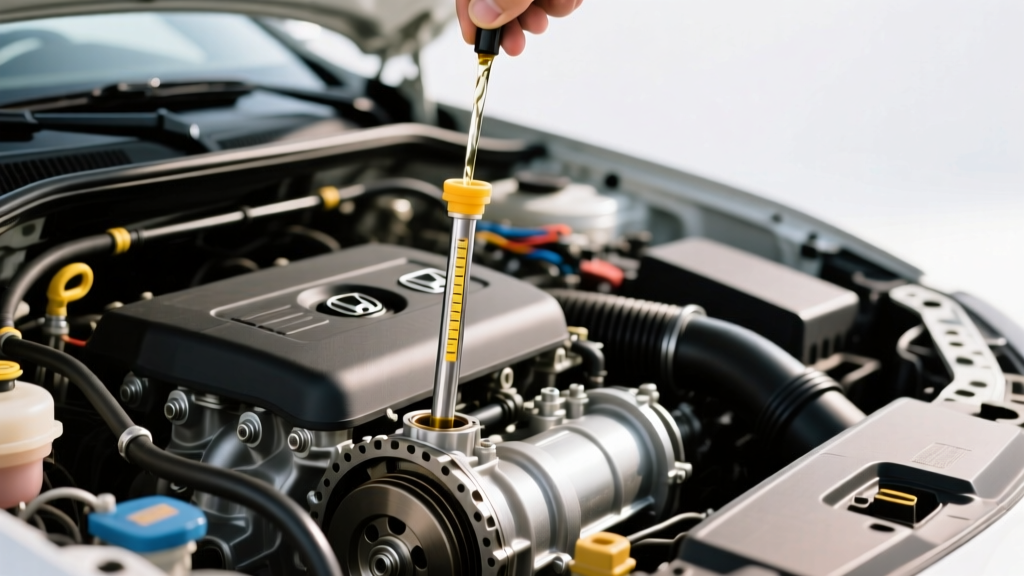
If your Accord is equipped with a traditional planetary automatic (5AT or 6AT), you will use the dipstick method. The dipstick is typically identifiable by a yellow or red looped handle, often located low in the engine bay near the firewall or directly in front of the engine block.
Step-by-Step Dipstick Procedure
- Warm Up the Vehicle: Drive the Accord for 10 to 15 minutes until the engine reaches normal operating temperature (the radiator cooling fan should cycle on at least once).
- Park on Level Ground: This is non-negotiable. An incline of even a few degrees will skew the reading by up to half a quart.
- Turn the Engine OFF: Shut off the engine and wait exactly 60 to 90 seconds. This allows the fluid in the torque converter to drain back into the transmission pan.
- Pull and Wipe: Pull the dipstick, wipe it clean with a lint-free white cloth, and reinsert it fully until it clicks or seats completely.
- Read the Level: Pull it out again. The fluid should be between the upper and lower marks on the hot-side indicator. If it is below the lower mark, add fluid in small increments (1/4 quart at a time) using a narrow funnel.
Method 2: The Check Plug Procedure (CVTs and 10ATs)
Modern Honda Accords (2013+ 4-cylinders and 2018+ 2.0T models) utilize 'sealed' transmissions. There is no dipstick under the hood. Instead, fluid level is verified using a physical check plug located on the side or front of the transmission casing. This procedure requires safely lifting the vehicle.
Step-by-Step Sealed Transmission Check
- Lift and Level: Raise the vehicle using a hydraulic lift or jack stands. The vehicle must be perfectly level side-to-side and front-to-back. Never attempt this on standard ramps, as the incline will cause fluid to pour out prematurely.
- Warm Up the CVT/10AT: Unlike the older models, Honda CVTs and the 10AT generally require the fluid to be within a specific temperature window (usually between 104°F and 113°F / 40°C - 45°C) for an accurate level check. You can verify this via an OBD2 scanner reading the Transmission Fluid Temperature (TFT) PID.
- Locate the Check Plug: Clean the area around the transmission check plug to prevent debris from entering the casing. On most Honda CVTs, this is a 10mm or 12mm hex bolt located on the passenger side of the transaxle housing.
- Crack the Plug: With the engine OFF (for CVTs) or idling (for some specific 10AT procedures, consult Honda TechInfo for your exact year's service manual), slowly loosen the check plug.
- Observe the Flow: If a steady stream of fluid flows out and then slows to a drip, your fluid level is perfect. If nothing comes out, your transmission is dangerously low and requires fluid injection via the fill port until it weeps from the check hole.
- Reinstall with New Hardware: Always replace the crush washer. Torque the CVT check plug to 12 Nm (9 lb-ft) and the drain plug (if performing a drain-and-fill) to 49 Nm (36 lb-ft).
Assessing Fluid Condition: What Your Eyes and Nose Tell You
Checking the level is only half the battle; assessing the fluid's health is where true preventative maintenance happens.
- Clear Red or Light Amber: Healthy. OEM Honda DW-1 and HCF-2 fluids start with a distinct red or amber hue. No action needed.
- Dark Brown or Opaque: Oxidized. The fluid has lost its frictional modifiers and anti-wear additives. A drain-and-fill is urgently required. Expect to spend around $45 to $60 on OEM fluid for a standard 3.7-quart CVT drain-and-fill.
- Burnt Smell (Like Toast): Severe overheating. This indicates that the internal clutch packs or the CVT steel push-belt have been slipping and burning. Fluid replacement may not save a transmission exhibiting this symptom; internal mechanical damage has likely occurred.
- Glitter or Metal Flakes: Normal in very small amounts on the magnetic drain plug, but if visible on the dipstick or suspended in the fluid sample, the transmission bearings or planetary gears are actively failing.
Common Beginner Mistakes to Avoid
When learning how to check automatic transmission fluid in Honda Accord vehicles, novices frequently make three costly errors:
- Overfilling a CVT: Unlike engine oil, an overfilled CVT will cause the fluid to aerate (foam) due to the rotation of the internal shafts. Aerated fluid cannot transmit hydraulic pressure, leading to immediate belt slip and catastrophic failure. Always let the check plug drip to verify the exact level.
- Using 'Universal' ATF: Auto parts stores sell 'multi-vehicle' ATF that claims to be compatible with Honda DW-1 or HCF-2. Do not use these. Honda's friction modifiers are proprietary. Using universal fluid in a Honda CVT will cause shuddering and eventual failure within a few thousand miles.
- Reusing Crush Washers: The 18mm aluminum crush washer (Part# 90471-PX4-000) on the CVT drain plug is designed to deform once to create a seal. Reusing it will result in a slow, expensive leak onto your garage floor.
Final Thoughts on Accord Drivetrain Maintenance
Maintaining your Honda Accord's transmission does not require a dealership service bay, but it does require strict adherence to Honda's specific engineering parameters. By identifying your exact transmission type, utilizing the correct OEM fluid, and respecting the unique 'engine-off' dipstick rule or the precise temperature requirements of the CVT check plug, you can easily push your Accord's drivetrain well past the 200,000-mile mark. Keep your torque wrench calibrated, your jack stands secure, and always reference the official service documentation when in doubt.