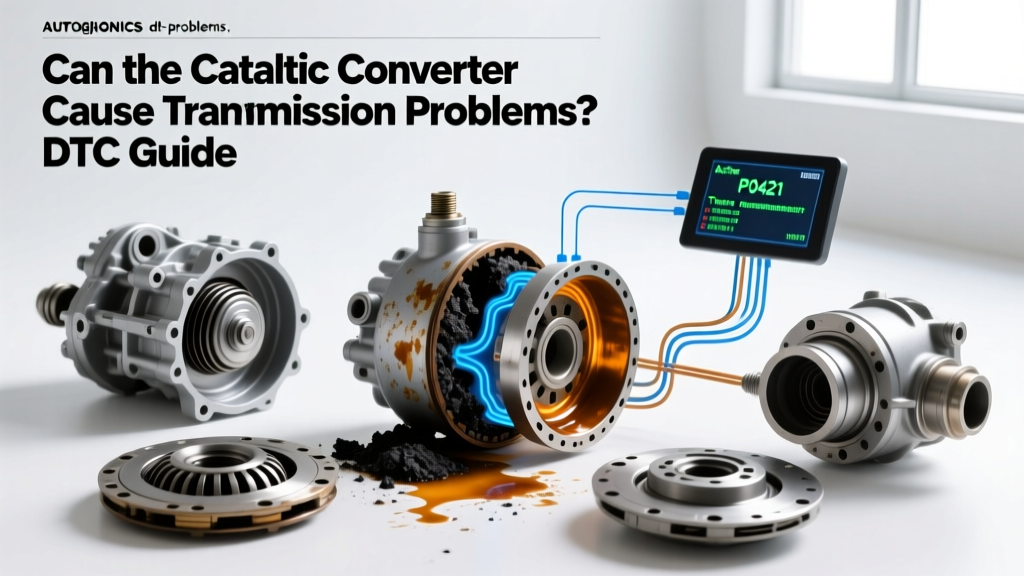
Modern vehicles operate as highly integrated networks where the exhaust, engine, and transmission systems constantly communicate via the Controller Area Network (CAN) bus. When drivers and technicians alike ask, can the catalytic converter cause transmission problems, the answer requires looking past the exhaust pipe and directly into the powertrain control module (PCM) logic. A failing or restricted catalytic converter does not just increase emissions; it fundamentally alters engine torque output, exhaust gas temperatures (EGT), and powertrain thermal dynamics. These anomalies frequently trick the Transmission Control Module (TCM) into logging secondary transmission diagnostic trouble codes (DTCs), sending technicians on wild goose chases to replace perfectly healthy valve bodies and torque converters.
The Physics of Exhaust Restriction and Torque Management
To understand how an exhaust component triggers a transmission DTC, we must examine modern torque management strategies. In vehicles equipped with advanced transmissions like the ZF 8HP70 or the Ford 10R80, the TCM relies on real-time engine torque data to calculate precise clutch apply pressures and shift timing. The PCM estimates engine torque based on throttle position, manifold absolute pressure (MAP), and mass air flow (MAF).
When a catalytic converter's ceramic substrate begins to melt or collapse, it creates a severe exhaust bottleneck. This restriction causes excessive exhaust backpressure, which in turn reduces engine volumetric efficiency. The engine begins to "lug," and actual crankshaft torque drops significantly below the PCM's calculated indicated torque. Because the TCM is still commanding shift pressures based on the expected torque, the physical clutch packs may slip, or the torque converter clutch (TCC) may fail to lock. The TCM detects this RPM discrepancy and immediately logs a transmission ratio or slip code, entirely masking the root exhaust issue.
Thermal Soak: How a Glowing Cat Bakes the Valve Body
Beyond aerodynamic restrictions in the exhaust stream, a clogged catalytic converter generates immense radiant heat. Under heavy load, a restricted substrate can push EGTs well past 1,800°F (980°C). In many rear-wheel-drive platforms, such as GM trucks utilizing the 6L80-E transmission, the passenger-side catalytic converter sits mere inches from the transmission fluid pan and the mechatronic solenoid body.
Expert Insight: Prolonged exposure to radiant heat from a failing catalytic converter will degrade synthetic automatic transmission fluids like Dexron VI or ATF+4. The fluid oxidizes, loses its friction-modifying properties, and forms varnish inside the valve body, leading to sticky solenoids and erratic shift DTCs long before a mechanical transmission failure occurs.
DTC Crossfire: Catalyst Codes Masking as Transmission Faults
Diagnosing these intertwined issues requires a firm grasp of how specific emission codes cascade into transmission DTCs. Below is a cross-reference matrix of common diagnostic trouble codes that frequently appear together when the catalytic converter is the true culprit.
| Primary Emission DTC | Secondary Trans DTC | TCM Logic Trigger & CAN-Bus Interaction |
|---|---|---|
| P0420 / P0430 | P0700 | PCM detects catalyst inefficiency, requests MIL illumination, and commands the TCM to alter shift adaptions to protect the powertrain. |
| P0420 / P0430 | P0741 | TCC Stuck Off. The PCM intentionally disables TCC lockup to increase engine RPM and exhaust temperatures in an attempt to light off a failing catalyst. |
| P0420 / P0430 | P0731 - P0734 | Gear Ratio Errors. Severe backpressure causes engine lugging; the TCM calculates a false slip ratio because RPMs do not match vehicle speed parameters. |
| P0420 / P0430 | P0711 / P0712 | TFT Sensor Circuit Issues. Extreme radiant heat from the exhaust damages the wiring harness or skews the Transmission Fluid Temperature sensor readings. |
Understanding the P0741 Torque Converter Clutch Trap
One of the most common misdiagnoses in the shop is the P0741 (TCC Performance/Stuck Off) code. According to OBD-Codes P0420 Reference data and OEM technical service bulletins, when the PCM detects a P0420 (Catalyst System Efficiency Below Threshold), it may initiate a "catalyst protection mode." To generate enough heat to burn off carbon deposits in the substrate, the PCM commands the TCM to inhibit torque converter lockup. This keeps engine RPMs artificially high. If a technician reads only the transmission codes, they might condemn the torque converter or the TCC PWM solenoid, completely missing the fact that the TCM was simply following a thermal management directive from the PCM.
Step-by-Step Diagnostic Protocol: Isolating the Fault
When faced with a combination of emissions and transmission DTCs, technicians must systematically isolate the exhaust system from the drivetrain. Relying solely on a generic OBD2 scanner is insufficient; a bidirectional scan tool like the Snap-on Zeus+ or Autel MaxiSys is mandatory for live data PID analysis.
1. Exhaust Backpressure Verification
Before dropping the transmission pan, verify the physical health of the exhaust. Remove the upstream oxygen sensor and install an exhaust backpressure gauge (such as the Lisle 55500).
- Idle Spec: Backpressure should be less than 1.5 psi.
- 2,500 RPM Spec: Backpressure should remain below 3.0 psi.
- Failure Indicator: Any reading exceeding 4.0 psi at 2,500 RPM confirms a severe substrate restriction that will absolutely cause torque management DTCs.
2. Live Data PID Analysis
Connect your scan tool and monitor the following PIDs simultaneously during a road test:
- TCC_SLIP_RPM: If the TCC is commanded ON but slip remains above 100 RPM, check for PCM thermal management overrides.
- O2S_1_1 & O2S_1_2 (Upstream/Downstream O2): A healthy catalytic converter will show a lazy downstream waveform (hovering around 0.45V). If the downstream sensor mirrors the rapid switching (0.1V to 0.9V) of the upstream sensor, the catalyst is dead, validating the P0420/P0430 code.
- ENGINE_TORQUE_CALC vs. TRANS_TORQUE_REQ: A massive discrepancy here indicates the engine is choking on its own exhaust gases, confusing the TCM's line pressure algorithms.
3. Thermal Imaging Inspection
Use an infrared thermal camera to scan the exhaust and transmission bell housing after a 20-minute drive cycle. A healthy catalytic converter will typically read between 400°F and 600°F at the inlet, and slightly hotter at the outlet due to the exothermic chemical reaction. If the inlet reads significantly hotter than the outlet, or if the transmission pan temperature exceeds 220°F due to radiant exhaust heat, you have found the source of your transmission fluid degradation and subsequent solenoid DTCs.
Component Verification and Repair Economics
If the diagnostic protocol confirms a restricted catalytic converter is the root cause of the transmission DTCs, the repair must focus on the exhaust system while simultaneously addressing any heat-induced transmission fluid damage.
When replacing the catalytic converter, adherence to environmental standards is critical. The EPA Vehicle and Fuel Emissions Testing guidelines mandate the use of EPA-compliant or CARB-certified replacement units. Cheap, non-compliant "universal" cats often lack the necessary precious metal loading (platinum, palladium, rhodium) and will trigger a P0420 code within 500 miles, immediately putting the transmission back into torque-management limp mode.
- OEM Catalytic Converters: $800 to $2,500+ depending on the vehicle (e.g., GM Silverado 5.3L vs. Ford F-150 EcoBoost).
- EPA-Compliant Aftermarket (e.g., Walker, MagnaFlow): $350 to $900.
- Transmission Fluid & Filter Service (6L80-E): $250 to $400. Requires 10-12 quarts of Dexron VI. Note: Pan bolt torque spec is strictly 106 lb-in (inch-pounds, NOT foot-pounds) to avoid warping the aluminum valve body casting.
- Exhaust Manifold Stud Replacement: If heat and corrosion have damaged the manifold-to-head studs, replace them with OEM-grade hardware and torque to 22 lb-ft using high-temperature copper anti-seize.
Conclusion
The modern powertrain is a closed-loop ecosystem. A restriction in the exhaust system alters the thermodynamic and mechanical realities of the engine, forcing the TCM to react to phantom transmission slips and ratio errors. By understanding the intricate relationship between catalyst efficiency, torque management logic, and thermal soak, technicians can accurately diagnose these cross-system DTCs. Always verify exhaust backpressure and O2 sensor waveforms before authorizing invasive transmission repairs, and remember that a glowing catalytic converter is often the silent killer of transmission fluid and valve body solenoids.