Diagnostic Path: Is Your Honda Accord Clutch Actually Failing?
Before tearing into the bell housing of your manual Honda Accord, accurate symptom diagnosis is critical. Many owners prematurely search for the Honda Accord clutch replacement cost when the true culprit lies within the hydraulic circuit or engine management. Whether you are driving an 8th-generation K24, a 9th-generation Sport, or a 10th-generation 2.0T (K20C1) 6-speed, misdiagnosing the failure will result in wasted labor and incorrect parts selection.
Symptom 1: RPM Flare Under Load (True Slipping)
If you are in 4th or 5th gear at wide-open throttle (WOT) and the tachometer climbs without a proportional increase in vehicle speed, your friction disc is worn past its service limit, or the pressure plate diaphragm springs have fatigued. Diagnostic Check: Inspect for rear main seal or input shaft seal leaks. Oil contamination destroys organic friction material rapidly. If the flywheel is contaminated, a simple pad swap will fail; the flywheel must be replaced or machined, and the leak source sealed.
Symptom 2: Chatter and Judder on Takeoff
Aggressive shuddering when releasing the pedal in 1st gear usually points to flywheel hot spots, uneven friction material wear, or broken damper springs in the disc hub. Diagnostic Check: If your Accord has high mileage, the dual-mass flywheel (if equipped on specific diesel or European markets) or the standard single-mass flywheel has likely warped from excessive heat dumping during stop-and-go traffic.
Symptom 3: Crunching Gears or Incomplete Disengagement
If the car creeps forward with the pedal depressed or grinds entering reverse, do not immediately assume the clutch disc is warped. Diagnostic Check: The Honda Clutch Master Cylinder (CMC) and the Clutch Delay Valve (often integrated into the slave line) are notorious for internal seal bypass. Bleed the system and check for fluid weeping at the firewall pushrod. Replacing a $60 CMC is vastly cheaper than a full transmission drop.
The OEM vs. Aftermarket Dilemma: Matching Parts to Symptoms
Once you have confirmed mechanical friction failure, you face the core decision that dictates the final Honda Accord clutch replacement cost: Do you restore the factory feel with OEM components, or upgrade to an aftermarket clamping system? Your choice must align with your vehicle's current power output and your tolerance for Noise, Vibration, and Harshness (NVH).
The OEM Route: Exedy and Honda Genuine
Honda does not manufacture its own manual transmission clutches; they contract Exedy USA. Buying a 'Honda Genuine' clutch kit (e.g., Part #22200-6A0-A01 for the 10th Gen 2.0T) is essentially buying an Exedy kit in a red Honda box, complete with a dealership markup. Sourcing the direct Exedy aftermarket equivalent (like the HHC011U or similar K-series application) saves you 20-30% while retaining the exact organic friction compound and sprung-hub damper design engineered for the Accord's chassis harmonics.
- Best For: Daily drivers, commuter vehicles, and Accords retaining the factory ECU tune.
- Drivability: Smooth engagement, excellent low-speed manners, zero gear rattle.
- Torque Capacity: Rated for factory output (approx. 250-280 lb-ft at the crank).
The Aftermarket Route: ACT, Sachs, and Clutch Masters
If your diagnostic phase revealed that your clutch slipped specifically after an ECU reflash (e.g., Hondata or KTuner on the 1.5T or 2.0T L15B/K20C engines), the OEM organic disc is no longer sufficient. Aftermarket kits utilize heavier pressure plates (increased diaphragm spring load) and advanced friction materials like Kevlar, ceramic, or sintered iron.
- Best For: Tuned Accords, track-day builds, and drivers who frequently tow or haul.
- Drivability: Heavier pedal effort (up to 40% stiffer), potential gear rattle if using a solid (unsprung) hub.
- Torque Capacity: Ranges from 350 lb-ft to over 550 lb-ft depending on the kit.
2026 Honda Accord Clutch Replacement Cost Breakdown
Labor is the great equalizer in clutch replacement. Dropping the subframe and transmission on a modern Accord takes a certified technician roughly 5.5 to 7.5 hours. Therefore, the variance in your total bill comes down to parts selection and flywheel machining. Below is a realistic 2026 pricing matrix based on national averages and current RockAuto parts indexing.
| Kit Category | Brand / Part Example | Friction Material | Hub Type | Est. Kit Cost | Total Installed Cost (w/ Labor) |
|---|---|---|---|---|---|
| OEM Replacement | Exedy HHC Series / Honda Genuine | Organic | Sprung (Marcel) | $220 - $350 | $950 - $1,350 |
| Heavy Duty Street | ACT HD/SS (Heavy Duty / Sprung Street) | Organic / Ceramic Blend | Sprung | $450 - $600 | $1,200 - $1,650 |
| Performance Track | ACT HD/Race (Solid Hub) | Sintered Iron / Ceramic | Unsprung (Solid) | $550 - $750 | $1,400 - $1,850 |
| OEM Premium | Sachs OE Replacement | Organic | Sprung | $280 - $400 | $1,050 - $1,450 |
*Note: Total costs assume a standard flywheel resurfacing ($75-$120). If the flywheel is cracked or warped beyond the 0.010-inch machining limit, add $350-$600 for a new OEM flywheel.
Critical Installation Specifications for Honda Manuals
Whether you choose OEM or ACT Clutches, improper installation will void warranties and cause immediate chatter or failure. Honda's K-series and L-series engines require strict adherence to torque sequences and surface preparations.
Flywheel and Machining Tolerances
Never install a new clutch on an unverified flywheel. The friction surface must be perfectly flat. Furthermore, Honda flywheels utilize a specific 'step height' (the difference between the friction surface and the pressure plate mounting pad). If a machine shop removes too much material without cutting the step, the pressure plate will sit too low, resulting in a disengagement failure and a pedal that feels stuck to the floor.
Must-Know Torque Specifications (K20 / K24 Applications)
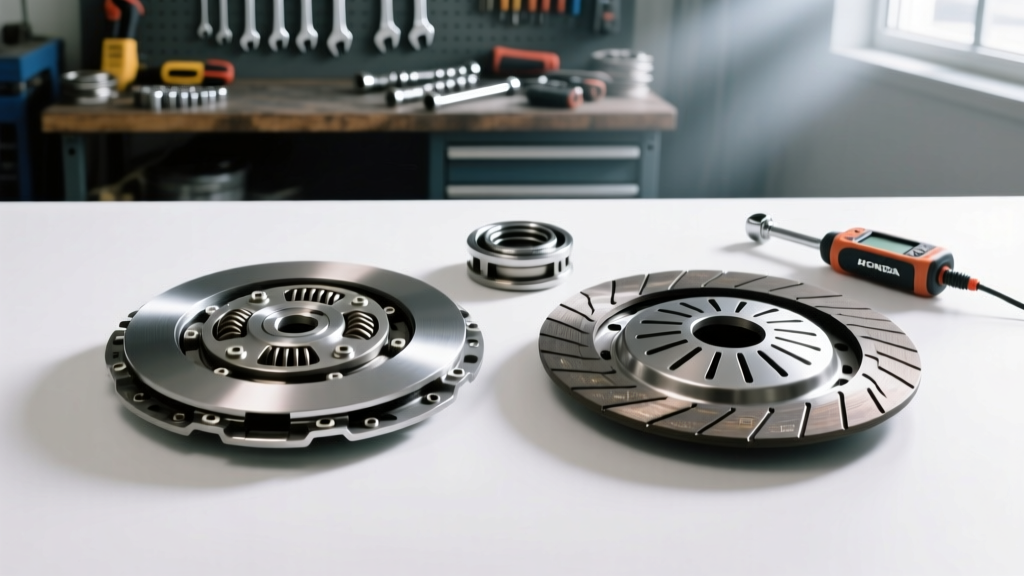
Use a calibrated torque wrench and an angle gauge for the following critical fasteners. Do not rely on 'feel'.
- Flywheel to Crankshaft Bolts (M10x1.25): 76 lb-ft (103 Nm) followed by an additional 90-degree turn. Always use new OEM stretch bolts (Part #90022-PRP-A01).
- Pressure Plate to Flywheel Bolts (M8x1.25): 19 lb-ft (26 Nm) in a star pattern to prevent warping the pressure plate housing.
- Drive Axle Spindle Nuts: 180 lb-ft (245 Nm). These are prevailing torque nuts and must be replaced upon removal to prevent hub bearing failure.
- Clutch Fork Pivot Ball: 28 lb-ft (39 Nm). Ensure the pivot ball is inspected for spherical wear, which causes inconsistent pedal feel.
Hydraulic System Bleeding and the Clutch Delay Valve
A major troubleshooting oversight during a Honda Accord clutch replacement is ignoring the hydraulic circuit. Modern Accords feature a Clutch Delay Valve (CDV) in the slave cylinder line designed to smooth out engagement for novice drivers by restricting fluid flow. If you are upgrading to a high-clamp-load aftermarket pressure plate, the CDV can cause the slave cylinder to lag behind your foot, leading to incomplete engagement and premature synchro wear.
Expert Recommendation: When performing an aftermarket clutch upgrade, delete or bypass the CDV and install a braided stainless steel clutch line. Perform a reverse-bleed of the hydraulic system using a motive bleeder to ensure zero air pockets remain in the CMC, which sits higher than the slave cylinder on the firewall.
Final Verdict: Which Path Should You Take?
If your diagnostic tests confirm standard wear and tear, and your Accord remains unmodified, the OEM Exedy route offers the most cost-effective and drivable solution. The Honda Accord clutch replacement cost will remain on the lower end of the spectrum, and factory NVH levels will be preserved. However, if your diagnostic data shows slipping under boosted conditions or heavy load, investing in a sprung-hub aftermarket kit like the ACT HD/SS is mandatory to protect your transmission investment, even if it pushes the final invoice closer to the $1,600 mark.