The Thermal Reality of the 3.08 Open Differential
When running a 3.08 open differential in a half-ton truck, SUV, or heavy performance coupe, the numerical gear ratio is specifically chosen to prioritize low-RPM highway cruising and marginal fuel economy gains. In platforms like the GM 8.5-inch or 8.625-inch 10-bolt rear axle, the 3.08 ratio keeps engine RPMs low at 70 MPH. However, this mechanical advantage comes with a hidden thermal penalty. Because the engine operates at lower RPMs, it produces less parasitic cooling airflow through the engine bay and undercarriage, while the differential itself is forced to multiply torque from a lugging engine during heavy hauling or steep inclines.
An open differential inherently sends power to the path of least resistance. While this is perfectly adequate for dry pavement and light loads, the hypoid gear set inside the housing is subjected to immense sliding friction. When you pair a 3.08 ratio with a 6,000-pound towing load, the pinion gear must exert tremendous force against the ring gear to initiate movement from a dead stop. This high-torque, low-speed scenario generates localized heat spikes at the gear mesh point that can rapidly exceed the thermal limits of standard stamped-steel differential covers and conventional gear oils.
Hypoid Gear Tribology and Heat Generation
To understand why differential cooling is critical, we must examine the tribology of the hypoid gear set. Unlike straight-cut or helical gears that primarily experience rolling friction, hypoid gears feature an offset pinion that creates a profound sliding motion across the ring gear teeth. This sliding action requires extreme pressure (EP) additives—typically sulfur-phosphorus compounds found in API GL-5 fluids—to maintain a boundary lubrication film.
According to tribological data published by Machinery Lubrication, the oxidation rate of petroleum-based and synthetic gear oils doubles for every 18°F (10°C) increase in temperature above the baseline of 200°F (93°C). Once the internal sump temperature of a 3.08 open differential exceeds 250°F (121°C), the EP additives begin to thermally degrade, leading to varnish formation, micro-pitting on the gear teeth, and eventual bearing failure.
| Sump Temperature | Oxidation State | Operational Consequence |
|---|---|---|
| 180°F - 200°F | Optimal | Maximum additive stability; ideal viscosity. |
| 210°F - 240°F | Accelerated Aging | Fluid shear begins; EP additive depletion starts. |
| 250°F - 280°F | Critical Degradation | Varnish formation; seal hardening; micro-pitting risk. |
| 290°F+ | Terminal Failure | Carbonization; bearing cage meltdown; gear scoring. |
The Physics of Finned Differential Covers
The factory stamped-steel cover on a GM 10-bolt or Ford 8.8-inch axle is designed strictly for cost-efficiency and packaging clearance. It offers minimal surface area for convective heat transfer and holds a marginal volume of fluid (typically 2.0 to 2.4 quarts). Upgrading to a cast-aluminum, finned differential cover fundamentally alters the thermal management profile of the axle assembly through three distinct mechanisms:
1. Convective Surface Area Expansion
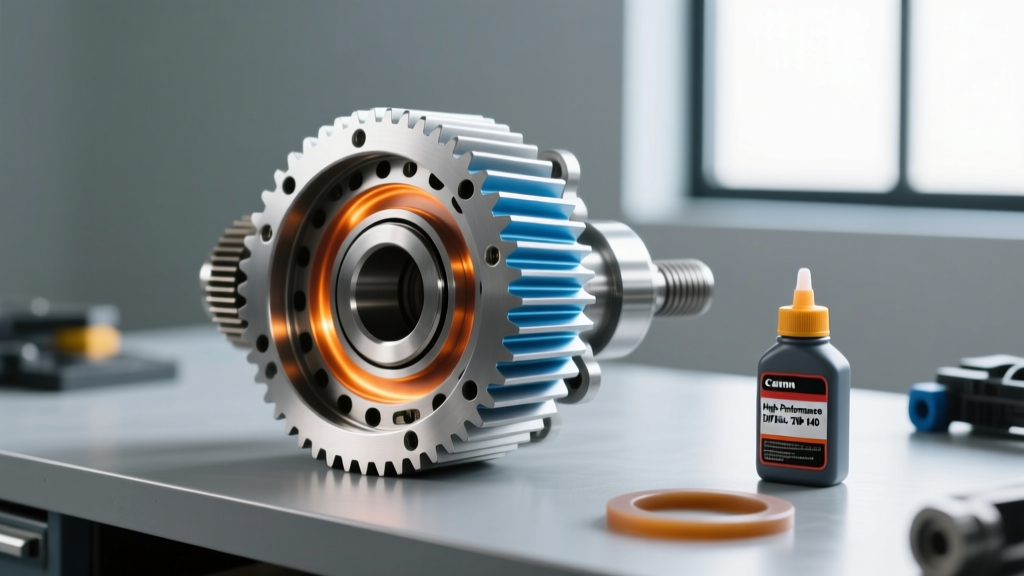
High-quality aftermarket covers utilize directional cooling fins aligned longitudinally with the axle tubes. As the vehicle moves forward, ambient air is channeled directly across these fins. Cast A356-T6 aluminum possesses a thermal conductivity of approximately 151 W/m·K, compared to the 43 W/m·K of mild steel. This material swap alone increases the heat rejection rate by over 40%, pulling thermal energy away from the gear oil sump and dissipating it into the slipstream.
2. Increased Fluid Sump Capacity
Thermal mass is a vital component of heat management. By increasing the fluid capacity from 2.2 quarts to upwards of 3.5 quarts, the differential benefits from a larger thermal reservoir. More fluid means the heat generated at the hypoid mesh is distributed across a greater volume, delaying the onset of peak sump temperatures during sustained heavy-load driving.
3. Internal Baffling and Bearing Lubrication
Premium covers feature internal baffles and directional scoops. At highway speeds, the ring gear acts as a centrifugal pump, slinging gear oil outward. Internal scoops capture this oil and direct it toward the critical pinion and carrier bearings, preventing cavitation and ensuring that the bearings remain submerged in cool fluid rather than relying on splash lubrication.
Aftermarket Cover Matrix: Real-World Options
When selecting an upgrade for your 3.08 open differential, the market offers several tier-one manufacturers. Pricing generally reflects the complexity of the internal casting and the inclusion of external cooling hardware. Data sourced from industry benchmarks and Randy's Ring & Pinion technical archives support the following comparisons for standard GM 8.5/8.625-inch 10-bolt applications:
| Manufacturer | Part Number | Capacity | External Features | Est. Price (USD) |
|---|---|---|---|---|
| Stock Stamped Steel | OEM | 2.2 Quarts | None | $45 |
| Mag-Hytec | GM10-8.5 | 3.5 Quarts | Fin-aligned, magnetic drain plug | $240 - $275 |
| PPE Racing | 1150600 | 2.8 Quarts | Deep fins, internal heat sinks | $180 - $210 |
| AFE Power | 46-70172 | 3.0 Quarts | Integrated cooling fins, billet plug | $190 - $230 |
Precision Installation Protocol
Installing an upgraded differential cover on a 3.08 open differential is not simply a matter of unbolting the old unit and bolting on the new one. Improper sealing or contamination will lead to catastrophic fluid loss and gear seizure. Follow this exact protocol for GM 10-bolt applications:
Step 1: Drain and Decontamination
Remove the factory fill plug (usually a 3/8-inch square drive) before breaking the cover seal. Once drained, remove the 10 cover bolts (typically 3/8'-16 or M8 depending on the model year). Clean the mating surface of the axle housing using a non-chlorinated brake cleaner and a plastic scraper. Never use a metal razor blade on the axle housing mating surface, as gouges will create permanent leak paths for low-viscosity synthetic gear oils.
Step 2: Sealant Application
While some covers utilize reusable O-rings, RTV silicone remains the industry standard for irregular castings. Use a high-torque, oil-resistant RTV such as Permatex Ultra Black (Part #81878). Apply a continuous 2mm bead to the cover flange, ensuring a complete circle around every bolt hole. Allow the RTV to skin over for 10 minutes before mating it to the axle housing to prevent silicone extrusion into the sump, which can clog the pinion bearing oil feed.
Step 3: Torque Sequence and Specifications
Hand-thread all bolts to prevent cross-threading the aluminum cover or steel housing. Tighten the bolts in a crisscross star pattern to ensure even flange loading. The factory specification for GM 10-bolt differential cover bolts is 22 to 25 lb-ft. Over-torquing will warp the cast aluminum flange, guaranteeing a leak.
Step 4: Fluid Selection and Fill
Allow the RTV to cure for a minimum of 12 hours before filling. For a 3.08 open differential subjected to towing or track use, bypass conventional 80W-90 mineral oils. Opt for a full synthetic 75W-90 API GL-5 fluid (e.g., Amsoil Severe Gear or Red Line 75W90). These synthetics maintain their boundary film strength well past 275°F. Fill the housing until the fluid level is exactly even with the bottom of the fill hole. If your aftermarket cover features a higher fill plug to accommodate increased capacity, ensure you fill to the manufacturer's specified level, which may require up to 3.5 quarts.
Conclusion: Protecting the Drivetrain Investment
The 3.08 open differential is a highly efficient cruising setup, but its thermal vulnerability under load cannot be ignored. By upgrading to a finned, high-capacity cast aluminum cover and pairing it with a robust synthetic GL-5 fluid, you effectively insulate the hypoid gear set from thermal degradation. This relatively minor investment of $200 to $300 yields exponential returns in bearing longevity, seal integrity, and overall drivetrain reliability, ensuring that your axle assembly survives the harshest towing and performance environments.