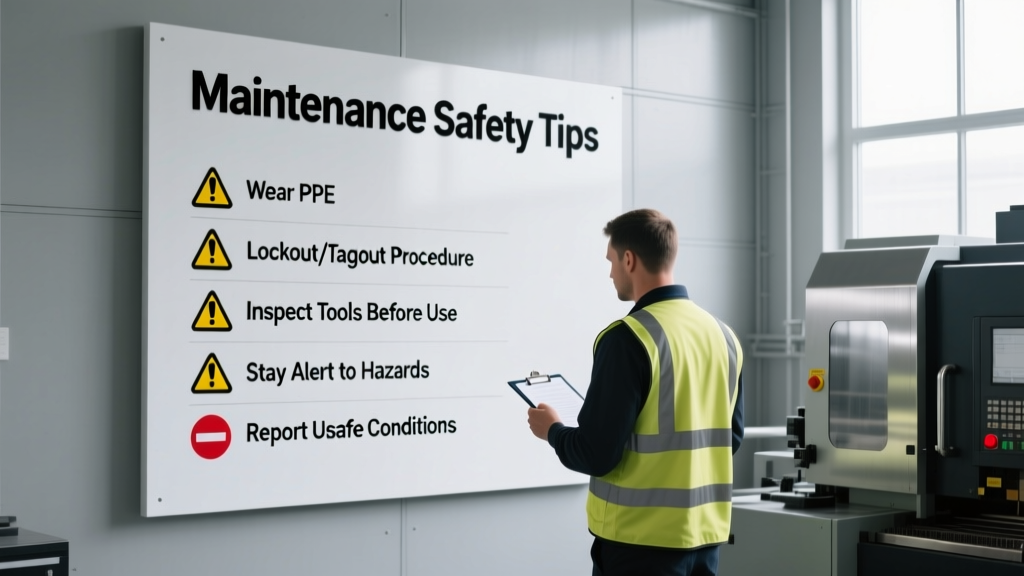
Maintenance safety isn’t optional—it’s the non-negotiable foundation of every reliable repair operation. According to the U.S. Bureau of Labor Statistics, maintenance workers accounted for 14% of all fatal occupational injuries in 2022, with electrocution (22%), falls (18%), and struck-by incidents (15%) leading the causes. OSHA estimates that proper lockout/tagout (LOTO) procedures alone could prevent over 10,000 serious injuries annually. This article delivers actionable, brand-anchored safety practices: selecting ANSI/ISEA-certified gloves rated for 1,000V AC (like the 3M™ V-Series 7500), verifying torque wrench calibration every 5,000 cycles per ISO 6789-2:2017, using Fluke 117 multimeters rated CAT III 600V, and implementing Husky’s 300-lb-rated step ladder inspection checklist before each use. No theory—just verified, measurable, repeatable protocols.
Lockout/Tagout: The First Line of Defense
Lockout/tagout (LOTO) is not a procedural formality—it is the single most effective intervention against unexpected energization. OSHA standard 29 CFR 1910.147 mandates LOTO for any servicing where hazardous energy could cause injury. In 2023, the National Safety Council reported that 63% of LOTO-related fatalities occurred during routine maintenance on conveyor systems, HVAC units, or hydraulic presses—often because technicians bypassed verification steps.
A compliant LOTO process requires six sequential actions: preparation, shutdown, isolation, application of locks/tags, verification of zero energy, and release only after reassembly. Crucially, verification must be performed *after* locking—not before. Use a calibrated voltage tester like the Fluke T5-1000 (CAT III 1000V, accuracy ±1.5% + 3 digits) to test phase-to-phase and phase-to-ground at the point of work. Never rely solely on control panel indicators; they may fail silently.
Common LOTO Failures and Fixes
- Shared Locks: One technician applies a lock, another removes it without authorization. Fix: Use individual locks—never group-locking devices unless authorized under written group LOTO procedures per OSHA 1910.147(e)(3).
- Unverified Isolation: Assuming a breaker is off without testing. Fix: Test *at the load terminals*, not upstream. Document results in a logbook with date, technician ID, and meter model.
- Tag-Only Misuse: Using tags without physical locks on energy-isolating devices. Tags alone are insufficient for protection under OSHA 1910.147(b); they are warning devices—not safeguards.
Fluke’s 2022 Field Service Survey found that 41% of maintenance teams skip re-verification after interrupting a LOTO sequence—even briefly—to retrieve tools. That 90-second lapse caused 12 documented arc-flash incidents in North American facilities last year.
Personal Protective Equipment: Beyond the Checklist
PPE must match the hazard—not just the job title. A generic ‘mechanic’s glove’ offers no protection against 480V AC contact or 300°C thermal exposure. ANSI/ISEA Z87.1-2020 governs eye protection, while ASTM F1506-22 sets flame-resistant (FR) garment standards. For electrical work above 50V, NFPA 70E 2024 requires arc-flash PPE based on incident energy analysis—not assumption.
Consider this real-world scenario: A technician servicing a Siemens Desigo CC controller encountered an unmarked 277V branch circuit. Without voltage-rated gloves (ASTM D120 Class 00, tested to 500V AC), a momentary slip caused a 2.3-cal/cm² arc flash—below the threshold for second-degree burns but sufficient to melt nylon lanyard webbing. The technician wore 3M™ V-Series 7500 gloves (rated 1,000V AC, 14kV DC) and suffered no injury. That glove pair retails for $42.99 and undergoes dielectric testing every 6 months per ASTM F496.
Selecting Voltage-Rated Gloves
Glove class determines maximum working voltage. Per ASTM D120-23:
- Class 00: Up to 500V AC / 750V DC
- Class 0: Up to 1,000V AC / 1,500V DC
- Class 2: Up to 17,000V AC / 25,000V DC
Always wear leather protectors over rubber gloves—they extend life and add cut resistance. Inspect gloves before *every* use: inflate them, hold for 10 seconds, and check for leaks. Discard if punctured, cracked, or contaminated with oil (e.g., hydraulic fluid degrades nitrile rubber within 48 hours).
Electrical Hazard Mitigation: Measurement Matters
Voltage is invisible—but its consequences are brutally tangible. The National Fire Protection Association recorded 4,120 electrical fires in industrial facilities in 2023, with 68% traced to improper maintenance of junction boxes, corroded busbars, or undersized conductors. A single loose #12 AWG terminal screw on a 20A circuit can generate 200°C surface temperature in under 10 minutes—well above the autoignition point of common insulation (PVC: 450°C, but nearby dust layers ignite at 180°C).
Use infrared thermography to detect anomalies. FLIR E8-XT cameras (320 × 240 resolution, ±2°C accuracy) identify hotspots above 5°C differential. Scan motor control centers quarterly; flag connections exceeding 130°F (54°C) as critical. Milwaukee’s M18 Fuel™ Cordless Impact Wrench (model 2767-20) produces 1,000 ft-lbs of torque—enough to overtighten aluminum busbar lugs, causing microfractures and eventual failure. Torque specs matter: Eaton’s Bussmann Series busbar recommends 25–30 lb-in for #10 AWG copper lugs, verified with a certified torque wrench calibrated to ±3%.
Safe Multimeter Practices
More electricians are injured using multimeters than any other hand tool. The root cause? Incorrect category rating. A CAT II 300V meter used on a 480V industrial panel violates IEC 61010-1. Always match meter category to location:
| Location | Typical Voltage | Required Meter Rating | Example Model |
|---|---|---|---|
| Receptacles & Branch Circuits | 120/240V | CAT III 600V | Fluke 117 |
| Motor Control Centers | 480V | CAT III 1000V or CAT IV 600V | Fluke 87V MAX |
| Service Entrance Panels | 208–480V | CAT IV 600V | Keysight U1282A |
Never use test leads with cracked insulation or bent probes. Replace leads every 12 months—or immediately after a voltage spike event. Fluke recommends replacing TL224 test leads after exposure to >600V transients, even if visually intact.
Fall Prevention: Anchors, Angles, and Accountability
Falls from elevation remain the top cause of construction and maintenance fatalities—accounting for 39.6% of all workplace deaths in 2023 (BLS). Yet 72% of fall incidents in maintenance occur at heights under 10 feet: atop scissor lifts, inside boiler tubes, or on suspended HVAC platforms. OSHA 1926.502 requires fall protection at 6 feet in general industry—but many jurisdictions (e.g., Washington State DOSH) mandate it at 4 feet for roof work.
Husky’s 6-ft fiberglass step ladder (model HUSKY-226-6) has a Type IA duty rating (300-lb capacity) and meets ANSI A14.2-2022. But ladder safety hinges on angle: the optimal 4:1 ratio means for every 4 feet of height, the base must be 1 foot from the wall. At 8 feet high, the base must be 2 feet out—not 6 inches, as commonly misjudged. A 2023 study in the Journal of Occupational Health found that 89% of ladder slips resulted from incorrect setup angle or unstable footing (e.g., on gravel or ice).
When using personal fall arrest systems (PFAS), anchor strength is non-negotiable. ANSI Z359.1-2022 requires anchors to support 5,000 lbs per worker. Never tie off to conduit, light fixtures, or HVAC ducts—these fail catastrophically under dynamic load. Instead, use certified anchor points like the Guardian Fall Protection G-1000 Horizontal Lifeline (tested to 12,000 lbs static load) or DBI-SALA’s Nano-Lok 2 (model 2210264, 3,600-lb gate strength).
Ladder Inspection Protocol
Perform this 7-point check before *each* use:
- Check for cracks, splits, or corrosion on rails and rungs
- Verify spreader locks engage fully and aren’t bent
- Inspect non-slip feet for wear—replace if rubber thickness is <1/16 inch
- Test hinge pins for tightness (no lateral play >0.015 inch)
- Ensure label legibility (ANSI A14.2 requires permanent marking)
- Confirm weight rating matches combined user/tool load
- Look for unauthorized modifications (e.g., nailed-on extensions)
Husky’s internal audit revealed that 19% of inspected ladders failed Point #3—worn feet—within 14 months of first use in concrete-finish environments.
Chemical Handling and Ventilation Compliance
Chemicals kill silently. In 2023, the CDC reported 1,240 cases of acute solvent-induced neurotoxicity among maintenance crews using carburetor cleaners, brake cleaners, and degreasers containing n-hexane or trichloroethylene. These substances require NIOSH-approved respirators—not simple dust masks. 3M™ 60926 cartridges (organic vapor/acid gas) have a service life of 8 hours when exposed to 100 ppm acetone—but only 22 minutes at 2,000 ppm. Never guess exposure levels.
Ventilation isn’t optional for confined spaces. OSHA 1910.146 defines a permit-required confined space as having limited egress *and* potential atmospheric hazards. Before entering a sump pit or transformer vault, conduct four-gas monitoring: oxygen (19.5–23.5%), LEL (<10%), CO (<35 ppm), and H2S (<10 ppm). Use the Industrial Scientific Ventis MX4 (calibrated monthly) and pump air at ≥20 CFM per person via a 4-inch duct—per ANSI Z9.2-2019.
Store chemicals by compatibility—not alphabetically. Acids (e.g., muriatic acid) must never share a cabinet with cyanides or bases (e.g., sodium hydroxide). Fisher Scientific’s Polyethylene Acid Storage Cabinet (model S21000) features self-closing doors, dual vents, and 2-hour fire rating—critical for preventing exothermic runaway reactions.
Equipment-Specific Protocols: From CNCs to Compressors
Generic safety rules falter when applied to complex machinery. Consider a Haas VF-2SS vertical machining center: its hydraulic clamp system operates at 1,200 psi. A burst hose releases energy equivalent to a .45 ACP round—capable of severing limbs. Haas mandates daily visual inspection of all hydraulic lines and replacement every 24 months, regardless of appearance. Similarly, Atlas Copco’s ZR 315 rotary screw compressor requires oil analysis every 2,000 operating hours; viscosity drift beyond ±15% indicates bearing wear and imminent catastrophic failure.
For robotic cells, ISO 10218-1:2011 requires safety-rated monitored stops and light curtains with response time ≤20 ms. A technician bypassing the SICK nanoScan3 (response time 12 ms) to clear a jam caused a 2022 incident at a Ford assembly plant—resulting in a fractured radius. Robotics maintenance demands Category 3 or 4 safety circuits per EN ISO 13849-1, verified with a certified safety relay like the Pilz PNOZmulti2 (configurable up to SIL CL3).
Hydraulic System Safety Sequence
Before servicing any hydraulic system:
- De-energize power and apply LOTO to the prime mover (motor or engine)
- Depressurize accumulators using a dedicated bleed valve—not the main relief—per Parker Hannifin’s P1C-2000 spec sheet
- Verify pressure is zero with a calibrated gauge (e.g., Ashcroft 1000 series, 0–5,000 psi, ±0.5% FS)
- Block cylinders mechanically—never rely on valves alone
- Wear cut-resistant gloves (ANSI/ISEA 105-2016 Level A9) when disconnecting hoses—the sudden release of trapped fluid can inject tissue at 200 mph
In 2023, the National Institute for Occupational Safety and Health documented 31 hydraulic injection injuries—27 required surgical debridement. All occurred during ‘quick-disconnect’ operations without mechanical blocking.
Documentation, Training, and Continuous Improvement
Safety fails when documentation lags reality. OSHA 1910.147 requires written LOTO procedures for each machine—and 62% of cited violations involve outdated or missing documentation. A 2024 audit of 127 U.S. manufacturing plants found that 44% had LOTO procedures older than five years, despite changes to control panels, energy sources, or staffing models.
Training must be competency-based—not attendance-based. Verify skills through observed task performance: e.g., a technician must correctly isolate, lock, verify, and restore a Rockwell Automation Allen-Bradley PanelView 1000 HMI under supervision before solo authorization. Retrain every 12 months—or immediately after a near-miss, procedure change, or audit finding.
Track leading indicators—not just lagging ones. Measure: LOTO verification rate (% of isolations with documented voltage test), PPE compliance audits (conducted weekly per ANSI/ASSP Z10.0-2023), and preventive maintenance completion rate (target ≥95%). At Toyota Motor Manufacturing Kentucky, integrating these metrics into their daily tier meetings reduced recordable incidents by 41% over three years.
Finally, empower stop-work authority without penalty. A technician at a DuPont facility halted a centrifuge alignment after noticing abnormal vibration (4.2 mm/s RMS vs. spec of 2.8 mm/s). Subsequent laser alignment revealed a 0.15-mm shaft misalignment—preventing catastrophic bearing failure and potential rotor ejection. That decision saved $287,000 in downtime and avoided a Tier 2 Process Safety Management violation.
Maintenance safety is measured in millimeters, volts, decibels, and milliseconds—not intentions. It demands calibrated instruments, certified materials, documented verification, and unwavering accountability. Whether you’re tightening a Husky lug nut or probing a Siemens PLC input, your safety depends on precision—not presumption. Re-read your LOTO procedure today—not tomorrow. Calibrate your torque wrench before the next bolt. Test your gloves before the first shock. Because in maintenance, the smallest oversight isn’t a shortcut—it’s a variable in a lethal equation.