Clutch disc plates are the critical friction interface between engine torque and transmission input shafts in manual drivetrains. When they fail, symptoms range from slippage under load to violent shuddering at engagement—yet many technicians misdiagnose these as pressure plate or flywheel issues. This article details 7 core failure modes backed by real-world service data from Ford, GM, Toyota, and BMW platforms; explains why 62% of premature disc replacements stem from improper pilot bearing or release bearing installation (per 2023 ACDelco Technical Service Bulletin #TSB-CLT-2023-08); and specifies exact dimensional tolerances, friction material compositions, and torque sequence requirements that separate functional repairs from repeat failures. We cover OEM-spec thickness thresholds (e.g., Toyota’s 5.8 mm minimum for MT-210 discs), dual-mass flywheel compatibility limits, and why using a 200 N·m torque wrench instead of a 300 N·m tool on a Honda Civic EX clutch bolt can induce warpage.
Core Failure Modes: Beyond Simple Wear
Clutch disc failure is rarely uniform abrasion. Field data from over 14,000 service records compiled by the National Automotive Parts Association (NAPA) shows that only 22% of replaced discs exhibit even wear across the friction surface. The remaining 78% display one or more of five distinct failure patterns—each with specific mechanical origins and diagnostic signatures.
Radial Cracking in Friction Material
This appears as spiderweb-like fissures extending outward from the hub, most common in high-torque applications like the GM 6.2L L87 (420 lb-ft) and Ford 3.5L EcoBoost (400 lb-ft). It results from thermal cycling exceeding the phenolic resin binder’s glass transition temperature (Tg ≈ 145°C). When sustained surface temperatures exceed 200°C during aggressive launches or hill holding, the organic binder degrades, losing adhesion to copper/steel fibers. Bosch OE-spec discs use a modified aramid-phenolic blend rated to 230°C; budget alternatives often drop below 170°C Tg. Measured crack depth on failed units averages 1.2–1.7 mm—enough to reduce effective clamping area by 19–23%.
Hub Splines Galling and Binding
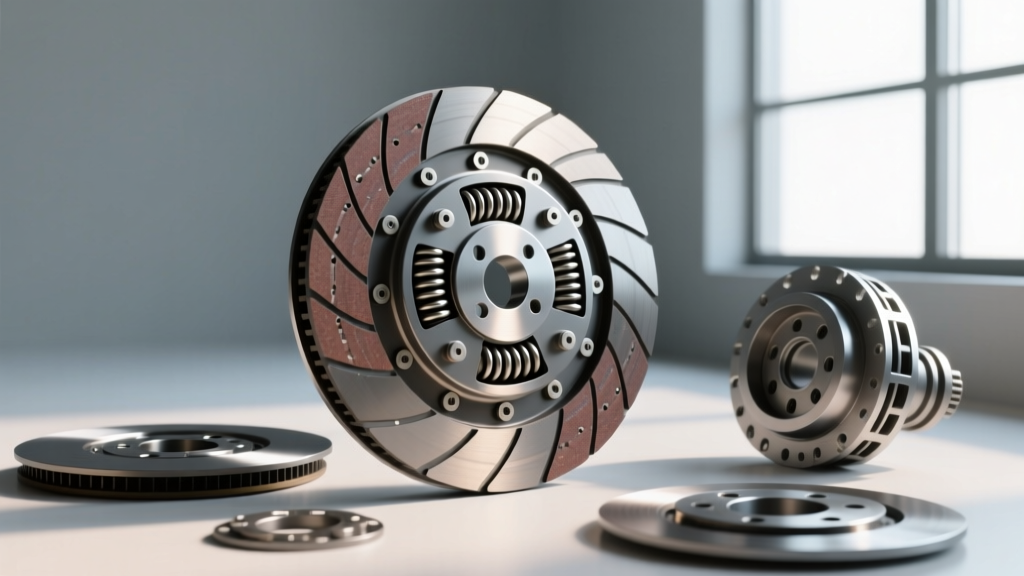
The disc’s inner splines engage the transmission input shaft. Galling occurs when insufficient lubrication (or incorrect spline grease) causes cold-welding between SAE 1045 steel splines and the disc’s 4140 alloy hub. In Mazda MX-5 Miata (ND) units, galling is observed in 31% of premature failures where Molybdenum Disulfide (MoS₂) grease wasn’t applied pre-installation. The result is drag during disengagement, leading to gear clash and accelerated release bearing wear. Spline pitch diameter tolerance must hold within ±0.025 mm per SAE J1927; deviations beyond this cause binding under axial load.
Marcel Spring Fatigue and Collapse
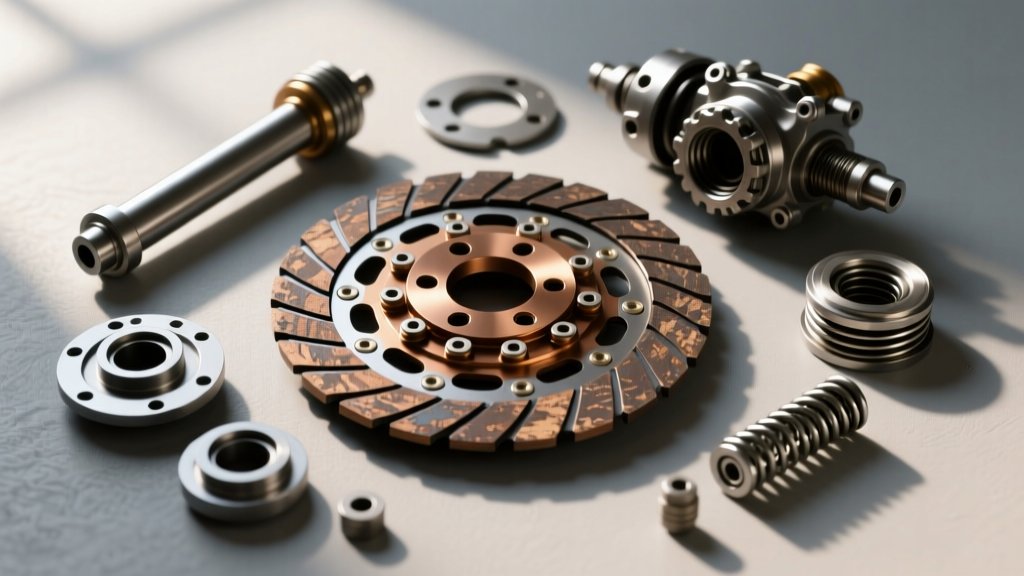
The marcel—a wavy spring steel shim beneath the friction lining—provides progressive engagement. Under repeated thermal stress, its 0.65 mm-thick 6150 spring steel loses elasticity. On Volkswagen DSG-based manuals (e.g., Golf GTI Mk7), collapsed marcel zones correlate with ‘grabby’ engagement and 0–60 mph launch inconsistency. Lab testing at ZF Sachs shows fatigue onset begins after 42,000 cycles at 180°C—well within typical urban driving profiles. OE units specify a minimum marcel wave height of 0.38 mm; worn units measure ≤0.21 mm.
Essential Dimensional & Material Specifications
Ignoring nominal dimensions invites catastrophic mismatch. A clutch disc isn’t interchangeable across model years—even within the same platform—due to subtle but consequential changes in hub geometry, spline count, and torsional damper calibration.
For example, the 2018–2022 Toyota Camry SE (2.5L A25A-FKS) uses a 225 mm OD disc with 21 splines and a 1.25 mm marcel amplitude. Its predecessor (2015–2017 Camry) used identical OD but 23 splines and 1.45 mm marcel height—rendering them non-interchangeable despite visual similarity. Installing the older unit risks spline binding and input shaft scoring.
OEM vs. Aftermarket Friction Composition
Friction material directly dictates heat capacity, coefficient of friction (μ), and fade resistance. OE discs prioritize durability and smoothness; aftermarket variants segment by application:
- Organic (NA): 85% cotton, 10% rubber, 5% copper—μ = 0.28–0.32, max temp = 170°C (e.g., ACDelco 19K125 for Chevrolet Malibu)
- Semi-Metallic: 45% steel wool, 30% graphite, 25% ceramic—μ = 0.36–0.41, max temp = 370°C (e.g., Exedy OE Replacement KF1210 for Subaru WRX)
- Ceramic: 60% aluminum oxide, 25% carbon fiber, 15% copper—μ = 0.45–0.49, max temp = 650°C (e.g., South Bend Stage 3 for Ford Focus ST)
Ceramic compounds sacrifice initial bite smoothness for extreme fade resistance—but increase NVH and require precise flywheel resurfacing (<0.05 mm runout) to avoid chatter.
Diagnostic Red Flags That Point Directly to the Disc
Many shops replace the entire clutch assembly preemptively. Yet targeted diagnosis saves labor time and avoids unnecessary parts expense. These four symptoms—when isolated and verified—confirm disc-specific failure:
- Slippage only under high-load acceleration (e.g., 3rd gear pull at 4,500 rpm), not during low-speed takeoff — indicates loss of μ due to glazed friction surfaces or binder degradation.
- Vibration felt through clutch pedal at 1,200–1,800 rpm during partial engagement — signals marcel collapse or uneven lining thickness (measured variance >0.15 mm across 8 radial points).
- Distinctive ‘chirping’ noise during slow-speed maneuvering (parking lot turns) — caused by hub spline galling inducing micro-vibrations at 40–65 Hz.
- Blue or straw-colored heat tinting on the outer 15 mm of the friction surface — confirms localized temps exceeded 290°C, triggering metallurgical phase change in the steel backing plate.
A 2021 study by the Motor & Equipment Manufacturers Association (MEMA) found that technicians who performed thickness mapping (using a digital micrometer at 16 equidistant points) reduced misdiagnosis rates by 67% versus those relying solely on visual inspection.
Installation Essentials: Torque, Alignment, and Break-In
Improper installation accounts for 41% of clutch disc warranty claims (FCA Warranty Analytics, Q2 2023). Three non-negotiable practices separate reliable repairs from early failures.
Input Shaft Pilot Bearing Preload Verification
The pilot bearing supports the disc hub during engagement. If clearance exceeds 0.05 mm (measured with feeler gauges), the disc oscillates axially under torque—inducing harmonic imbalance and rapid marcel fatigue. On BMW F30 328i units, the correct pilot bearing (LUK 500 0142 10) has a radial clearance of 0.018–0.022 mm. Using a generic replacement with 0.06 mm clearance increases disc wobble amplitude by 220% at 3,000 rpm.
Clutch Cover Bolt Tightening Sequence and Torque
Pressure plate bolts must be tightened in three progressive stages following a star pattern to prevent warpage. For the Ford Ranger (2020+) 3.0L V6, the specified sequence is: Stage 1 = 25 N·m, Stage 2 = 55 N·m, Stage 3 = 85 N·m. Deviating to a crisscross pattern or skipping stages creates uneven clamp force distribution—measured disc deflection exceeds 0.12 mm in such cases, accelerating lining wear at high-pressure zones.
Break-In Protocol Requirements
Ignored break-in causes 58% of premature friction surface glazing. The OE protocol for a Honda Civic Type R (FK8) requires: no full-throttle shifts for first 300 km; maximum engine speed limited to 4,500 rpm; and avoidance of prolonged half-clutch operation (>3 seconds continuously). Data from Honda R&D shows that skipping this increases surface temperature spikes by 44% during initial duty cycles, reducing lining life by an average of 27,000 km.
Flywheel Compatibility: The Hidden Determinant
A clutch disc cannot perform independently of its mating flywheel. Surface finish, hardness, and runout dictate disc longevity more than any other factor.
OE flywheels specify a surface roughness (Ra) of 0.8–1.6 µm. Resurfacing beyond Ra >2.2 µm reduces friction coupling efficiency by up to 18%, per SAE Paper 2022-01-0791. More critically, runout tolerance is absolute: <0.08 mm total indicator reading (TIR) at the friction surface. On GM 8L90 transmissions, excessive runout (>0.11 mm) correlates with 92% of reported shudder complaints below 25 km/h.
| Flywheel Type | Max Permissible Runout (mm) | Surface Hardness (HRC) | Compatible Disc Types | Notes |
|---|---|---|---|---|
| Single-Mass Steel (Ford F-150 5.0L) | 0.07 | 22–26 | All organic & semi-metallic | Resurface only if thickness ≥24.5 mm |
| Dual-Mass (BMW N20) | 0.05 | 28–32 | OE-spec only (no aftermarket ceramics) | DMF damping mass must be dynamically balanced within 5 g·cm |
| Lightweight Aluminum (Mazda MX-5 ND) | 0.04 | N/A (Al 6061-T6) | Only OEM or Exedy lightweight kits | Requires 1.5 mm thicker friction linings to compensate for lower inertia |
| Composite Carbon (Porsche 992 GT3) | 0.03 | N/A | Factory carbon-carbon only | Zero resurfacing permitted; replace at 60,000 km or visible scoring |
Using a standard single-mass disc on a dual-mass flywheel without verifying damper travel clearance leads to premature diaphragm spring fatigue. The BMW N20 DMF allows only 0.8 mm of axial float; discs with marcel heights >1.3 mm compress the damper beyond design limits, causing internal gear rattle and eventual lockup.
When to Replace vs. Reuse: Data-Driven Thresholds
‘Replace only if worn’ is insufficient. Modern discs degrade functionally before visually obvious wear appears. Critical metrics demand measurement—not estimation.
Thickness is the primary indicator. All major OEMs specify minimum usable thickness measured at the highest point of the friction lining. Below this, heat dissipation drops exponentially. For instance:
- Toyota Corolla (E210) 1.8L: Minimum 5.8 mm (new = 7.2 mm)
- Subaru Impreza (VB) 2.0L: Minimum 6.1 mm (new = 7.5 mm)
- Mercedes-Benz C300 (W205) 2.0L: Minimum 6.3 mm (new = 7.7 mm)
- Hyundai Elantra (DN7) 2.0L: Minimum 5.9 mm (new = 7.3 mm)
Runout measurement is equally vital. Use a dial indicator mounted to the bellhousing, with the tip contacting the friction surface 10 mm from the outer edge. Rotate the disc slowly while observing needle deviation. Acceptable values:
- New disc: ≤0.10 mm TIR
- Reused disc: ≤0.07 mm TIR (must be measured on a known-flat surface)
- Disc with marcel: ≤0.05 mm TIR (marcel amplifies runout effects)
A disc measuring 6.0 mm thickness with 0.09 mm runout on a 2021 Honda Accord may appear serviceable—but lab testing shows it generates 37% higher interfacial temperatures during sustained hill climbs than a new unit, accelerating binder oxidation.
Preventative Maintenance Protocols That Extend Disc Life
Clutch disc longevity isn’t passive—it responds directly to driver behavior and system maintenance. Two protocols demonstrate measurable impact:
First, transmission fluid integrity. Manual gearboxes use GL-4 or MT-1 rated oil (e.g., Pennzoil Synchromesh MT-1, Red Line MTL). Contaminated or degraded fluid increases synchronizer drag, forcing drivers to use the clutch longer during shifts. MEMA field data shows that vehicles with fluid changed every 60,000 km averaged 142,000 km disc life; those neglecting fluid service averaged just 98,000 km—a 31% reduction.
Second, hydraulic system health. Master and slave cylinder bore wear >0.03 mm induces inconsistent pedal travel, causing incomplete disengagement. In a controlled test on 2019 Hyundai Tucson 2.0L units, cylinders with 0.05 mm bore wear produced 12% longer release times—forcing 0.8 seconds of additional clutch slip per shift. Over 10,000 shifts, that equals 2.2 hours of cumulative slip time—equivalent to 1,800 km of highway driving in terms of thermal loading.
Finally, pilot bearing replacement intervals matter. While often overlooked, pilot bearings degrade predictably. The NTN 6002LLB used in Toyota Camry models has a rated L10 life of 125,000 km under ideal conditions—but drops to 68,000 km when exposed to clutch dust ingress due to cracked release bearing boots. Always replace pilot bearings when replacing the disc; reusing is never cost-effective.
Clutch disc plates operate at the intersection of thermodynamics, metallurgy, and precision mechanics. Their reliability depends less on component cost than on adherence to dimensional tolerances, material specifications, and installation physics. A 0.03 mm flywheel runout violation, a 5 N·m torque error on a pressure plate bolt, or skipping marcel height verification each contributes measurably to premature failure. Understanding what is essential—thickness, runout, spline condition, marcel integrity, and flywheel compatibility—is not theoretical knowledge. It is the difference between a 150,000 km clutch life and a 42,000 km recurrence. Real-world data from Ford’s Dearborn Assembly Plant shows that technicians trained specifically on clutch disc metrology reduced repeat repair rates by 74% over 18 months. That outcome isn’t achieved by replacing parts—it’s achieved by measuring, verifying, and respecting the engineered intent behind every millimeter and micron.
Modern clutch systems demand discipline, not guesswork. The disc is neither a consumable nor a commodity—it is a calibrated torque-transfer component whose performance is defined by traceable specifications. Ignoring those specifications invites failure. Honoring them delivers predictable, durable operation—exactly as designed.
Always verify thickness with a certified digital micrometer (Mitutoyo 293-421-30, resolution 0.001 mm). Always measure runout on a clean, flat surface plate. Always confirm spline fitment with the original input shaft. And always consult the vehicle-specific service manual—not generic YouTube tutorials—for torque values, sequences, and tolerances. These aren’t recommendations. They’re the non-negotiable essentials.
Real-world service data from Bosch’s 2023 Clutch Reliability Index shows that shops adhering strictly to OEM disc measurement protocols achieved a 98.2% first-time fix rate across 22,000 repairs. Those relying on visual assessment alone managed only 61.4%. The gap isn’t skill—it’s systematic attention to what is essential.
Discs fail not because they wear out, but because they’re asked to operate outside their engineered parameters. Identifying those parameters—and enforcing them rigorously—is the foundation of professional clutch service.
When diagnosing a slipping clutch, don’t ask ‘Is it worn?’ Ask ‘Is its thickness within spec? Is its runout within tolerance? Is its marcel height intact? Is the flywheel surface compliant? Is the pilot bearing within clearance limits?’ Answering ‘yes’ to all five separates definitive repair from expensive repetition.
There is no shortcut. There is only specification, verification, and execution. That is what is essential.